Magnesium Alloys for Consumer Electronics
Lightweight housings, frames and thermal-management structures for laptops, tablets, mobile devices and portable equipment.
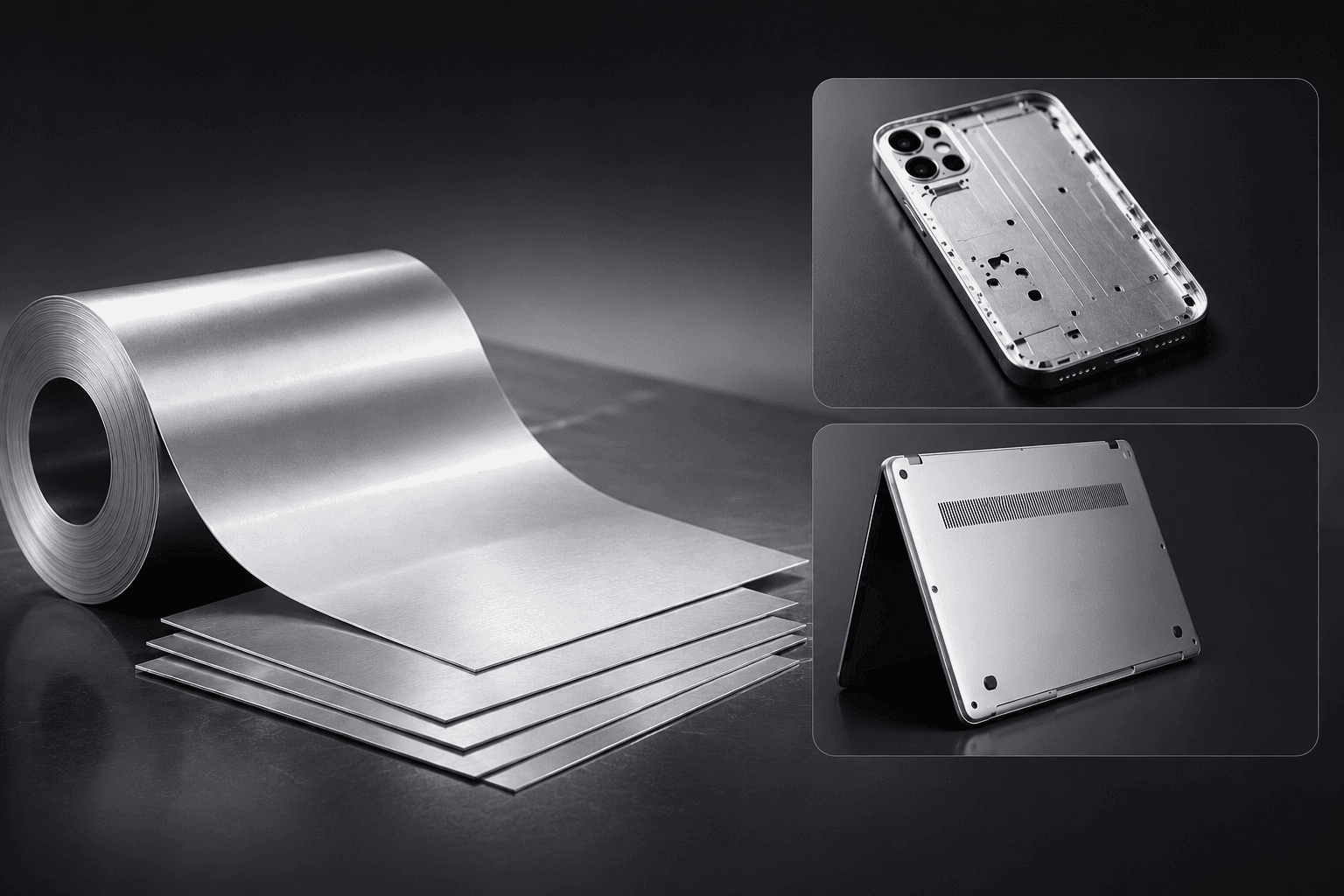
A practical sourcing guide to magnesium sheet, die-cast parts and extrusion profiles for consumer electronics. Compare material routes, design priorities and the information needed for an engineering quotation.
Why magnesium is considered for electronics
Magnesium alloys combine low density with useful specific stiffness, vibration damping, heat transfer and electromagnetic-shielding potential. In consumer electronics, the material is evaluated when a project needs a lighter enclosure or frame without treating structure, thermal behavior, appearance and manufacturability as separate problems.
Material selection must still be application-specific. Drop performance, local stiffness, operating temperature, corrosion protection, coating adhesion, antenna layout, assembly and cosmetic requirements can change the preferred alloy and process.
Product routes for different part geometries
| Product route | Current Matrix Mg range | Typical project direction | Key RFQ data |
|---|---|---|---|
| Rolled magnesium thin sheet | 0.3–1.0 mm; hot-rolled or annealed condition by specification | Laptop, tablet and portable-device housings; stamped or CNC-processed structures | Alloy, temper, thickness, width, flatness, surface class and forming route |
| Magnesium die-cast components | AZ91D, AM60B, AS41 or project-specific alloy review | Complex frames, housings, internal supports and integrated structures | 2D/3D drawing, wall thickness, tolerances, annual volume, finish and inspection |
| Magnesium extrusion profiles | AZ31, AZ61 and ZK60; custom sections by drawing | Rails, frames, supports and continuous structural sections | Section drawing, length, straightness, surface, machining and quantity |
Engineering questions to resolve early
Sheet or die casting?
Use geometry and production volume as the starting point. Thin sheet is evaluated for stamped, CNC-machined or formed structures. Die casting is evaluated for complex three-dimensional geometry, ribs, bosses and integrated features. Extrusion is suited to continuous sections that can be cut or machined after forming.
Which property controls the alloy choice?
The correct alloy is not simply the one with the highest strength. Consumer-electronics projects may be limited by impact behavior, thin-wall castability, surface finish, heat, dimensional stability or downstream processing. Describe the failure mode and service conditions instead of requesting a generic “best magnesium alloy.”
How should cosmetic surfaces be specified?
Define visible zones, permitted defects, texture, coating, color, protection film and packaging. Cosmetic acceptance should be agreed before tooling or production because the requirement affects process selection and inspection.
Information to send with an RFQ
- 2D and 3D drawings with critical dimensions and datums
- Target alloy, or the required structural, thermal and impact performance
- Prototype and annual volumes
- Surface treatment, color and cosmetic class
- Assembly, grounding, shielding and thermal-interface requirements
- Inspection documents, packaging and target schedule
Frequently asked questions
Can Matrix Mg evaluate both sheet and die-cast concepts?
Yes. Submit the part geometry, performance targets and volume so the project can be reviewed against sheet, die-cast or extrusion routes. A final process recommendation requires drawing-level information.
Can parts be supplied after machining or finishing?
Machining, surface treatment and finished-part delivery can be evaluated by project. The required process sequence and acceptance standard should be listed in the RFQ.
What should be validated before mass production?
Material condition, dimensional capability, drop or impact behavior, thermal performance, corrosion protection, coating adhesion, assembly and cosmetic criteria should be validated against the approved specification.
Discuss the complete device and part requirements with Matrix Mg to receive a project-specific material and sourcing review.