Ignition-Resistant Magnesium Alloys: Ca, Rare Earths and Fire Tests
Calcium and selected rare-earth additions can improve the oxidation-film stability and ignition resistance of magnesium alloys, but they do not make every component fireproof. Safety depends on alloy, product form, section size, surface condition, heat exposure and the exact qualification test.
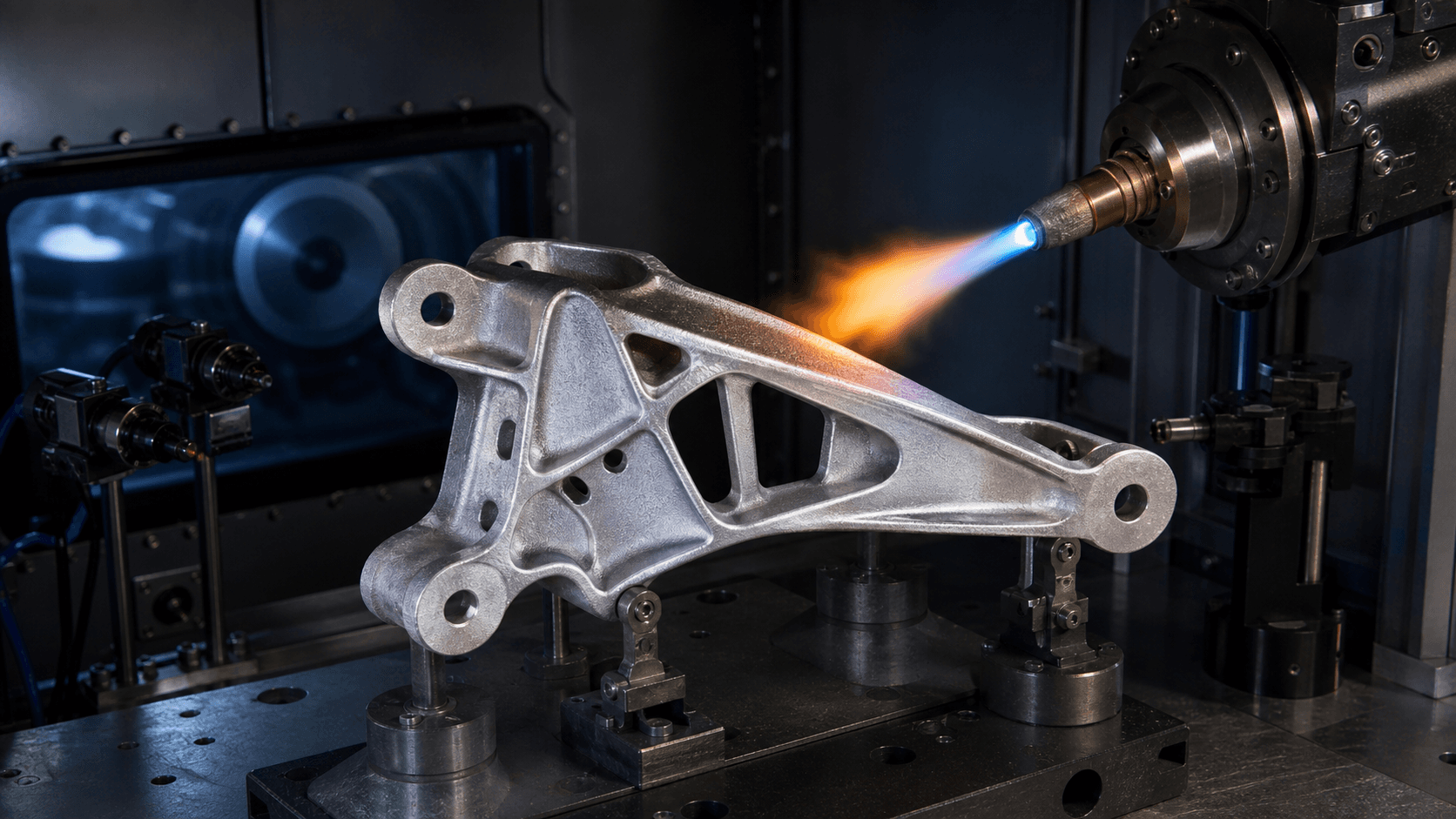
Are calcium- or rare-earth-containing magnesium alloys fireproof?
No magnesium alloy should be described as universally fireproof. Calcium (Ca) and selected rare-earth (RE) additions can form more protective oxide films and delay ignition under particular test conditions. That is why “ignition-resistant” or “flame-resistant under a specified test” is more accurate than “nonflammable.”
A finished seat component, a thin sheet, machining chips, airborne dust and molten magnesium present very different hazards. Aerospace approval depends on the actual alloy, geometry, installation and prescribed fire test—not on an element being present in the chemistry.
First separate the material forms
| Form or condition | Dominant concern | Appropriate evidence |
|---|---|---|
| Finished bulk component | External heat flux, flame exposure, section thickness and heat dissipation | Component or representative-coupon fire test |
| Thin edge or small feature | Faster heating and reduced thermal mass | Worst-case geometry testing |
| Machining chips and turnings | High surface-area-to-mass ratio and ignition during collection | Machining fire-risk controls and housekeeping |
| Fine powder or dust cloud | Rapid combustion or explosion potential | Combustible-dust assessment and process controls |
| Molten alloy | Oxidation, protective atmosphere/flux, film rupture and melt handling | Foundry-specific melt-protection procedures |
| Coated or assembled component | Coating degradation, joints, adjacent fuels and heat path | Test the final material/process/assembly system |
Passing a bulk-component test does not qualify dust collection, melt handling or a different wall thickness.
How do Ca and rare-earth additions improve ignition resistance?
Magnesium oxide alone may become porous or crack during heating, allowing fresh metal to oxidize. Research reviews report that calcium can promote CaO-rich or mixed CaO/MgO surface films that reduce oxygen transport. Rare-earth additions may form denser RE-containing oxide layers. Combined additions can produce useful effects, but composition must be optimized because alloying also changes castability, phase formation, mechanical properties, corrosion and cost.
The mechanism should be verified for the specific alloy. A protective film can be affected by:
- alloy chemistry and impurity control;
- casting, extrusion or heat-treatment history;
- heating rate, atmosphere and pressure;
- surface roughness, machining damage and coatings;
- specimen thickness and orientation;
- oxide-film cracking or mechanical disturbance.
An ignition-temperature number without the test method and specimen description is not comparable.
What did FAA research establish?
FAA research reported that certain newer magnesium alloys, including a prototype WE43 material evaluated in its program, did not create additional hazards in the full-scale cabin fire scenario studied. The work supported development of a laboratory-scale test for magnesium aircraft-seat components.
The correct takeaway is not “WE43 or rare-earth magnesium is automatically approved.” It is that specific materials and component configurations can be evaluated through defined fire tests. Certification remains application- and installation-specific, and the applicable authority, aircraft program and current compliance basis must be confirmed.
What must a fire-test report state?
A useful report should identify:
- full alloy designation and chemistry limits;
- product form, temper and manufacturing route;
- specimen dimensions, thickness and exposed area;
- surface condition, coating and machining state;
- heat source, heat flux or flame characteristics;
- orientation, distance and exposure duration;
- airflow, pressure and ambient conditions;
- ignition definition and measurement method;
- flame duration, propagation, mass loss and structural behavior;
- number of specimens and result variability;
- photographs/video and post-test examination;
- exact standard, handbook method or authority-approved procedure.
“Higher ignition point” is not enough for aerospace procurement.
Alloying is only one part of safety
Mechanical properties
Ca and RE additions may refine grains or create strengthening phases, but excessive or unfavorable intermetallic phases can affect ductility, fatigue or cracking. Use certified design allowables or program-specific test data—not a research average.
Corrosion and coatings
FAA corrosion guidance identifies magnesium alloys as requiring specialized protection, especially in salt or pollutant exposure. An ignition-resistant chemistry does not eliminate corrosion control. Coating, conversion treatment, sealants, fastener isolation, drainage and maintenance remain part of the system.
Manufacturing
Melt handling needs foundry controls even when the final alloy is ignition-resistant. Machining must address chip collection, tool condition, coolant compatibility and the possibility of fine dust. Never use finished-part fire behavior as a substitute for process hazard analysis.
Repair and service damage
Grinding, welding, torch heating or coating removal can create a new local condition. Approved repair data should specify heat limits, surface restoration and inspection. Field personnel need the exact alloy and repair procedure.
How should aerospace buyers qualify an alloy?
Use a staged qualification plan:
- Define the hazard scenario. Cabin seat, avionics housing, transmission casing and spacecraft structure do not share the same exposure.
- Select the compliance basis. Confirm the current regulation, advisory material, fire-test handbook method or authority-approved equivalent.
- Lock the material route. Chemistry, supplier, casting/extrusion route, heat treatment and surface system must be controlled.
- Test worst-case geometry. Include thin sections, edges, joints, fasteners, coating defects and realistic heat paths.
- Verify mechanical and environmental performance. Fire resistance cannot be traded against unacceptable fatigue, corrosion or impact behavior.
- Control production. Define certificates, chemistry verification, process-change notification and periodic conformity testing.
- Plan maintenance. Specify inspection, coating repair, damage limits and end-of-life handling.
For complex housings or brackets, Matrix Mg’s magnesium die-casting parts page can support an initial manufacturability discussion. It does not establish fire-test compliance; the exact alloy and finished component require separate qualification.
Common mistakes in specifications
Avoid requirements such as:
- “contains calcium, therefore nonflammable”;
- “ignition temperature above X°C” without a method;
- “aerospace grade” without an alloy specification and compliance basis;
- transferring a billet test to a thin finished component;
- treating rare-earth content as a substitute for corrosion protection;
- ignoring chips, dust and molten-metal hazards during production;
- accepting one successful specimen without repeatability data.
A better requirement names the alloy, product form, final surface system, representative geometry, test method, acceptance criteria and change-control obligations.
Frequently asked questions
Will a solid magnesium component ignite from a small spark?
Not necessarily. Ignition depends on the energy input, section size, surface condition, alloy and environment. Fine chips or dust are much easier to ignite than a massive finished component, so the material form must always be stated.
Does adding calcium make magnesium self-extinguishing?
Some Ca-containing alloys show improved ignition resistance in defined tests, but “self-extinguishing” is not a universal outcome. Verify flame behavior with the required test and final geometry.
Are rare-earth magnesium alloys automatically suitable for aircraft cabins?
No. FAA research shows that certain materials and component concepts can perform acceptably in specific tests. Aircraft eligibility still depends on the certified design, installation and current compliance requirements.
Can coatings replace ignition-resistant alloying?
Coatings may contribute to oxidation and corrosion protection, but they can be damaged or degrade under heat. Qualification should evaluate the intended alloy, coating and component together.
Conclusion
Ca and rare-earth additions can materially improve oxidation-film protection and ignition resistance, but safety is a system property. The defensible engineering statement is conditional: a controlled alloy and finished component demonstrated acceptable behavior under a named test and exposure. Avoid “fireproof” claims; specify the hazard scenario, material form, surface system, qualification method and production controls.
This article provides general engineering information and is not a certification, fire-response procedure or substitute for the requirements of the responsible aviation or safety authority. Magnesium fires, dust and molten-metal operations require trained personnel and approved site-specific controls.
Sources
FAA, FY 2012 Research and Development Annual Review — https://www.faa.gov/sites/faa.gov/files/about/office_org/headquarters_offices/ang/FY2012RDAnnualReview.pdf FAA, Materials Flammability Working Group — https://www.faa.gov/media/32006 FAA, AC 43-4B Corrosion Control for Aircraft — https://www.faa.gov/documentLibrary/media/Advisory_Circular/AC_43-4B.pdf Tian et al., Effects and mechanisms of rare earth and calcium on the flame retardancy of magnesium alloys — https://doi.org/10.1016/j.jmrt.2024.06.009 Minárik et al., Ignition-resistant Mg-2Y-2Gd-1Ca alloy for aviation applications — https://www.sciencedirect.com/science/article/abs/pii/S0925838823009866