Applications of Magnesium Alloys in the Automotive Industry
Magnesium alloys—among the lightest structural metallic materials available—are widely used in automotive applications such as steering wheel frames, instrument panel supports, seat frames, transmission housings, and components for new-energy vehicles. Their low density enables vehicle lightweighting, while excellent castability supports complex part manufacturing. As the industry intensifies its focus on energy efficiency and extended driving range, magnesium alloys are increasingly integral to automotive lightweighting strategies. This article outlines their fundamental properties, key applications, manufacturing processes, and industry trends.
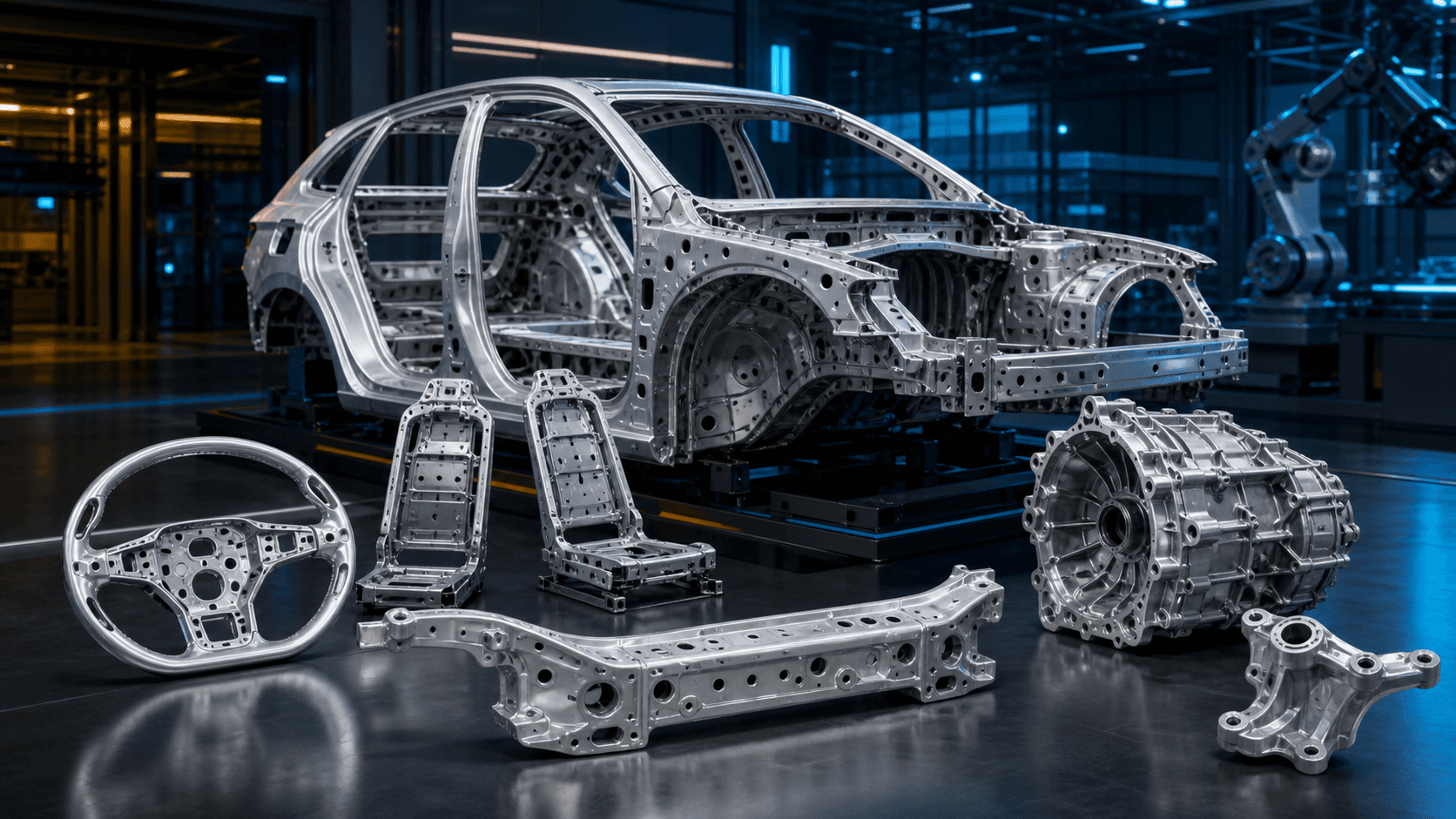
The automotive industry has long been a major application domain for lightweight materials. With rising fuel economy requirements and the rapid growth of new-energy vehicles, vehicle weight reduction has become a critical design objective. Beyond steel, aluminum alloys, high-strength plastics, and composites, magnesium alloys—owing to their low density and superior formability—are gaining increasing attention from automotive manufacturers.
What Are Magnesium Alloys?
Magnesium alloys are metallic materials based on magnesium with additions of elements such as aluminum, zinc, manganese, and rare earths.
Magnesium’s density is approximately 1.74 g/cm³, compared with:
| Material | Density (g/cm³) |
|---|---|
| Magnesium alloy | 1.74 |
| Aluminum alloy | 2.70 |
| Steel | 7.85 |
Due to their low density, magnesium alloys are frequently selected for weight-sensitive product designs.
However, material selection in automotive applications depends not only on weight but also on strength, durability, cost, manufacturability, and safety requirements. Consequently, magnesium alloys are typically used in combination with other materials—not as wholesale replacements for conventional ones.
Why Is the Automotive Industry Focusing on Magnesium Alloys? Lightweighting Demand
Vehicle mass directly impacts fuel consumption and energy efficiency.
For conventional internal-combustion vehicles, weight reduction lowers fuel consumption; for new-energy vehicles, it extends driving range and optimizes powertrain design.
Thus, automakers have long explored the viability of various lightweight materials.
Complex-Geometry Forming Capability
Many magnesium alloys exhibit excellent die-casting performance.
High-pressure die casting enables production of large, geometrically complex components—reducing part count and assembly steps.
Vibration Damping Performance
Magnesium alloys possess strong damping capacity.
In certain structural applications, this property helps suppress vibration and noise transmission—though actual effectiveness depends on overall vehicle architecture and component design.
Key Automotive Applications of Magnesium Alloys
- Steering Wheel Frames
Steering wheels were among the earliest automotive components to adopt magnesium alloys.
Magnesium alloy steering wheel frames are typically produced via die casting, achieving structural integrity while minimizing weight.
Given their relatively complex geometry and high-volume production requirements, such parts are well suited to magnesium die-casting.
- Instrument Panel Supports
Instrument panels house instruments, HVAC systems, displays, and numerous electronic devices.
Magnesium alloy instrument panel supports integrate multiple subcomponents into a single structural unit—reducing part count and system weight.
This application is already implemented in select passenger vehicle models.
- Seat Frames
Automotive seats must balance comfort, safety, and weight control.
Some models utilize magnesium alloys for:
Backrest frames Seat base structures Headrest support structures
Specific implementation varies by vehicle platform and OEM design strategy.
- Transmission Housings and Powertrain Components
Certain vehicles employ magnesium alloys for:
Transmission housings Clutch housings Transfer case housings Powertrain mounting brackets
These components require careful trade-offs between weight reduction and structural integrity—demanding application-specific engineering and validation.
- New-Energy Vehicle Components
With the expansion of new-energy vehicles, magnesium alloys are being explored and deployed across additional lightweighting applications—including:
Battery system structural components Electric drive system housings Electronic control unit enclosures In-vehicle electronics mounting brackets
Implementation approaches vary by OEM; final adoption depends on vehicle-level design requirements.
Primary Manufacturing Processes for Automotive Magnesium Components Die Casting
Die casting is the most common manufacturing method for automotive magnesium components.
Its advantages include:
Suitability for complex geometries High production efficiency Excellent dimensional consistency Scalability for high-volume production
Today, the majority of structural magnesium components in automobiles are die-cast.
Semi-Solid Forming
Semi-solid forming is an intermediate process bridging casting and forging.
It can improve microstructure and mechanical properties in select applications—but remains limited in current production scale.
Machining and Post-Processing
Many magnesium components undergo additional operations after forming, including:
CNC precision machining Surface finishing Corrosion protection treatments Assembly-related machining
To meet the automotive industry’s stringent requirements for dimensional accuracy and long-term durability.
Challenges in Magnesium Alloy Application
Although magnesium alloys offer distinct advantages for automotive lightweighting, real-world deployment requires careful evaluation across multiple dimensions.
Corrosion Resistance
Magnesium exhibits relatively high chemical reactivity.
Therefore, automotive-grade magnesium alloys typically require appropriate surface treatments and protective technologies to ensure service life under demanding environmental conditions.
Cost Considerations
Compared with conventional steels, magnesium alloys generally incur higher raw material and manufacturing costs.
OEMs thus conduct comprehensive value assessments—balancing performance gains against cost targets—before committing to adoption.
Design and Engineering Validation
Automotive components must satisfy rigorous safety and durability standards.
Prior to volume production, magnesium components typically undergo extensive testing and validation—including:
Tensile and yield strength testing Fatigue testing Corrosion resistance testing Crash safety validation Future Trends
The automotive industry continues to advance lightweighting technologies.
Current R&D directions for magnesium alloys include:
Development of high-strength magnesium alloys; Enhancement of corrosion resistance; Large-scale integrated die-casting technology; Expanded use of magnesium sheet and extruded products; Hybrid structural designs combining magnesium alloys with aluminum alloys and steel.
The future automotive materials ecosystem will likely continue evolving toward multi-material integration—with magnesium alloys playing targeted roles in weight-critical components.
Conclusion
As a lightweight engineering material, magnesium alloys are already applied in steering wheel frames, instrument panel supports, seat frames, powertrain housings, and new-energy vehicle components. Their low density and excellent castability make them a compelling choice for automotive lightweighting. Yet successful material deployment always requires balancing performance, cost, manufacturability, and safety. With ongoing advances in alloy development and processing technologies, magnesium alloys are poised for broader, more rational adoption across the future automotive landscape.
Sources
https://www.energy.gov/cmei/vehicles/lightweight-materials-cars-and-trucks https://doi.org/10.1016/j.jma.2022.12.015