Magnesium Hydride Storage: From 7.6 wt% Material Capacity to System Acceptance Tests
MgH₂ offers about 7.6 wt% theoretical material capacity, but reactor hardware, heat transfer, kinetics and safety determine usable system performance. This guide defines project qualification gates and acceptance-test metrics.
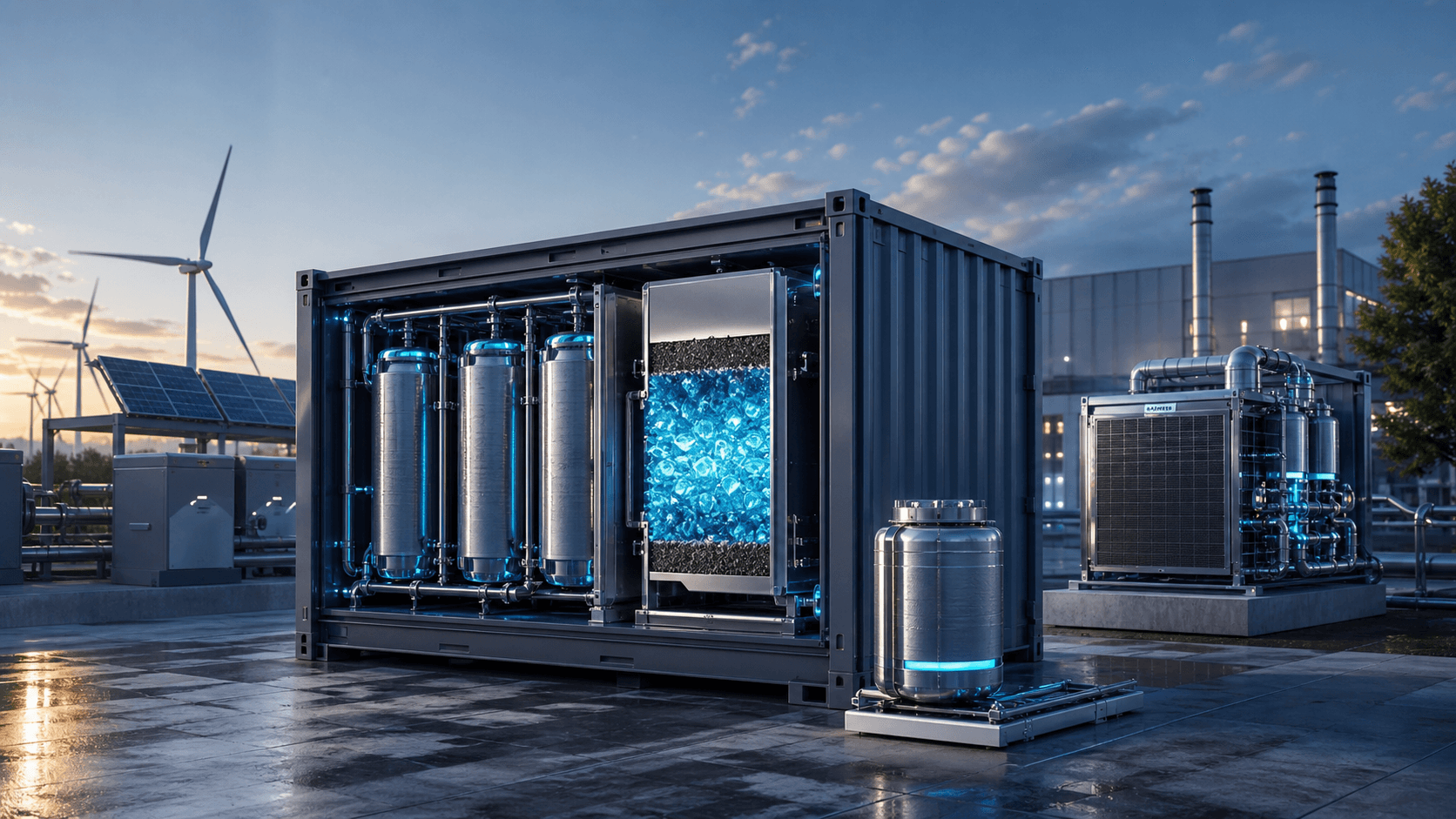
Executive answer
Magnesium hydride is attractive because the MgH₂ material reaction corresponds to about 7.6 wt% hydrogen on a pure-material basis. A commercial storage module will be lower after adding heat exchangers, vessel, insulation, catalysts, expansion space, sensors and safety hardware.
The central project question is therefore not “Can MgH₂ store hydrogen?” but “Can the complete reactor deliver the required usable hydrogen, charge/discharge rate, temperature, cycle life, safety and cost?”
Material capacity versus system capacity
Always report three different metrics:
- theoretical or measured material capacity;
- usable reversible capacity under the stated temperature and pressure;
- complete-system gravimetric and volumetric capacity.
Mixing these values is the most common source of misleading comparisons. State whether capacity is measured after activation, how many cycles are included, and whether hydrogen purity and balance-of-plant mass are counted.
Why heat management controls performance
Hydrogen absorption releases heat and desorption requires heat. Even a fast-reacting powder will deliver slowly if the reactor cannot move heat. A credible design specifies heat-transfer area, thermal conductivity enhancement, coolant conditions, startup energy, allowable temperature gradient and emergency heat-removal strategy.
Catalysts, nanostructuring and additives may improve kinetics or lower operating temperature, but they can reduce net capacity, increase cost or change cycle stability. Report the full formulation, not only the MgH₂ fraction.
Application fit
Mg-based solid-state storage is more plausible where mass is less critical than compact stationary storage, safety architecture, thermal integration or low-pressure operation. Potential project categories include stationary buffers, renewable-energy demonstrations, industrial hydrogen management and systems that can reuse waste heat.
Mobile applications face stricter mass, startup and heat-rejection constraints. A laboratory material result does not prove vehicle-level feasibility.
Project qualification gates
Gate 1: Material evidence
Verify composition, particle size, catalyst/additive loading, activation, impurity tolerance, plateau behavior, usable capacity, kinetics and cycle retention. Require independent or witnessed testing when performance is critical.
Gate 2: Reactor evidence
Measure complete-module capacity, temperature distribution, pressure drop, heat-transfer performance, charging time, delivery rate, parasitic energy and standby loss.
Gate 3: Durability
Test realistic cycling, dwell periods, partial cycles, contamination, thermal excursions and shutdown/restart. Track capacity fade, powder agglomeration, expansion, decrepitation and filter behavior.
Gate 4: Safety
Perform hazard analysis for hydrogen leakage, overpressure, air or moisture ingress, hot surfaces, loss of cooling, sensor failure and emergency venting. Use appropriate hydrogen and metal-hydride standards; do not assume “solid state” means risk-free.
Gate 5: Economics
Model hydrogen cost after efficiency losses, heat supply, compression, purification, replacement, maintenance and end-of-life handling. Compare against compressed gas, liquid hydrogen and alternative hydrides for the same duty cycle.
Acceptance-test data sheet
A procurement specification should record:
- usable kg H₂ and complete system mass/volume;
- inlet hydrogen purity and allowable contaminants;
- charge/discharge pressure and temperature windows;
- time to 90% usable capacity;
- continuous and peak delivery rates;
- thermal input and parasitic electricity;
- retained capacity after an agreed cycle count;
- leak, overpressure and abnormal-condition tests;
- sensor, valve and control-system architecture;
- material traceability and change-control rules.
Frequently asked questions
Does 7.6 wt% mean a tank stores 7.6% of its total weight as hydrogen?
No. It is a pure MgH₂ material-basis figure. The complete module includes substantial non-storage mass.
Can catalysts make MgH₂ work at room temperature?
Research can improve kinetics and thermodynamics, but project claims must state usable capacity, pressure, temperature and cycle life for the complete formulation.
Is metal-hydride storage safer than compressed gas?
It changes the hazard profile; it does not eliminate hydrogen, pressure, heat or materials risks. Compare specific system designs.
What proves commercialization readiness?
Repeatable module-level performance, manufacturing yield, safety validation, service support and bankable economics—not a single high-capacity laboratory cycle.
Buyer takeaway
Treat MgH₂ as a coupled material–thermal–pressure system. Use staged gates from powder characterization to reactor durability and witnessed acceptance testing before making commercial claims.
Sources
https://www.energy.gov/eere/fuelcells/hydrogen-storage ISO 16111 Transportable gas storage devices — Hydrogen absorbed in reversible metal hydride ISO/TR 15916 Basic considerations for the safety of hydrogen systems https://www.sandia.gov/hydrogen-safety-codes-and-standards/ https://doi.org/10.1016/j.jpowsour.2015.10.071