Magnesium for Foldables and Drones: Enclosure, RF, Thermal and Drop-Test Guide
Magnesium can reduce mass and integrate structure in foldable devices, laptops, cameras and drones, but RF windows, thermal paths, drop durability, coating and carbon-fiber isolation determine success.
Executive answer
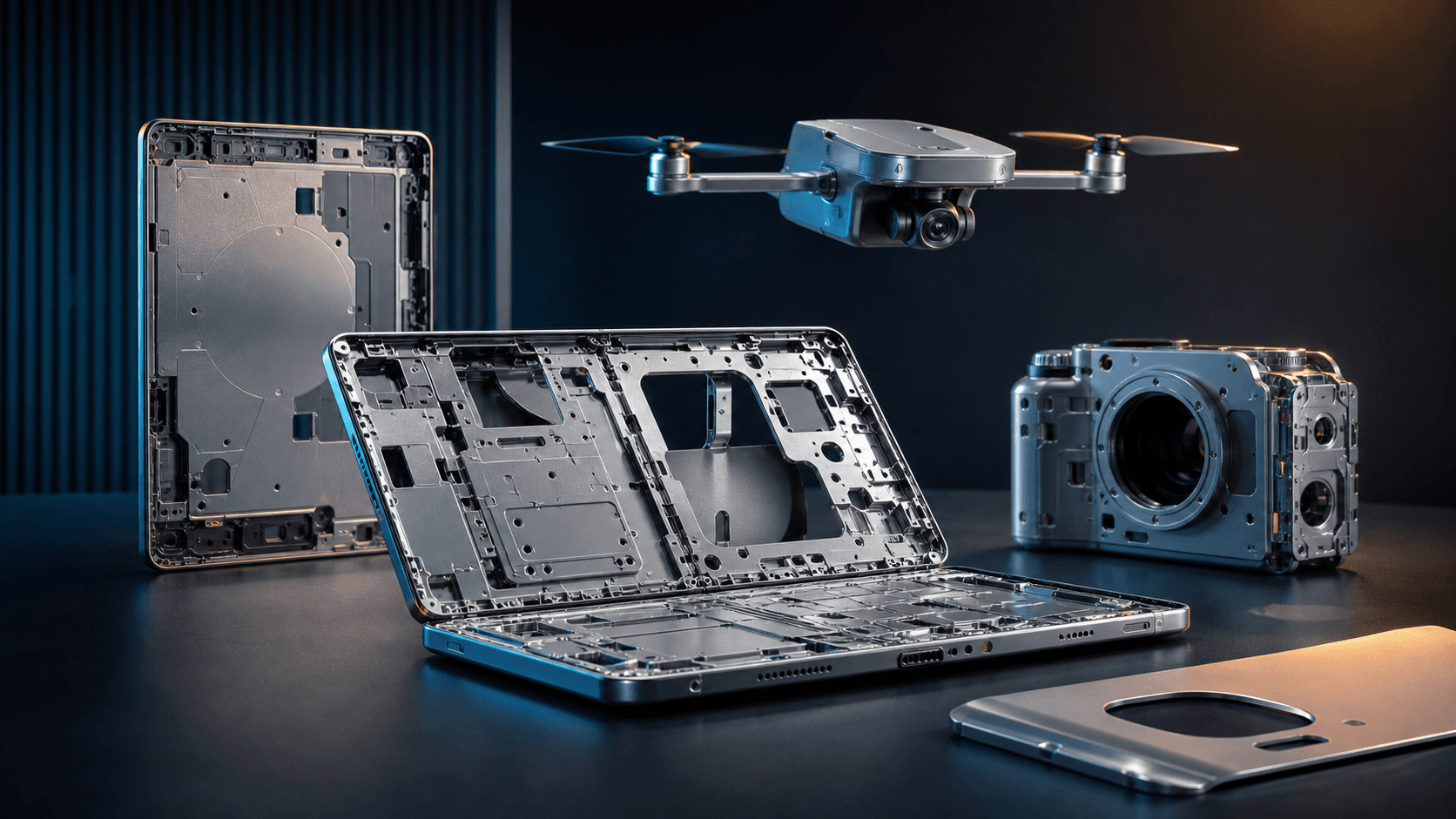
Magnesium alloys can be effective for laptop decks, camera bodies, foldable-device support plates, drone housings and gimbal structures when low mass, stiffness through geometry, electromagnetic shielding and die-cast integration are valuable. They are not automatically the best material for every visible enclosure.
A successful product balances structural performance, RF transparency, thermal paths, drop durability, coating quality, corrosion, cosmetic yield and total assembly cost.
What magnesium contributes
With density around 1.8 g/cm³, magnesium offers a meaningful starting advantage over aluminum. High-pressure die casting can integrate ribs, bosses, screw features and shielding walls, potentially reducing part count. Wrought sheet can serve thin support plates where forming and surface treatment are qualified.
The final enclosure mass depends on modulus, wall thickness, ribs, inserts and coating. Compare optimized assemblies, not raw density.
Foldable and thin-device design
Foldable products impose repeated hinge loads, tight flatness, local wear and drop shocks. Magnesium may suit internal mid-plates or structural frames, but hinge pins, threads and wear surfaces often need inserts or other materials.
Qualification should include:
- torsion and bending stiffness;
- hinge-cycle loads transmitted into the frame;
- drop and corner impact;
- threaded insert pull-out and torque;
- flatness after casting, machining and coating;
- coating wear at edges and joints;
- battery and display clearance after deformation.
Public supplier claims should not be treated as proof that a specific phone model uses magnesium without manufacturer evidence.
Drone and gimbal design
Reducing moving mass can improve payload margin or dynamic response, but flight-time improvement depends on the entire aircraft. Candidate parts include camera housings, gimbal arms, motor or electronics covers and central frames.
Validate vibration modes, fatigue, crash/drop events, propwash cooling, moisture, salt and galvanic contact with carbon fiber. Carbon-fiber interfaces need isolation and sealing.
Thermal and electromagnetic behavior
A magnesium enclosure can conduct heat away from local sources and provide electrical continuity for shielding, but neither benefit is automatic. Thermal performance depends on contact resistance, wall geometry, heat-spreader interfaces and airflow. EMC performance depends on seams, apertures, coatings, grounding and cable design.
Antennas usually require engineered RF windows or nonconductive regions. A fully metallic shell can degrade wireless performance if the antenna system is not co-designed.
Surface finish and aesthetics
A premium appearance is a process outcome. Control casting porosity, machining marks, cleaning, conversion treatment, primer, paint, color consistency, edge coverage and cosmetic inspection lighting. Thin cosmetic coatings may not provide sufficient corrosion durability on their own.
Supplier qualification
Request alloy chemistry and impurity limits, casting or sheet route, dimensional capability, mechanical and fatigue data, coating stack, salt or cyclic-corrosion evidence, EMC and thermal test setup, drop results, insert performance and lot traceability.
Production-intent samples matter because laboratory coupons do not reveal gate marks, porosity, distortion or cosmetic yield.
Frequently asked questions
Does magnesium automatically improve drone endurance?
No. Component mass is only one input; propulsion, battery, aerodynamics, mission profile and structural redesign determine endurance.
Is magnesium better than aluminum for heat dissipation?
Not universally. Compare the complete thermal path and geometry for the exact design.
Can a magnesium enclosure block wireless signals?
A conductive enclosure can affect antennas. Co-design antenna placement, seams and RF windows.
Is magnesium suitable for visible premium surfaces?
Yes, with a qualified pretreatment and coating system plus strict cosmetic process control.
Buyer takeaway
Use magnesium when part integration and system-level mass savings outweigh added surface and galvanic controls. Validate structure, RF, thermal, drop, corrosion and cosmetic yield as one enclosure system.
Sources
IEC 60068-2-31 Environmental testing — Rough handling shocks and falls CISPR 32 Electromagnetic compatibility of multimedia equipment — Emission requirements IEC 60529 Degrees of protection provided by enclosures ISO 9227 Corrosion tests in artificial atmospheres — Salt spray tests ASTM B117 Standard Practice for Operating Salt Spray Apparatus ASTM B94 Magnesium-Alloy Die Castings