Magnesium for AI Hardware: Robotics, Edge Computing, Thermal Paths and EMI Design
Magnesium does not increase chip compute; it can improve robot, edge-AI and vision hardware through lower mass, integrated housings, thermal paths and EMI shielding—when system tests prove the benefit.
Executive answer
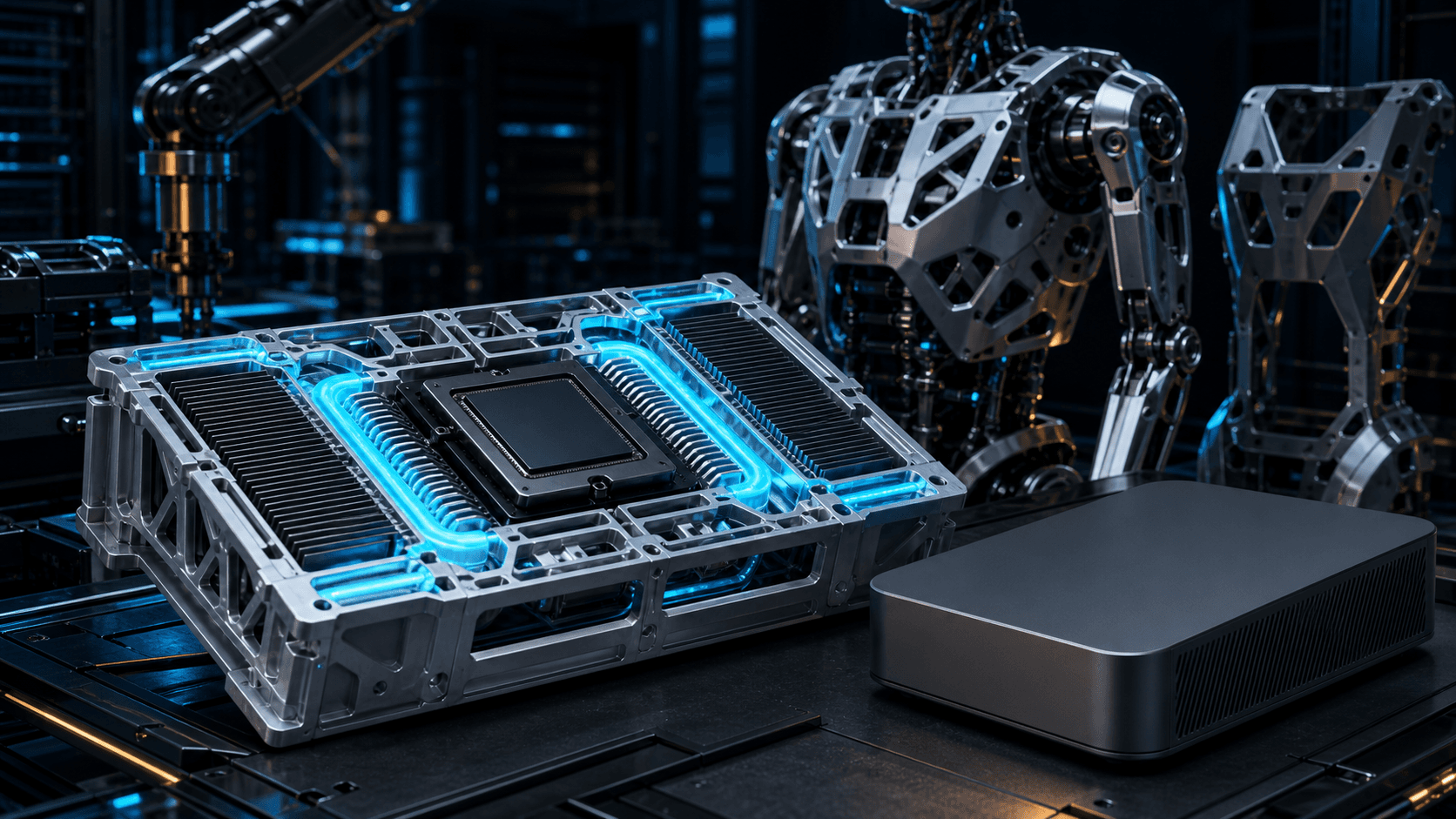
Magnesium alloys do not make an AI chip calculate faster. Their value is in the physical system around AI: lightweight robot links, edge-computing enclosures, machine-vision housings, mobile terminals, gimbals and structural heat-spreading or EMI-shielding parts.
A successful design proves system-level mass, stiffness, thermal path, electromagnetic compatibility, vibration, corrosion, joining and production yield.
Where magnesium fits in AI hardware
Edge AI and machine vision
Cameras, industrial vision processors and edge gateways often need rigid optical alignment, shielding and passive heat paths in compact housings. Magnesium die casting can integrate lens mounts, ribs, connector walls and grounding features.
Qualification must cover dimensional stability, thermal drift, sealing, EMC, connector loads and coating.
Robotics and humanoid systems
Lower link and end-effector mass can reduce inertia, improve acceleration or reduce actuator demand. Candidate parts include arm housings, joint covers, mobile-base structures and sensor brackets.
The benefit depends on the robot mass distribution and duty cycle. A lighter cover does not necessarily reduce motor size if payload and gearbox inertia dominate.
Drones, autonomous vehicles and gimbals
Magnesium may serve camera housings, sensor frames, gimbal arms and electronics covers where mass affects payload or dynamic response. Validate vibration modes, fatigue, crash/drop, moisture and carbon-fiber galvanic isolation.
Data-center and server equipment
Rack servers are not generally mass-critical in the same way as mobile systems. Magnesium may still be considered for specialized enclosures, handles or edge modules, but thermal, fire, grounding, repair, recyclability and total cost must beat established aluminum or steel solutions.
Thermal design: conductivity is not the whole answer
Magnesium alloys conduct heat, but thermal performance depends on the complete path:
- chip-to-interface contact resistance;
- heat spreader geometry and thickness;
- alloy conductivity and temperature;
- fastener pressure and flatness;
- coatings at thermal contacts;
- fins, airflow and coolant;
- thermal cycling and interface aging.
A lower-density magnesium wall may need different geometry from aluminum. Use finite-element analysis and instrumented prototypes, then report junction or case temperature under a defined power and ambient condition.
Do not describe magnesium as universally “high thermal conductivity” without comparing the exact alloy and design.
Electromagnetic shielding and grounding
A continuous conductive enclosure can support EMI shielding, but seams, apertures, connectors, cables and coatings often dominate. Design conductive contact zones, grounding paths and corrosion protection together.
Antenna-equipped AI terminals need RF windows and antenna co-design. Better shielding can reduce wireless performance if apertures and antennas are not engineered.
Structural integration
Die casting can combine ribs, bosses, cable guides, connector protection and thermal features. Integration may reduce fasteners and assembly but can increase tool complexity and replacement scope.
Validate:
- local stiffness and optical alignment;
- insert pull-out and torque retention;
- vibration and fatigue at joints;
- drop or impact;
- casting porosity in sealing and thermal zones;
- flatness after machining and coating;
- repair and service access.
Corrosion and surface finish
AI equipment can see factory humidity, condensation, cleaning agents, outdoor salt, sweat or coolant. Specify the complete pretreatment and coating stack plus galvanic isolation from steel, copper-rich alloys and carbon fiber.
Preserve conductive contact and thermal-interface zones with controlled masking or compatible coatings. Validate coating damage and field repair.
Supplier qualification
Request exact alloy, chemistry/impurity limits, casting or wrought route, local mechanical properties, thermal-property data with test method, dimensional capability, CT or sectioning plan, EMC test configuration, thermal report, vibration/drop data, coating controls, lot traceability and change notification.
Decision matrix
Magnesium is strongest when:
- moving mass has measurable dynamic value;
- geometry benefits from integrated casting;
- shielding and structure can share one enclosure;
- thermal path is verified;
- corrosion and coating are controllable;
- volume supports tooling.
Aluminum or steel may be better when high modulus, commodity supply, heat-sink performance, repair or lowest upfront cost dominates.
Frequently asked questions
Does magnesium improve AI computing performance?
Not directly. It can improve packaging mass, structural dynamics, shielding or thermal design, which may support system reliability or mobility.
Is magnesium better than aluminum for AI heat sinks?
Not universally. Compare complete geometry, alloy properties, interface resistance, airflow and cost.
Can magnesium shield EMI?
A conductive magnesium enclosure can contribute, but seams, grounding, apertures and coatings determine actual performance.
What is the best first AI application?
A mobile or robotic enclosure where mass and part integration have measurable value and qualification requirements are manageable.
Buyer takeaway
Use magnesium to optimize the AI machine, not to market the algorithm. The business case is strongest when lighter structure, integrated geometry, verified thermal performance and EMC are delivered by one qualified component.
Sources
IEC 62368-1 Audio/video, information and communication technology equipment — Safety requirements CISPR 32 Electromagnetic compatibility of multimedia equipment — Emission requirements IEC 60068-2-6 Environmental testing — Vibration IEC 60068-2-31 Environmental testing — Rough handling shocks and falls ASTM B94 Magnesium-Alloy Die Castings ISO 9227 Corrosion tests in artificial atmospheres — Salt spray tests