How to Conduct PMI on Magnesium Alloy Incoming Materials: A Guide to XRF, OES, and Composition Re-Verification
Compares handheld XRF and spark OES capabilities and limitations for magnesium alloy grade identification, covering light-element detection, surface condition, calibration, sampling, lab re-verification, and batch traceability.
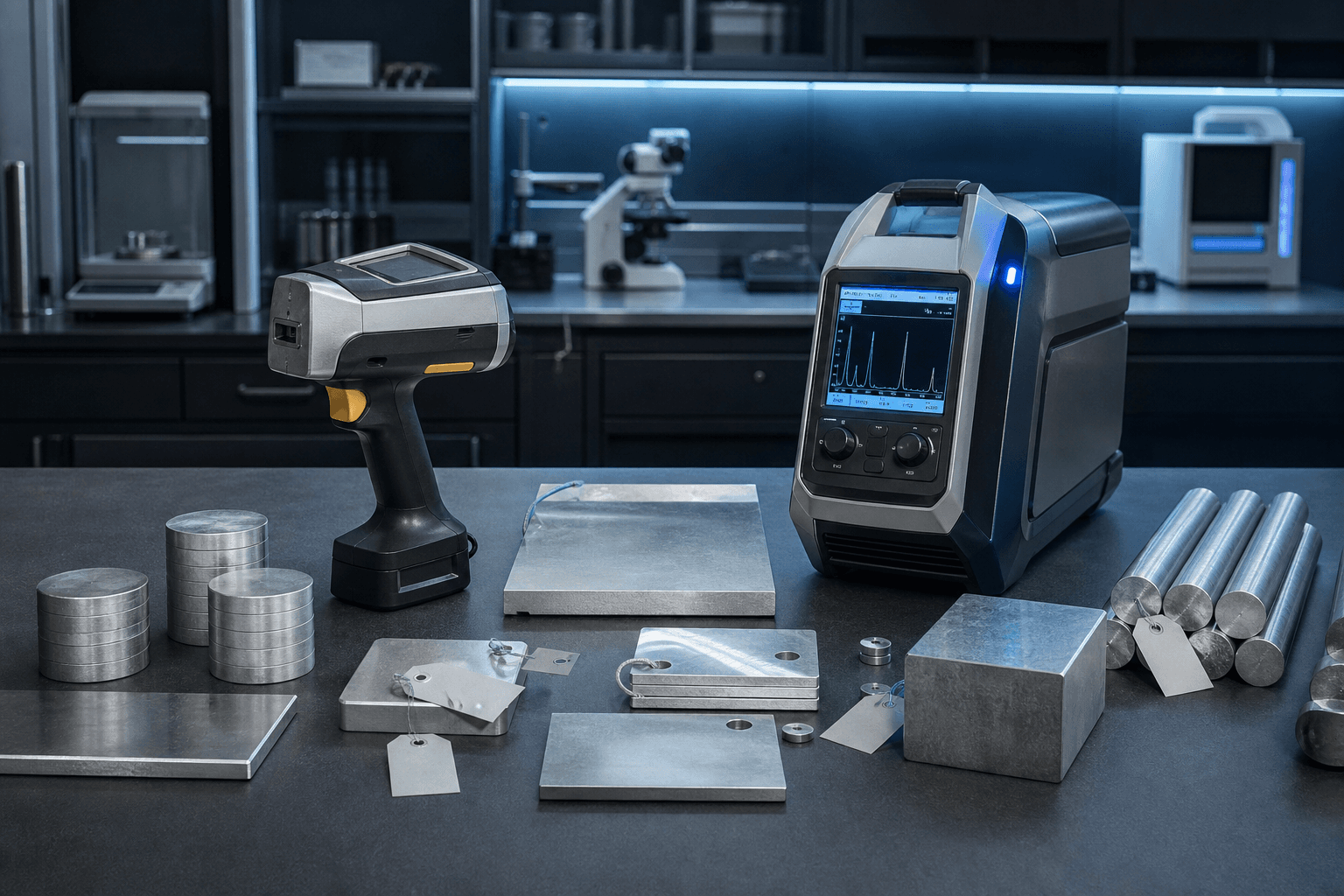
Grade identification of incoming magnesium alloy materials cannot rely solely on appearance, density, or supplier labels. PMI (Positive Material Identification) enables rapid verification that the material matches the specified grade—but because handheld XRF and spark OES differ fundamentally in detection principles and elemental coverage, method selection must account for magnesium alloys’ light-element characteristics.
How XRF and OES Complement Each Other
| Method | Advantages | Key Limitations for Magnesium Alloys |
|---|---|---|
| Handheld XRF | Fast, portable, minimal surface prep; suitable for on-site sorting | Limited sensitivity for light elements (e.g., Mg, Al) due to instrument configuration and physics—grade assignment requires dedicated calibration and validation |
| Spark OES | Capable of measuring multiple critical elements; ideal for precise grade confirmation and composition re-verification | Requires surface grinding, produces burn spots, and demands higher equipment and argon gas maintenance |
| Lab Chemical Analysis | Highest accuracy and traceability; resolves disputes | Longer turnaround time and higher cost—not suitable for high-throughput, per-piece screening |
A single XRF reading does not guarantee reliable differentiation across all magnesium alloy grades. When grade distinctions hinge on light elements or low-level impurities, validated OES or laboratory methods are required.
Surface Preparation Determines Data Reliability
Oxide films, coatings, oils, blasting media, and electroplated layers distort results. Test locations must expose representative base metal and avoid welds, repair areas, segregation zones, and thin-wall backing effects. Grinding tools must prevent cross-contamination; for OES, multiple sparks per sample are typically required, with stability assessed.
Build Your Own Grade Library—Don’t Rely on Default Names
Instrument-assigned grade names derive from internal databases and algorithms. Buyers must establish or validate their own grade library using traceable certified reference materials. Calibration/standardization, reference samples, drift checks, operator training, and measurement uncertainty must all be documented.
Incoming Inspection Workflow
- Verify CoA, heat/batch number, specification, condition, and product form;
- Define sampling plans by batch and packaging unit; perform visual and label inspection first;
- Screen using a validated PMI method and retain raw elemental data;
- Send borderline, conflicting, or unidentifiable readings for OES/lab re-verification;
- Correlate results with physical properties (e.g., hardness, conductivity, microstructure);
- Quarantine mixed-lot batches, expand inspection scope, and trace already-processed parts.
Common Pitfalls
- Saving only “PASS” status—not raw elemental data or spectral traces;
- Measuring directly on coated or oxidized surfaces;
- Using a single test point to represent large ingots, mixed bins, or entire heats;
- Treating PMI as full material certification—overlooking condition and performance requirements;
- Failing to verify whether the instrument can distinguish the two most similar candidate grades.
Is a Material Certificate Still Required After Passing XRF?
Yes. PMI is an independent verification—it does not replace heat/batch traceability, heat treatment condition, mechanical property reporting, or full impurity compliance.
To develop customized PMI and re-verification protocols for your magnesium alloy incoming materials, submit your target grades and volumes via Contact Us. Explore available products and grades at Product Center.
Sources
https://www.astm.org/membership-participation/technical-committees/workitems/workitem-wk69255 https://ims.evidentscientific.com/en/applications/metal-alloy-pmi