How to Design Thermal Management with Magnesium Alloys? Thermal Conductivity, Contact Thermal Resistance, and Thermal Validation
Explains thermal design methodologies for magnesium-alloy housings and heat-dissipation structures—from material thermal conductivity and wall thickness to die-cast porosity, contact interfaces, coatings, thermal spreading, and environmental testing.
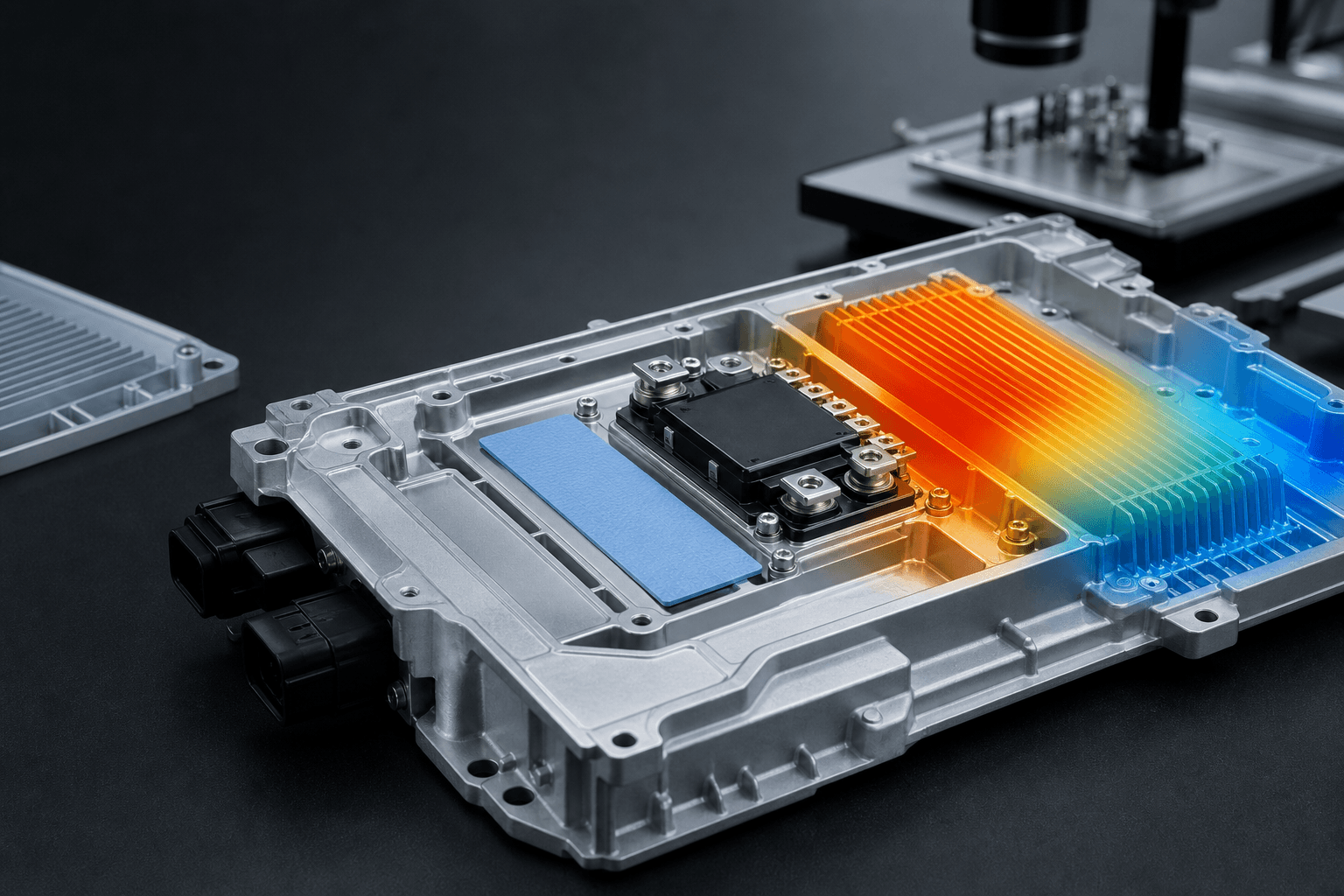
Effective thermal management using magnesium alloys cannot be assessed by comparing only bulk thermal conductivity values from material datasheets. Real-world thermal paths include the heat-source interface, housing wall thickness, contact pressure, thermal interface pads, coatings, fasteners, and convection conditions. Bulk thermal conductivity is merely one component within the overall thermal resistance network.
Map the Complete Thermal Path First
Starting from the chip, battery, or power device, sequentially list: package, thermal interface material, contact surface, magnesium-alloy structure, coating, and ambient air or coolant boundary. Each segment may dominate total thermal resistance. If surfaces are uneven, thermal pads too thick, or clamping pressure insufficient, increasing base-material conductivity yields negligible improvement.
How to Use Magnesium-Alloy Data Correctly
Thermal conductivity varies significantly across alloy grades (e.g., AZ31B, ZK61), tempers, and manufacturing processes; die-cast parts may exhibit porosity and localized microstructural variations. Design inputs must reflect the target grade and production process—not pure magnesium data. For thin-walled enclosures, in-plane thermal spreading and localized hot spots often matter more than one-dimensional conduction.
Structural and Thermal Design Must Iterate Concurrently
Ribs enhance stiffness but may impede in-plane thermal spreading or create thick-wall thermal bottlenecks; large-area thin walls support lightweighting yet risk reduced contact conformity due to warpage. Use realistic contact thermal resistance in thermal simulations—and treat assembly tolerances and clamping force as key sensitivity parameters.
Do Coatings Affect Thermal Performance?
Thin coatings may have minimal impact on large-area heat transfer—but at high heat flux densities, small contact areas, or with thick insulating layers, interfacial thermal resistance becomes non-negligible. Surface treatments also influence surface roughness, wettability, electrical insulation, and galvanic corrosion behavior—therefore, validation must use production-representative coated samples.
Testing Must Go Beyond Peak Temperature
- Is heat-source power and spatial distribution traceable?
- Are ambient temperature, airflow velocity, and mounting orientation controlled and fixed?
- Are thermocouples, infrared emissivity settings, and sensor attachment methods calibrated?
- Are steady-state duration, temperature rise, hotspot location, and temperature uniformity recorded?
- After thermal cycling, has the interface material extruded, aged, or relaxed?
- Do dimensional stability and coating integrity remain within specification?
Frequently Asked Questions
Are magnesium alloys inherently inferior to aluminum alloys for thermal management?
No—conclusions must consider specific alloy, wall thickness, and structural configuration. Magnesium’s weight advantage enables strategic redistribution of wall thickness; comparisons should be based on equivalent-mass or functional-equivalent designs.
Can thermal adhesives replace all mechanical fasteners?
Adhesive layer thickness, cure profile, long-term aging, reworkability, and structural load-bearing capacity must all be validated—not just initial thermal conductivity.
To evaluate lightweight housings or thermal skeletons, submit your power requirements, temperature limits, and structural models via Contact Us; explore candidate materials in our Product Center.
Sources
ASTM E1461 — Thermal Diffusivity by the Flash Method ASTM D5470 — Thermal Transmission Properties of Thermally Conductive Electrical Insulation Materials