Magnesium Alloy vs CFRP: Engineering Cost and Design Guide
Magnesium alloys and carbon-fiber-reinforced polymer solve different lightweighting problems. This engineering guide compares load-path efficiency, geometry, joining, cycle time, inspection, repair, corrosion interfaces and total production cost—without declaring a universal winner.
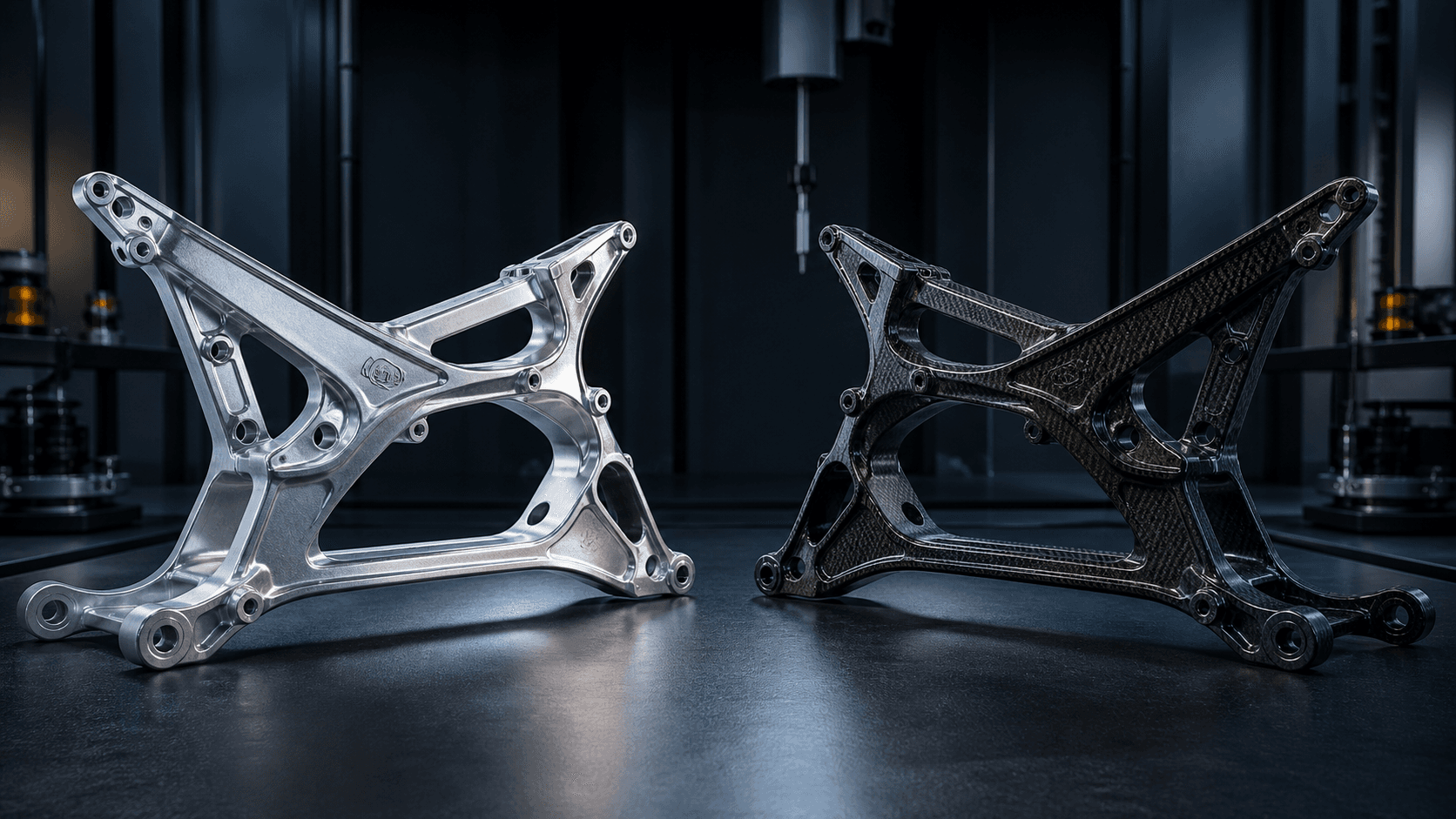
Magnesium alloy or CFRP: the short answer
Choose CFRP when directional stiffness or strength-to-weight performance dominates and the team can control laminate design, manufacturing and inspection. Choose a magnesium alloy when the part needs complex integrated geometry, metal-like joining, thermal or electromagnetic functionality, short repeatable cycles, or conventional machining and repair.
There is no universal winner. CFRP is a family of fiber, matrix and laminate systems—not one material. Magnesium performance also changes with alloy, temper, process and section design. Compare finished components under the same loads, environment, quality level and annual volume rather than comparing headline coupon properties.
Side-by-side engineering comparison
| Decision factor | Magnesium alloy | CFRP |
|---|---|---|
| Material behavior | Generally treated as homogeneous for common design calculations; verify anisotropy in wrought products | Inherently anisotropic; properties depend on fiber, matrix, layup and process |
| Best lightweighting use | Complex shells, housings, brackets and integrated metal features | Directional panels, tubes, beams and skins aligned to known load paths |
| Geometry | Die casting, extrusion, forming and machining support ribs, bosses, holes and local sections | Complex shapes are possible, but drape, ply drops, corners, inserts and cure tooling require laminate-specific design |
| Joining | Threads, inserts, welding or mechanical fastening depending on alloy and process | Bonding and mechanical fastening require damage, bearing and delamination controls |
| Production economics | Tooling can be high; repeatable cycles and part consolidation can favor volume production | Tooling, layup/automation, cure, trimming, inspection and scrap strongly affect cost |
| Damage and inspection | Dents, cracks and corrosion usually use familiar metallic inspection methods | Impact can produce subsurface damage; inspection and repair procedures are structure-specific |
| Temperature | Alloy choice, creep and surface protection govern limits | Polymer matrix, moisture and cure system govern limits |
| End-of-life | Remelting is established, but alloy segregation and oxidation control matter | Recycling route depends on thermoset or thermoplastic matrix and required reclaimed-fiber quality |
The table is a screening tool, not a design allowables database.
1. Compare the load path, not just tensile strength
CFRP can place fibers along dominant loads, producing excellent directional efficiency. The same benefit creates a design obligation: off-axis, transverse, interlaminar, bearing and impact behavior must also be substantiated. NASA guidance treats fiber type, reinforcement form, fiber volume, matrix, ply arrangement, processing, cost and end-item properties as linked selection variables.
Magnesium does not match the best unidirectional CFRP coupon values, but a cast or machined metal part can use ribs, beads and local thickness to manage multi-axial loads. The correct comparison is a mass-optimized component that meets stiffness, strength, fatigue, buckling and impact requirements—not equal-thickness coupons.
2. Geometry and part consolidation can reverse the cost result
For a simple constant-section beam or panel, CFRP may use fibers efficiently. For a housing with bosses, threaded interfaces, ribs, sealing lands, heat paths and many attachment points, magnesium can integrate functions that would otherwise require inserts, bonded details and assembly steps.
High-pressure die casting can support complex near-net-shape parts, but minimum wall, draft, gating, porosity and machining allowances are process- and geometry-dependent. Avoid universal wall-thickness or cycle-time claims. Review the actual component with a qualified supplier; Matrix Mg’s magnesium die-casting parts page is a starting point for a manufacturability discussion.
3. Model total cost at the target annual volume
A credible should-cost model includes:
- material and conversion yield;
- molds, dies, fixtures and cure tools amortized over expected volume;
- layup or molding labor and automation;
- cycle time, cure time and work-in-process;
- trimming, drilling, machining and surface finishing;
- inserts, adhesives, fasteners and assembly;
- dimensional inspection and nondestructive inspection;
- scrap, rework and process qualification;
- packaging, transport and repair provisions;
- end-of-life and recycled-content requirements.
CFRP is not automatically “too expensive,” and magnesium is not automatically the low-cost choice. Part size, process route, quality requirements, automation and utilization determine the crossover point.
4. Design joints and mixed-material interfaces early
Carbon fibers are electrically conductive. When CFRP contacts a metal in the presence of an electrolyte, galvanic-corrosion risk must be assessed. FAA composite guidance notes that isolation layers may be required between some composite and metal interfaces and that fasteners and installation procedures must address both corrosion and composite damage.
A magnesium-to-CFRP joint therefore needs an engineered isolation and sealing strategy. The design review should address:
- nonconductive barrier or compatible coating system;
- sealed edges, drainage and prevention of electrolyte traps;
- fastener material and isolation hardware;
- adhesive compatibility and surface preparation;
- clamp load, bearing stress and thermal-expansion mismatch;
- inspection access and coating repair after service damage.
Do not assume an adhesive layer alone provides durable electrical isolation without validation.
5. Include inspection and repair in the material decision
FAA guidance for composite aircraft structures emphasizes material/process control, structural substantiation, damage tolerance, maintenance and repair. NIST machining research also shows that CFRP cutting behavior and tool wear vary with fiber orientation and feed, which matters for holes and trimmed edges.
For each candidate, ask:
- What damage can be missed by visual inspection?
- Which nondestructive inspection method is required?
- Can the part be repaired in the field or must it be replaced?
- What skills, consumables, cure conditions and records are needed?
- Does repair restore the original load path and environmental protection?
The cheaper factory part can become the more expensive lifecycle option if inspection or repair is not available where the product operates.
6. Temperature, moisture and surface protection are system properties
For CFRP, service temperature and environmental durability depend heavily on the polymer matrix, cure, moisture uptake and laminate. For magnesium, alloy selection, sustained-load temperature, corrosion environment, coating and galvanic isolation are central. Do not publish one “maximum temperature” for either material family.
Validate the full system—including coatings, adhesives, inserts and fasteners—under representative thermal cycling, humidity, fluids, vibration and load.
When to shortlist each material
Shortlist CFRP when:
- loads are well defined and strongly directional;
- minimum structural mass justifies laminate design and qualification;
- large panels, tubes or beams dominate the geometry;
- inspection and repair infrastructure is planned;
- RF transparency or other composite-specific behavior is valuable.
Shortlist magnesium when:
- a complex housing or bracket can consolidate multiple parts;
- bosses, threads, sealing lands, heat paths or EMI shielding are important;
- repeatable metal production and conventional machining are preferred;
- multi-directional local loads and attachment features dominate;
- a casting, extrusion or plate route matches the annual volume.
Consider a hybrid architecture when: CFRP provides the primary load path while magnesium provides interfaces, housings, brackets or heat-spreading functions. In that case, galvanic isolation and differential thermal expansion become first-order requirements.
Design-review checklist
- Compare finished-component mass, not equal-thickness material samples.
- Define stiffness, strength, fatigue, buckling, impact and damage limits.
- State temperature, humidity, fluids and corrosion exposure.
- Identify every insert, fastener, adhesive and mixed-material interface.
- Build a volume-based cost model including tooling, inspection and scrap.
- Validate manufacturing capability with representative geometry.
- Define acceptance criteria and nondestructive inspection.
- Approve repair, replacement and end-of-life routes.
- Test the final material/process/joint system.
Conclusion
CFRP usually wins when engineers can exploit a controlled directional load path. Magnesium often wins when lightweighting must coexist with complex geometry, integrated interfaces and repeatable metal manufacturing. The best decision comes from a component-level trade study and validated prototypes—not from a single density, strength or price number.
This article is general engineering and procurement information. Material selection and structural substantiation must be performed by qualified engineers using application-specific standards, design allowables and test data.
Sources
NASA, Fiber-Reinforced Polymer Composite Material Selection — https://llis.nasa.gov/lesson/689 FAA, AC 20-107B Composite Aircraft Structure — https://www.faa.gov/documentLibrary/media/Advisory_Circular/AC_20-107B_with_change_1.pdf FAA, AC 43-214A Repairs and Alterations to Composite and Bonded Aircraft Structure — https://www.faa.gov/regulations_policies/advisory_circulars/index.cfm/go/document.information/documentID/1029806 NIST, Fiber Orientation Angle Effects in Machining of Unidirectional CFRP Laminated Composites — https://www.nist.gov/publications/fiber-orientation-angle-effects-machining-unidirectional-cfrp-laminated-composites