Why Do Magnesium Alloy Castings Warp or Crack During Heat Treatment? Controlling Solution, Quenching, and Aging
Analyzes blistering, warping, cracking, and property scatter in magnesium alloy castings during solution treatment, quenching, and aging—covering furnace loading, support design, temperature uniformity, and pre-heat-treatment porosity verification.
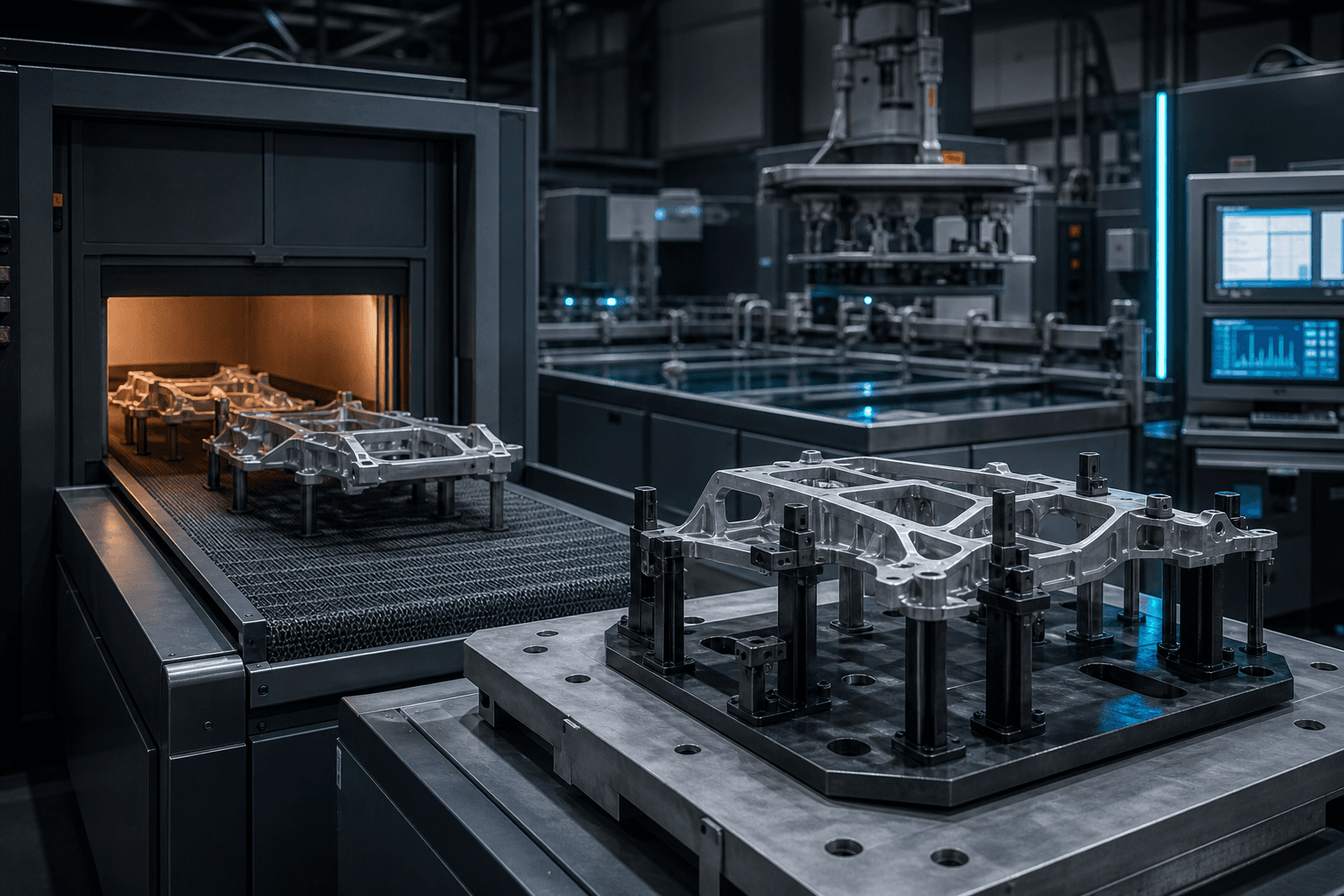
Warping, cracking, or surface blistering in magnesium alloy castings after heat treatment is rarely due to a single factor like “excessive temperature.” Instead, it results from the combined effects of casting porosity, wall-thickness variation, residual stress, part support, furnace temperature uniformity, transfer time, and cooling intensity. In conventional high-pressure die-castings, entrapped gas expands upon heating—potentially causing blistering or even cracking.
What Each Stage Controls
| Stage | Objective | Primary Risks |
|---|---|---|
| Solution Treatment | Dissolve strengthening phases and homogenize microstructure | Overheating, grain-boundary melting, pore expansion, distortion |
| Quenching/Cooling | Retain supersaturated solid solution | Thermal stress, cracking, warping, non-uniform local cooling |
| Aging | Precipitate strengthening phases and stabilize properties | Under-aging, over-aging, furnace temperature and batch-to-batch variation |
Not all magnesium alloys use identical heat treatment schedules—and not all casting processes tolerate high-temperature solution treatment. The heat treatment process must be tailored to the specific alloy grade (e.g., AZ31B, ZK61), casting method, and required temper condition.
Where Does Distortion Originate?
Non-uniform wall thickness causes differential heating and cooling rates; removal of gates, overflows, and machining releases residual stress; improper furnace loading or support placement may allow thin sections to deform under self-weight at elevated temperatures; and non-uniform quench flow induces thermal-gradient stresses. Forcing dimensional stability with rigid fixtures may instead introduce localized stress and cracking.
Conduct Process Feasibility Validation Before Heat Treatment
For die-cast parts, assess porosity level via vacuum curve analysis, CT scanning, density measurement, or representative cross-sectioning. For sand, gravity, or squeeze-cast parts, verify gating/riser removal, hot-spot conditions, and weld repair status. For first-article runs, record actual part temperature profiles using embedded thermocouples—not just furnace ambient readings—during heating and cooling.
Production Control Checklist
- Furnace temperature uniformity, system accuracy, and calibration status;
- Loading orientation, part quantity per load, spacing, and support fixture design;
- Start timing of soak period—and confirmation that target part temperature is reached;
- Transfer time from furnace to quench medium, and condition of quench medium;
- Stabilization time before dimensional measurement, datum selection, and support configuration;
- Hardness, tensile properties, microstructure, electrical conductivity, and other process indicators;
- Restrictions on rework, repeat heat treatment, and post-weld heat treatment.
Can Warped Parts Be Straightened Directly?
Straightening requires prior validation of temperature, strain magnitude, and crack risk—and subsequent verification of residual stress, dimensional stability, and mechanical performance. Straightening must not be treated as an unlimited rework option.
To develop a customized heat treatment and dimensional validation protocol for your magnesium castings, contact us via Contact Us with your alloy grade, casting process, and part geometry. Explore our materials in the Products section.
Sources
ASM Handbook, Volume 4E — Heat Treating of Nonferrous Alloys ASTM B661 — Heat Treatment of Magnesium Alloys