Can Magnesium Alloy Castings Be Repair-Welded? Defect Assessment, Rework Process, and Release Boundaries
Explains how to verify alloy grade, defect type, contamination, and load-bearing zones before repair-welding magnesium castings—and establishes a rework workflow covering bevel preparation, cleaning, preheating, welding, heat treatment, NDT, and dimensional revalidation.
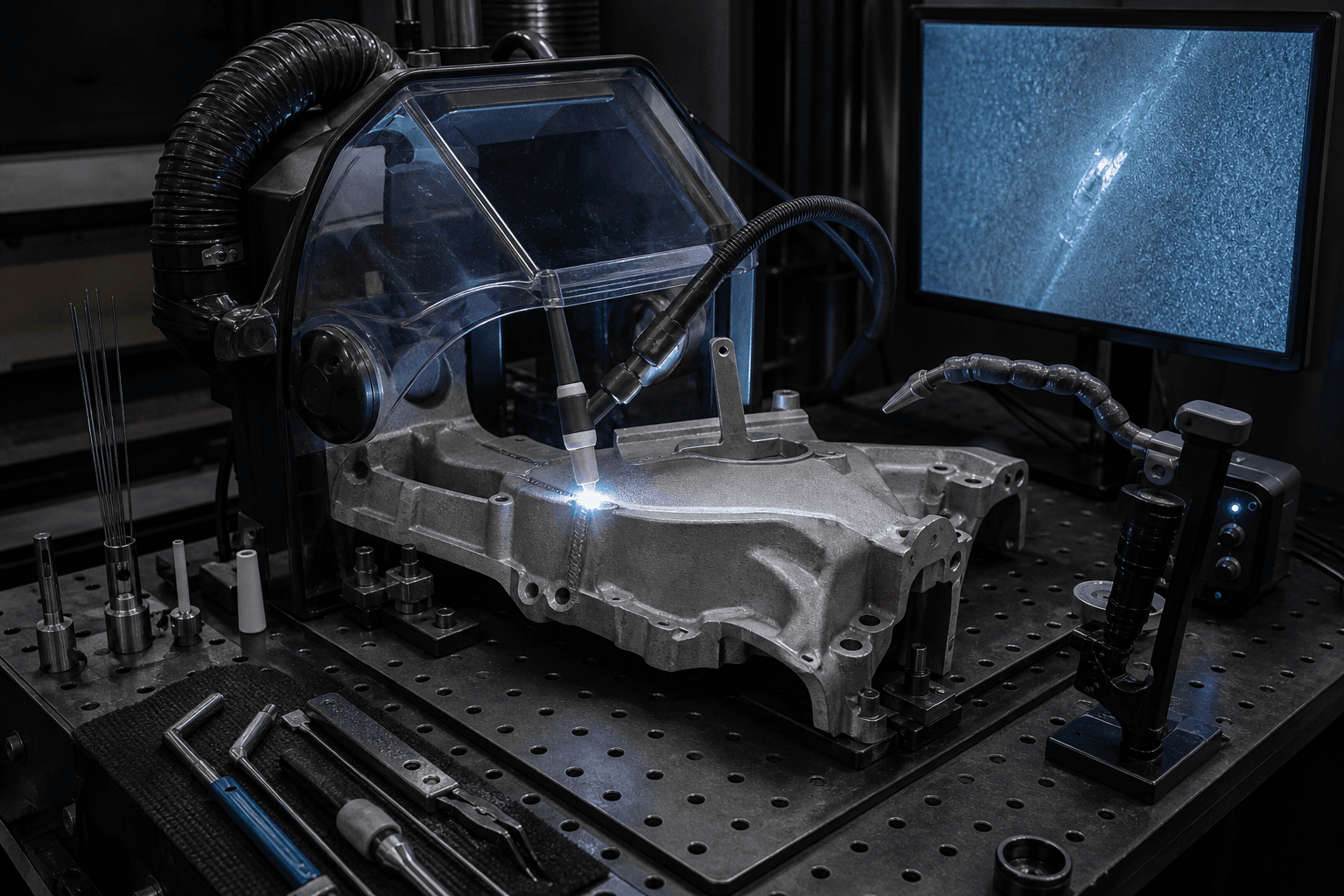
Some magnesium alloy castings can be repair-welded—but “weldable” does not mean “release-eligible.” Porosity, shrinkage cavities, cracks, oil contamination, and unknown alloy grades require distinct handling approaches; defects located in high-stress, sealing, rotating, or safety-critical zones—even if surface-ground smooth—may be non-repairable per specification.
Make the Rework Decision First—Not the Arc Strike
| Question | Decision Impact |
|---|---|
| Is base material grade and condition confirmed? | Determines filler wire selection, heat input, and post-weld heat treatment |
| Is the defect isolated—or through-going/clustering? | Determines full removal feasibility and verification method |
| Is the location critical for load-bearing or sealing? | Determines whether rework is permitted by specification |
| Has the casting absorbed oil or been coated? | Determines cleaning, degassing, and recontamination risk |
| What was the original casting process and porosity level? | Determines post-heating pore formation and cracking risk |
If material identity, defect extent, or service loading cannot be confirmed, repair-welding is inherently unsafe.
Essential Steps in the Rework Process
Mechanically remove the defect entirely and prepare a cleanable, fusion-ready bevel using magnesium-specific tools to avoid contamination from steel, copper, or other foreign materials. After cleaning, strictly control preheat, shielding gas, filler wire (e.g., AZ31B, ZK61), interpass temperature, and heat input per qualified WPS. For long cracks or thin-walled components, implement controlled weld sequencing and fixturing to minimize shrinkage distortion.
Post-Weld Validation Is Mandatory
Surface grinding only confirms visual smoothness. Select appropriate verification methods based on risk: PT, X-ray/CT, leak testing, dimensional inspection, hardness, metallography, or mechanical testing. If heat treatment is required, confirm whether repair welding occurs pre- or post-HT; assess whether repeated thermal cycles alter base material properties; and verify sufficient straightening allowance and machining stock remain.
Situations Requiring Extra Caution
- Legacy parts with unknown composition or mixed alloy grades;
- Porous areas with prolonged exposure to oil or coolant—and incomplete cleaning;
- Fatigue-critical zones, thin-wall junctions, hubs, or high-speed rotating components;
- Widely dispersed porosity requiring progressively larger repair areas;
- Customer specifications, airworthiness/medical regulations, or safety standards explicitly prohibiting rework;
- Absence of qualified welders, approved WPS/PQR, or certified NDT capability.
Traceability Requires Part-Level Rework Records
Document defect location & dimensions, removal method, filler wire batch, welder ID, parameters, preheat/interpass temperatures, NDT results, heat treatment data, and final dimensions. Rework iterations must be limited—repeated repair-welding until appearance meets spec is unacceptable.
Can Magnesium Alloy Grades Be Identified by Color or Spark Test?
No—these are unreliable identification methods. Confirm grade via mill certificates, OES/lab compositional analysis, and part history.
To develop a magnesium casting repair-welding review and release checklist, submit defect details, loading conditions, and material information via Contact Us; see available alloys in Products.
Sources
https://media.defense.gov/2014/Jun/20/2002655936/-1/-1/1/140620-N-ZZ182-6576.pdf AWS D17.1/D17.1M — Specification for Fusion Welding for Aerospace Applications