Why Does Magnesium-Alloy Coating Adhesion Fail? A Troubleshooting Guide for Pretreatment, Contamination, and Humidity-Temperature Exposure
Systematically diagnose blistering, delamination, and cross-cut failure in magnesium-alloy coatings—covering substrate, cleaning, oxide films, conversion treatment, coating cure, masking, handling, and environmental aging.
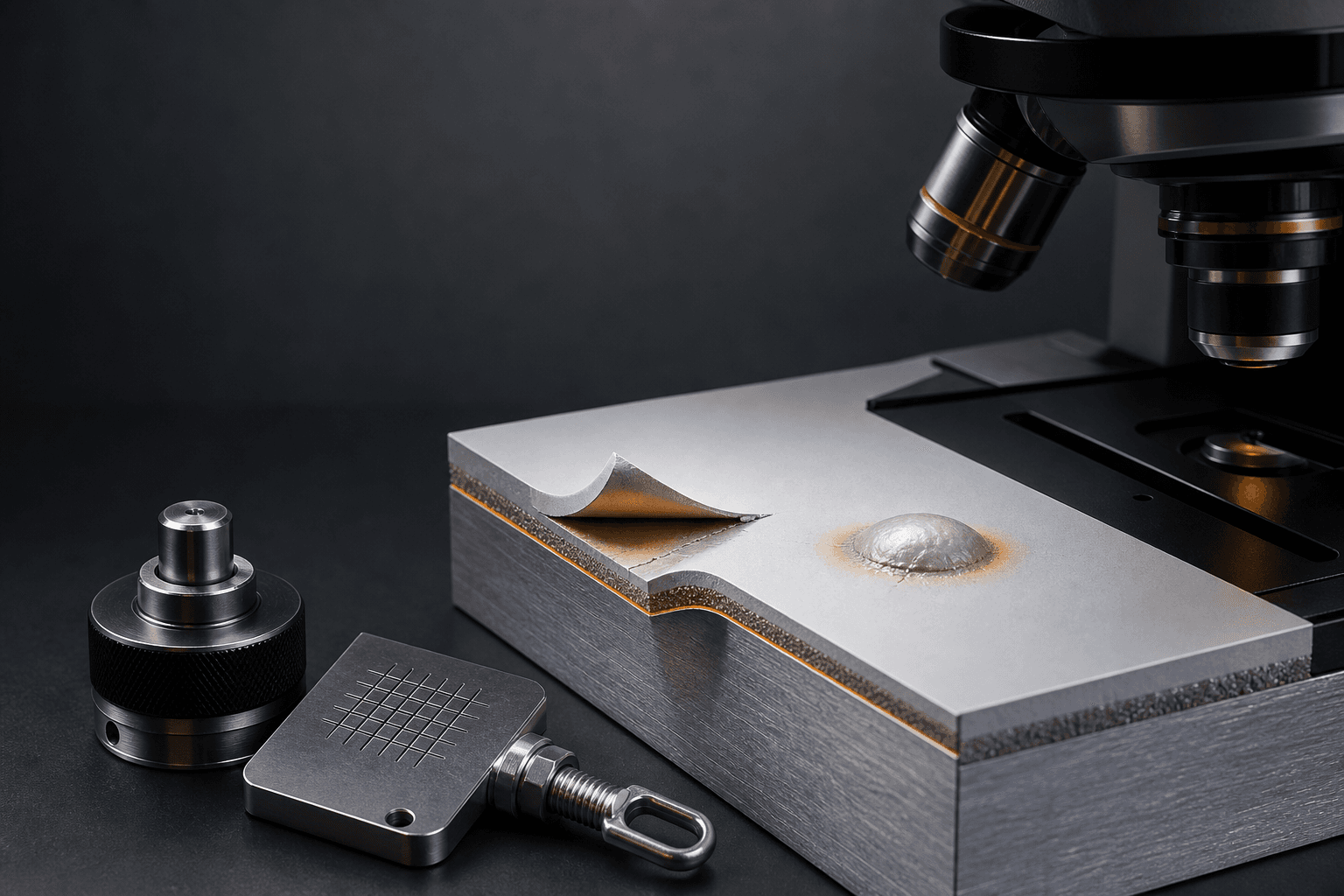
Magnesium-alloy coating adhesion failure is rarely as simple as "poor paint quality." Cutting fluids, mold-release agents, fingerprints, native oxides, water quality in cleaning, pretreatment dwell time, bake profiles, and fixture contact points can all create interfacial weaknesses. Root-cause analysis must begin by identifying where the fracture occurs.
First: Identify the Failure Interface
After delamination, determine whether failure occurs between substrate and pretreatment, pretreatment and primer, or within the coating itself (cohesive failure). Combine microscopic observation, cross-section analysis, surface characterization, and known reference samples—avoid relying solely on visual color assessment.
Common Root-Cause Map
Substrate & Contamination
Residual mold-release agents (e.g., from die-casting), machining oils, polishing waxes, and fingerprint salts—if not fully removed—impede wetting and chemical bonding. Trapped liquids in pores may volatilize during baking, causing pinholes and blisters.
Surface Activation & Pretreatment
Magnesium’s native oxide layer evolves rapidly. The time interval between cleaning and pretreatment, bath concentration, temperature, pH, and contaminant ion levels must be tightly controlled. Over-etching produces a porous, weak layer; under-treatment fails to form a uniform, protective conversion film.
Coating Application & Curing
Excessive film thickness, insufficient solvent flash-off, and reliance on furnace ambient temperature (rather than actual part temperature) lead to solvent entrapment or incomplete crosslinking. Thick vs. thin sections on complex parts heat at different rates—part-specific thermal profiling is essential.
Design & Handling
Sharp edges, fixture contact points, liquid-trap zones, masking tear-outs, and assembly-induced scratches locally compromise coating integrity. If failures consistently occur at identical geometric locations, prioritize design or process modification—not just paint substitution.
Troubleshooting Steps
- Freeze samples of both good and defective parts, along with full batch records;
- Re-evaluate substrate, machining history, cleaning parameters, and pretreatment bath chemistry;
- Measure surface roughness, conversion-coating weight (g/m²), or film continuity;
- Verify spray environment conditions, dry-film thickness, and actual part temperature profiles during cure;
- Conduct comparative adhesion tests—cross-cut, pull-off, humidity-temperature cycling, or corrosion exposure;
- Confirm root cause via single-variable small-scale trials before scaling to production.
Frequently Asked Questions
Initial cross-cut passes, but delamination occurs after humidity-temperature testing—what does this indicate?
Likely causes include interfacial contamination, discontinuous conversion film, coating water permeability, or galvanic corrosion. Initial adhesion strength does not substitute for long-term environmental aging performance.
Can touch-up paint be applied directly over delaminated areas?
No. Before repair, remove all loose material, treat underlying corrosion products, and reapply a compatible pretreatment layer. Direct overcoating merely masks—not resolves—the issue.
For professional coating failure analysis, contact us via Contact Us with photos of delamination, your process flow, and test conditions. Relevant materials are available in our Product Center.
Sources
ASTM D3359 — Measuring Adhesion by Tape Test ASTM D4541 — Pull-Off Strength of Coatings ISO 2409 — Cross-Cut Test