How to Ensure Air-Tightness in Magnesium Alloy Die-Cast Components?
Explains leakage pathways in magnesium alloy die-cast housings, pressure-decay and helium leak testing methods, fixture MSA, applicability boundaries of vacuum impregnation, and mass-production air-tightness release criteria.
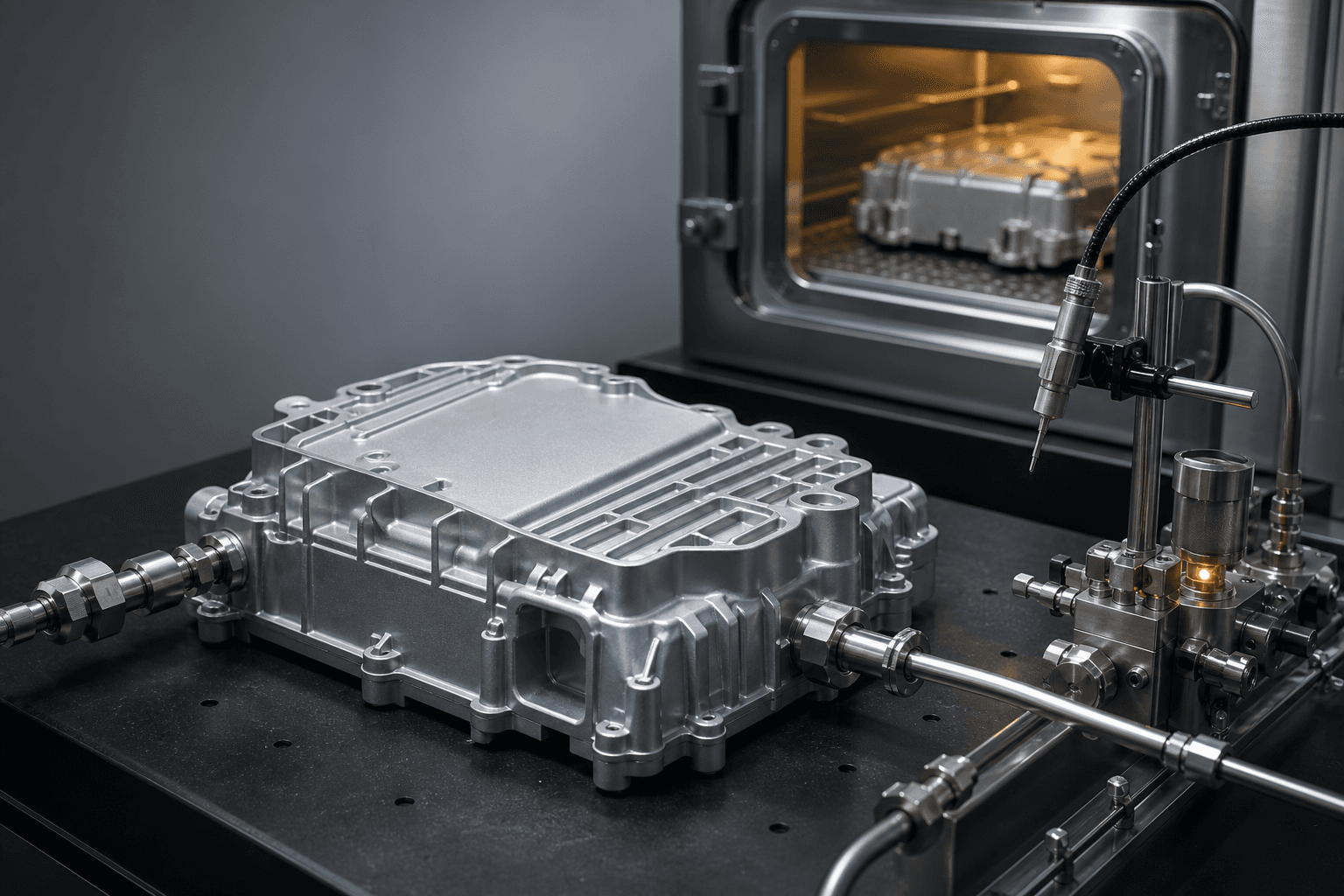
Leakage in magnesium alloy die-cast housings may originate from interconnected porosity, cold shuts, cracks, machining-induced breakthroughs, sealing surface defects, or the test fixture itself. A common pitfall in air-tightness projects is adjusting die-casting parameters immediately upon observing excessive pressure decay—without first identifying the true leakage path.
Establish a Unified Leakage Definition First
Drawings or technical agreements must specify test medium, test pressure, pressurization time, stabilization time, measurement duration, allowable leak rate, temperature range, and fixture sealing locations. “No leakage” is not an actionable acceptance criterion.
How to Select Common Leak Detection Methods
| Method | Applicable Scenario | Key Considerations |
|---|---|---|
| Pressure Decay or Differential Pressure | High-speed 100% inspection in mass production | Temperature, part volume, fixture elasticity, and stabilization time |
| Flow Measurement | Direct reading of steady-state leak rate | Requires stable supply pressure and background leak control |
| Water Immersion (Bubble Test) | Locating larger leaks | Subjective interpretation; drying and corrosion prevention must be controlled |
| Helium Mass Spectrometry | Ultra-low leak rates or R&D-level localization | High cost; vacuum or sniffer-mode conditions must be defined |
Four-Step Root-Cause Analysis for Failed Tests
First, validate equipment using calibrated standard leaks; then perform fixture dry-runs and repeatability tests to eliminate test-system variability. Next, localize leakage zones via sectional blocking, tracer gas, or water immersion. Finally, overlay identified locations with X-ray, CT, cross-sectioning, and machining path data to determine whether the root cause is interconnected porosity, cracking, or sealing-surface issues.
What Vacuum Impregnation Can—and Cannot—Resolve
Vacuum impregnation introduces sealant into interconnected micro-pores under vacuum and pressure, effectively addressing certain micro-porosity leaks and improving yield. It cannot repair structural cracks, weak-bond cold shuts, or severe shrinkage cavities, nor can it restore fatigue performance. When applying impregnation, explicitly define sealant compatibility, cleaning procedures, curing parameters, rework limits, batch traceability, and impact on subsequent coating processes.
Production Control Must Extend Beyond Final Testing
- Automated monitoring of vacuum and injection process parameters;
- In-process quality sampling of sealing zones and machined areas;
- Daily verification of leak testers using standard reference leaks;
- Fixture seal life management, maintenance schedule, and MSA;
- Data tracking pre- and post-impregnation, rework counts, and scrap reasons;
- Retesting plan after painting, baking, and thermal cycling.
Frequently Asked Questions
Why does a part pass leak testing immediately after machining but fail after storage?
Temperature equilibration, residual fluids, sealant curing, stress relaxation, or micro-crack propagation may alter results. Standardize preconditioning and test timing.
Is CT still necessary if 100% leak testing is performed?
The objectives differ: leak testing verifies functional air-tightness; CT reveals internal defect morphology and process trends. Safety-critical or high-reliability applications typically require both.
To evaluate air-tight housings, please contact us with your requirements—including test medium, pressure, allowable leak rate, cycle time, and cross-sectional drawings. Material specifications are available in our Product Center.
Sources
ASTM E515 — Leaks Using Bubble Emission Techniques ASTM E493 — Leaks Using the Mass Spectrometer Leak Detector