How to Achieve EMI Shielding with Magnesium-Alloy Enclosures: A Guide to Seams, Grounding, Coatings, and Testing
Explains how bulk conductivity, seam leakage, grounding, conductive coatings, gaskets, corrosion isolation, and radiated/conducted emissions testing must be co-designed for magnesium-alloy enclosures.
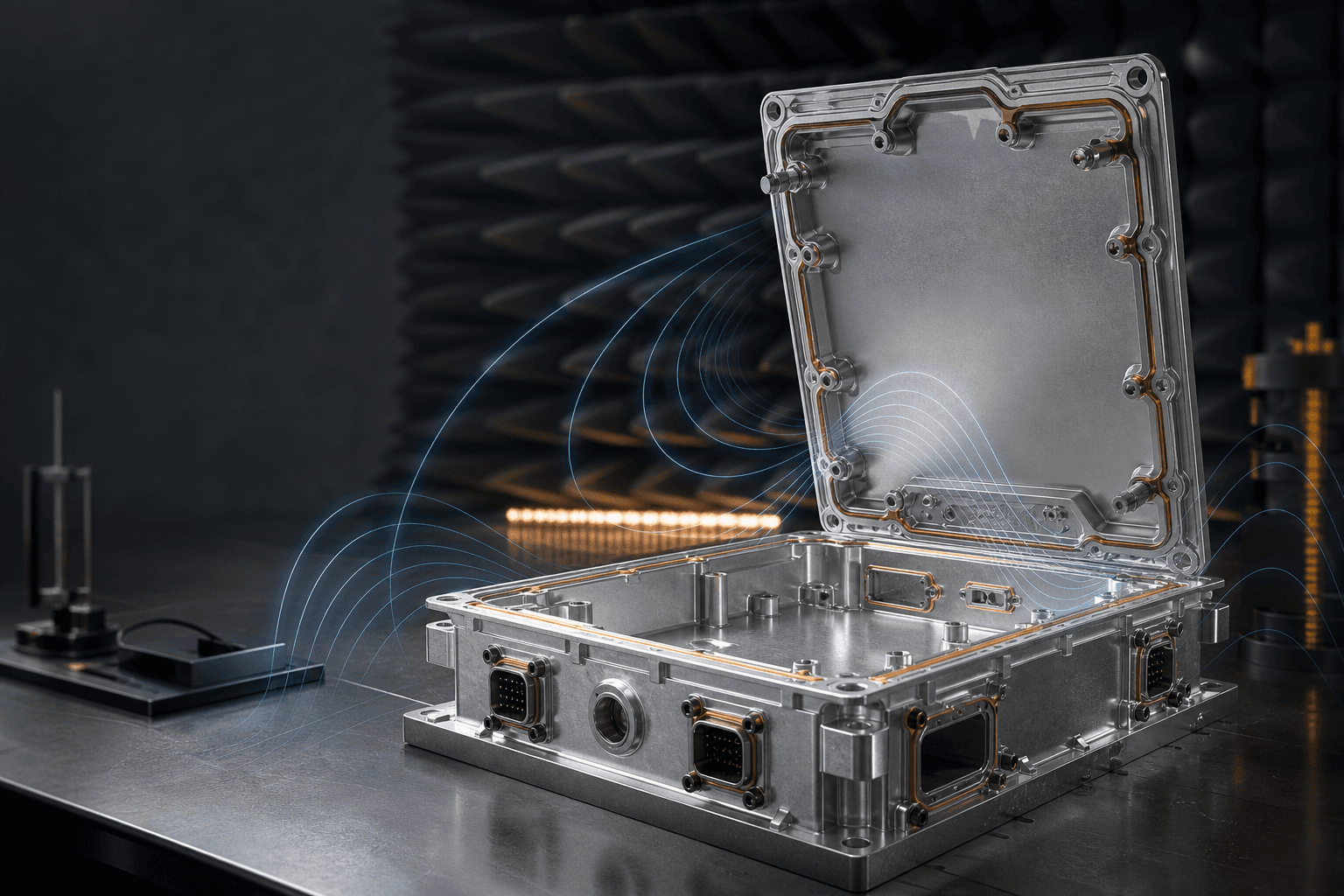
Magnesium alloys are inherently conductive; however, an enclosure’s EMI shielding performance is typically governed by apertures, seams, interconnect impedance, and surface coatings—not bulk material conductivity alone. Inherent conductivity does not guarantee compliant shielding after assembly, especially when painting, sealing, and dissimilar-metal fastening are involved.
Shortest Answer
First establish a continuous conductive path; then control seams and apertures; finally validate using measurement methods aligned with the system’s operating frequency band. If structural insulation or corrosion protection is required, retain controlled conductive zones at designated grounding points—never scrape paint onsite arbitrarily.
Four Key Design Considerations
Seams
Seam length, gap width, and fastener spacing critically impact high-frequency leakage. Insufficient flange stiffness or excessive bolt spacing may cause local warping post-assembly. Conductive gaskets require precise compression force—and must be validated for rebound stability across temperature cycles and service life.
Apertures
Ventilation openings, I/O interfaces, and display windows represent common weak points. Maximum aperture dimension, array geometry, waveguide-beyond-cutoff structures, or shielded mesh must be engineered per target frequency—while balancing airflow resistance, mechanical strength, and IP rating requirements.
Surface Finishes
Coatings improve corrosion resistance and aesthetics but increase contact resistance. Masking, conductive conversion layers, or localized finishing must be specified at grounding points, gasket interfaces, and fastener contact zones—with strict control over coating thickness and scratch-repair protocols.
Grounding
More grounding points do not automatically yield better performance. Grounding topology, conductor length, connection impedance, and system reference ground must be jointly defined by electronics and mechanical engineering teams.
Corrosion and Shielding Must Be Solved Together
Direct contact between magnesium alloy and copper, steel, or nickel-plated components in the presence of moisture and electrolytes can trigger galvanic corrosion. The requirement for low-impedance electrical continuity often conflicts with corrosion isolation—requiring balanced solutions via compatible plating systems, sealing, controlled contact area, and environmental validation.
How to Validate
Begin with surface and contact resistance measurements of base material and coatings; proceed to shielding effectiveness (SE) testing on bare enclosures or representative seam assemblies; conclude with full-system radiated emissions, immunity, and conducted emissions tests. Retest after drop, vibration, salt spray, or damp-heat exposure—since loosening and corrosion alter interconnect impedance.
Procurement Specifications Recommendations
- Target frequency band, required shielding effectiveness, or system-level compliance limits;
- Defined grounding locations, masked zones, and maximum allowable contact resistance;
- Gasket material, compression specification, and fastener torque requirements;
- Coating system, thickness tolerances, repair procedures, and inspection criteria;
- Re-test conditions before and after environmental aging;
- System boundary definitions among enclosure, PCB, and cabling.
For lightweight EMI-shielded enclosure evaluation—including material form factor options—submit your frequency band and assembly configuration via Contact Us. Material forms are detailed in our Products.
Sources
IEEE 299 — Measuring the Effectiveness of Electromagnetic Shielding Enclosures IEC 61000-4 Series — Electromagnetic Compatibility Testing