Are Weld Seams in Magnesium Alloy Hollow Profiles Reliable? A Guide to Porthole Dies, Microstructure, and Verification
Explains metal flow separation and high-pressure weld seam formation in porthole-die extrusion of magnesium alloys, covering seam location, temperature, extrusion ratio, microstructure, non-destructive testing, and destructive validation.
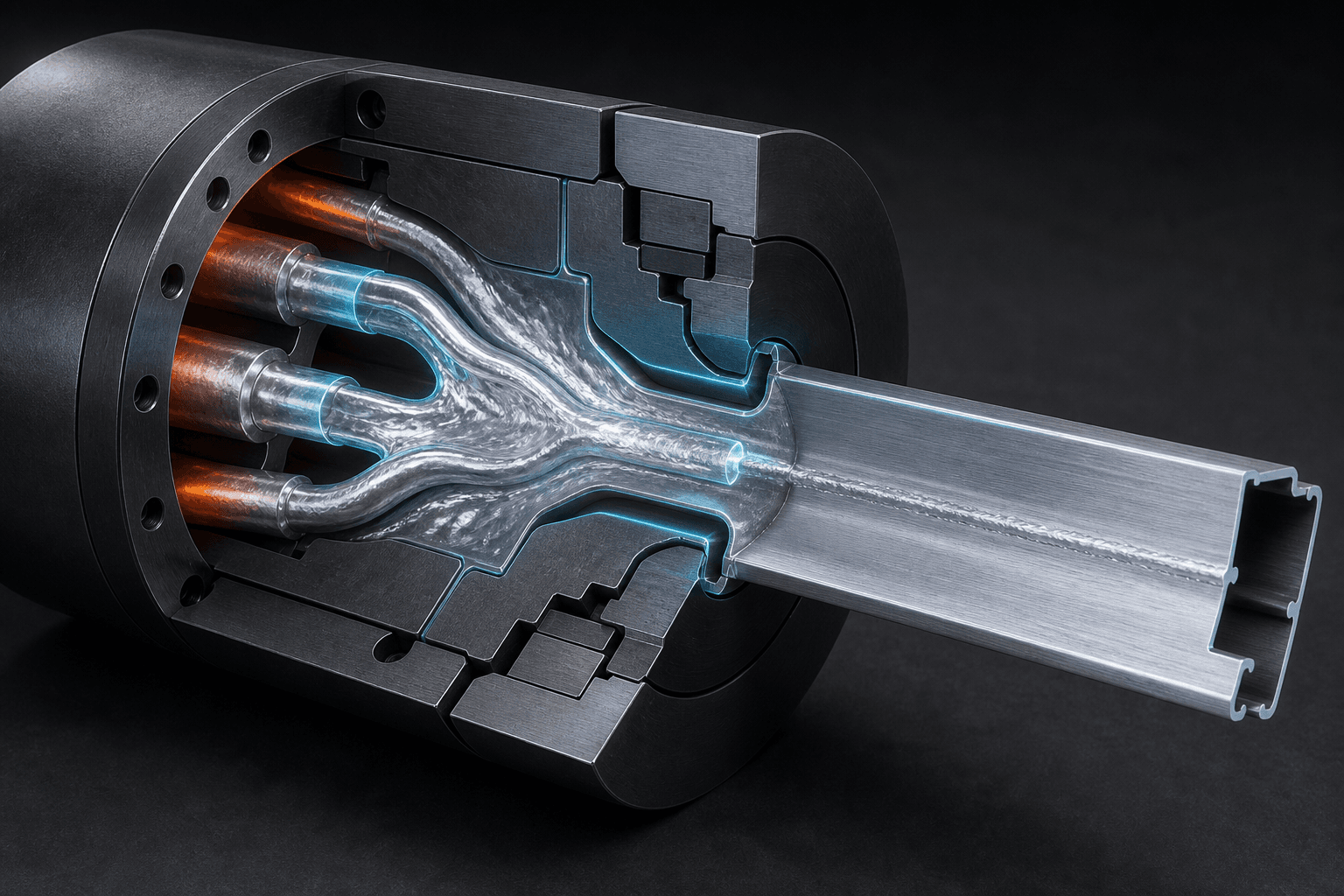
Hollow magnesium alloy profiles are commonly produced using porthole or bridge dies: the billet is divided into multiple streams, flows around die bridges, and recombines within the weld chamber—resulting in longitudinal weld seams across the cross-section. These are not fusion welds; however, their invisibility to the naked eye does not imply equivalence to base material.
How Weld Seams Form
Metal flow achieves bonding under high temperature, high hydrostatic pressure, and plastic deformation—breaking down the original surface oxide film. Weld quality depends on weld chamber pressure, residence time, temperature, extrusion ratio, speed, die bridge and port geometry, and billet surface condition—including oxide film and contamination.
Factors That Weaken Weld Integrity
- Insufficient weld chamber pressure or effective strain;
- Temperatures too low (inadequate bonding) or too high (microstructural degradation or surface defects);
- Imbalanced metal flow across streams, causing seam position drift;
- Surface contamination, oxide films, or inclusions carried into the interface;
- Die wear, rework, or speed changes altering local flow fields;
- Subsequent bending, flaring, or fatigue loading aligned unfavorably with the weld seam.
Reliable Verification Methods
First, use metallography to identify the actual weld seam location and microstructure. Then sample separately from the weld seam and non-welded regions. Validation may include transverse tensile, shear, bend, flaring, fatigue, or fracture analysis—selected based on component loading conditions. Conventional ultrasonic or eddy-current testing cannot be assumed capable of detecting poor bonding; detection capability must be proven using artificial defects or known-failure reference specimens.
Design Phase Considerations
Avoid placing critical high-stress zones, threaded holes, sharp bends, or subsequent machining locations over unfavorable weld seams—or control seam position via profile and die design. If avoidance is impossible, input measured weld seam properties—not generic base-material handbook values—into structural analysis.
Procurement Specifications Must Specify
- Permitted die types, number of ports, and allowable weld seam locations;
- Sampling orientation and separate mechanical property requirements for base material vs. weld seam;
- Re-validation after die maintenance, port replacement, or extrusion parameter changes;
- Sequence of downstream processes (e.g., stretch-bending, flaring, welding, machining);
- Macro-etching, metallography, destructive testing, and sampling frequency;
- Fractography and traceability requirements for failure specimens.
Do Solid Profiles Avoid Weld Seam Issues?
Solid sections typically do not develop comparable longitudinal weld seams—but may still exhibit flow non-uniformity, centerline defects, or inclusions. Verification must align with actual process conditions.
For evaluation of weld seam integrity and cross-sectional design, submit your profile geometry, bending direction, and loading conditions via Contact Us; view available profiles in our Product Center.
Sources
https://pure.tudelft.nl/ws/portalfiles/portal/47735872/Integrated_Physical_and_Numerical_Simulations_of_Weld_Seam_Formation_during_Extrusion_of_Magnesium_Alloy.pdf https://doi.org/10.1016/j.matdes.2022.111176