Hot-Chamber vs. Cold-Chamber Die Casting for Magnesium Alloys: Equipment, Cycle Time, and Part Boundaries
A comparative analysis of hot-chamber and cold-chamber die casting for magnesium alloys—covering furnace layout, metal transfer, cycle time, part dimensions, alloy compatibility, oxide inclusions, and equipment maintenance—plus a project selection and acceptance checklist.
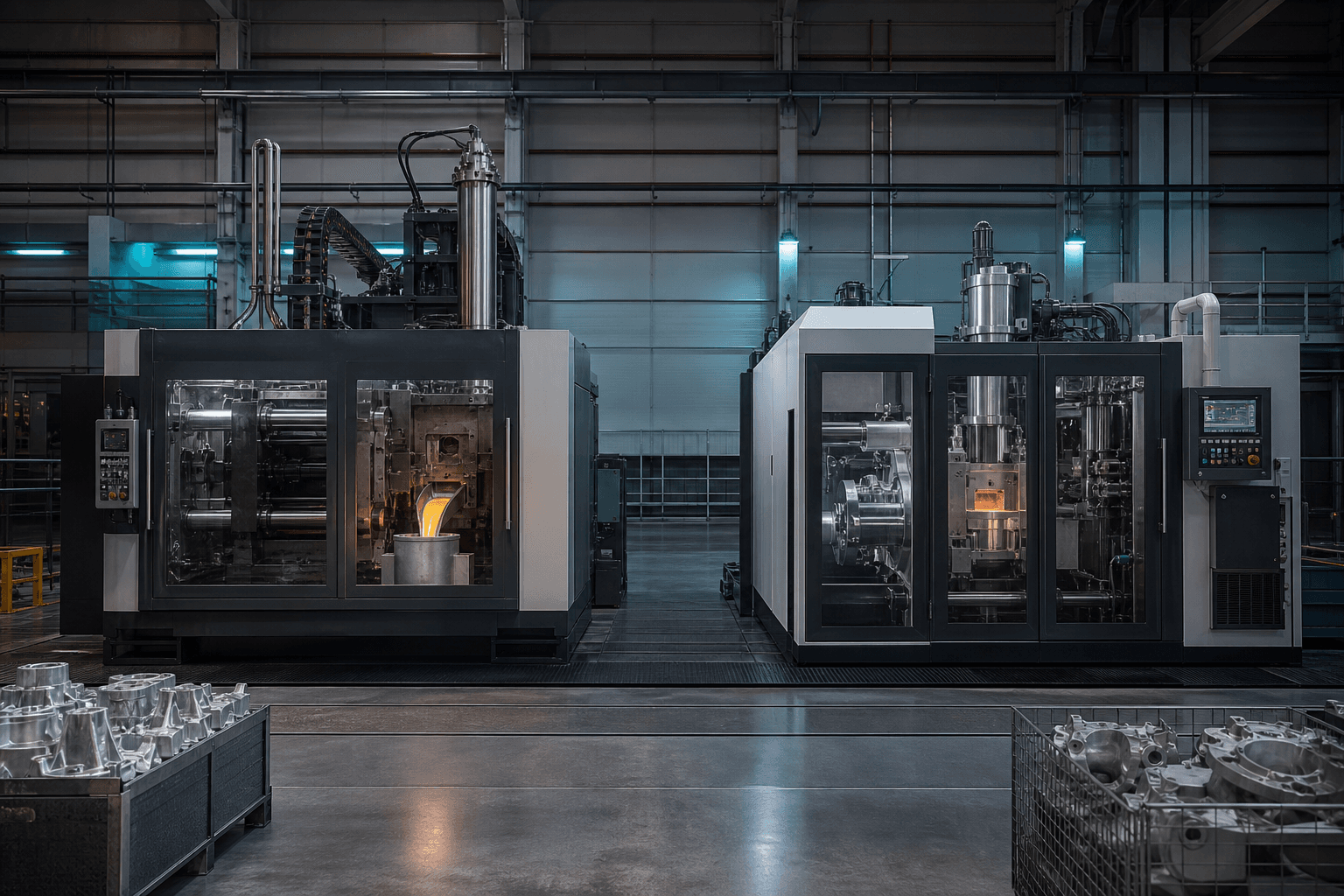
Magnesium alloys can be processed via either hot-chamber or cold-chamber die casting. The fundamental distinction lies not in injection pressure, but in whether the shot system remains continuously immersed in molten metal—and how far the melt must travel from保温 (holding) to mold cavity. Selecting the wrong process commonly results in mismatched cycle times, increased entrapped gas and oxidation, reduced equipment service life, or inability to stably produce large components.
Key Takeaways
| Parameter | Hot-Chamber Die Casting | Cold-Chamber Die Casting |
|---|---|---|
| Melt Transfer | Goose-neck and shot system immersed in melt; short path | Melt quantitatively transferred into shot sleeve prior to injection |
| Cycle Time | Typically faster—ideal for high-volume, small-to-medium parts | Additional transfer steps result in longer cycle times |
| Oxidation & Temperature Drop | Minimal transport reduces fluctuations when well controlled | More sensitive to dosing accuracy, transfer time, and protective gas coverage |
| Part & Clamping Requirements | Commonly used for thin-walled, small-to-medium parts | Better suited for large projected-area or high-mass parts |
| Equipment Maintenance | Focus on goose-neck, nozzle, and melt system integrity | Focus on shot sleeve, plunger, dosing consistency, and transfer repeatability |
There is no universally superior solution. Hot-chamber casting typically offers advantages for small-to-medium, thin-walled parts requiring extremely high volumes—provided alloy and equipment compatibility exists. Cold-chamber casting may be more practical for large structural components, higher shot weights, or facilities already standardized on cold-chamber infrastructure.
Five Critical Questions for Process Selection
First, do the part’s projected area, unit weight, and mold dimensions fall within the equipment’s stable operating window? Second, what are the target alloy’s requirements regarding melt temperature, sedimentation behavior, corrosion resistance, and protective atmosphere? Third, can fill time, gate velocity, and intensification pressure meet demands for the thinnest wall and longest flow path? Fourth, does projected volume justify investment in dedicated equipment, furnaces, and tooling? Fifth, does the supplier demonstrate proven mass production experience—not just matching machine tonnage—with comparable alloy grades, weights, and wall thicknesses?
How to Compare Both Routes During Prototyping
Do not rely solely on cosmetic inspection of individual castings. Establish a unified data sheet tracking melt temperature drop during transfer, melt level stability, injection velocity profile, cavity pressure, vent-end conditions, internal porosity, mechanical properties, and cycle time. For parts requiring hermetic sealing, welding, or heat treatment, further validate pore exposure, blistering risk, and downstream process yield.
Recommended Procurement Specifications
- Alloy grade (e.g., AZ31B, ZK61), scrap ratio, and melt protection method;
- Machine type, clamping force, shot capacity, and single-cavity shot weight;
- Monitoring requirements for slow-speed, fast-speed, intensification, and cavity pressure;
- Mold temperature, melt temperature, transfer time, and melt-level control methodology;
- Sampling rules for X-ray, CT, leak testing, or mechanical property verification;
- Revalidation protocol following replacement of critical wear components (e.g., goose-neck, shot sleeve, plunger).
Does Hot-Chamber Casting Always Yield Lower Porosity Than Cold-Chamber?
Not necessarily. While shorter melt paths reduce thermal loss and oxidation potential, actual porosity remains governed by gating & venting design, injection profile, vacuum application, spray pattern, and mold thermal balance.
To select the optimal die-casting route based on part weight, wall thickness, and annual volume, submit your drawings and demand forecast via Contact Us. Available candidate magnesium alloys are listed in our Product Center.
Sources
https://www.magnesiumtechnology.com/files/mgdiecasting.pdf ASM Handbook, Volume 15 — Casting