Magnesium Alloy LPBF Additive Manufacturing Guide: WE43 Powder, Defects, and Qualification
A technical guide for R&D and procurement teams covering powder handling, combustion risks, elemental evaporation, porosity, anisotropy, post-processing, and part qualification in magnesium alloy laser powder bed fusion (LPBF).
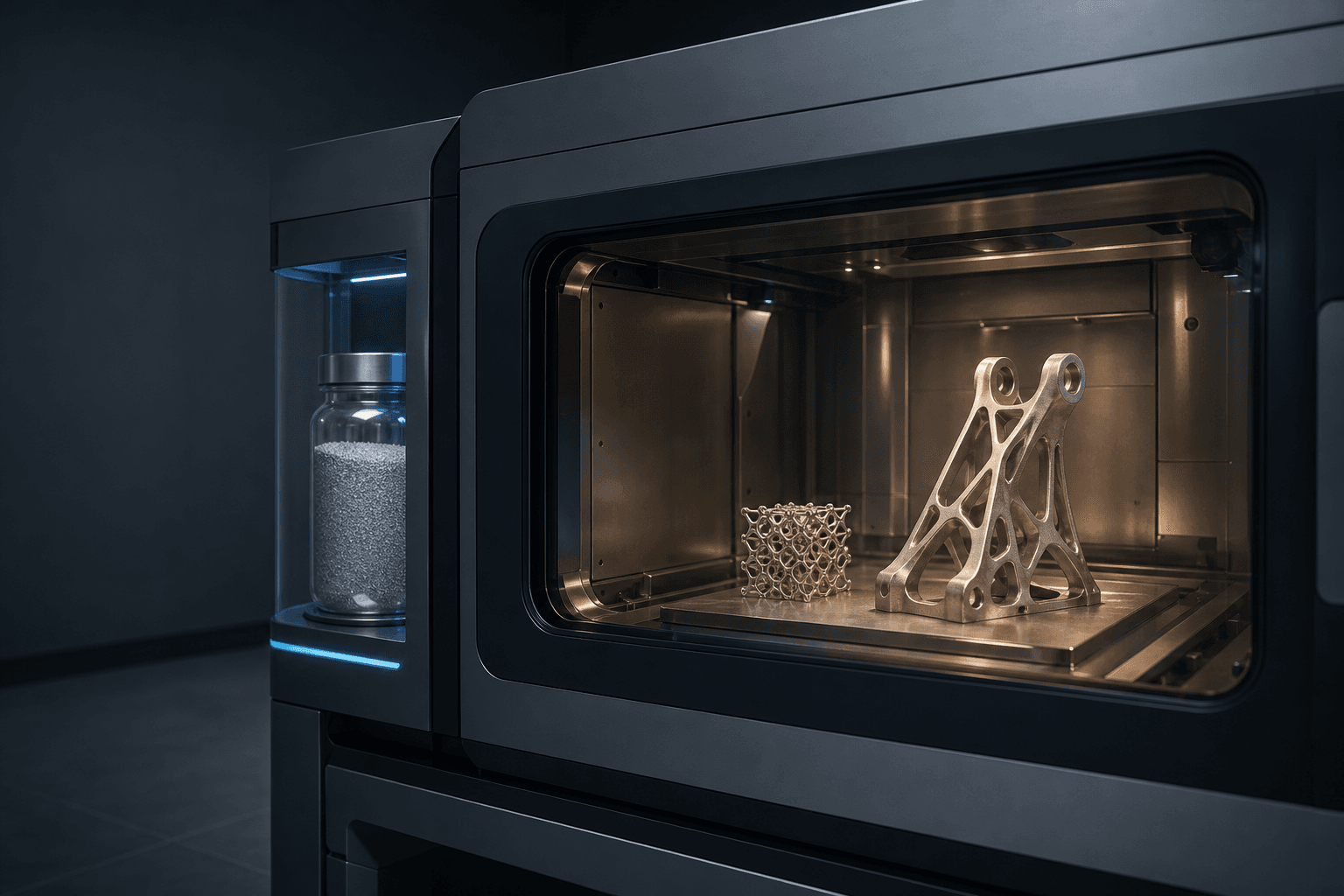
Magnesium alloy laser powder bed fusion (LPBF) enables lightweight internal flow channels, lattice structures, and topology-optimized geometries that are difficult or impossible to produce via conventional manufacturing—yet it remains a high-barrier, specialized AM route. Powder reactivity, elemental evaporation, spatter generation, and defect control mean aluminum alloy printing parameters cannot be directly applied.
Projects Worthy of LPBF Evaluation
LPBF may be justified when annual part volumes are low, geometry is highly complex, internal channels deliver significant functional value, or integrated design substantially reduces assembly and machining steps. If the part is a simple solid block—or can be efficiently produced from plate, forgings, or CNC machining—printing is typically not the lowest-risk solution.
Why WE43 Is Frequently Discussed
Rare-earth-containing magnesium alloys such as WE43 offer high performance potential and have accumulated substantial data in aerospace and biomedical research, making them common candidates for LPBF studies. However, alloy designation does not guarantee consistent printability; powder particle size distribution, oxygen content, batch-to-batch variability, equipment configuration, and heat treatment all critically influence outcomes.
Four Core Risk Categories
- Powder Safety: Fine magnesium powder exhibits high reactivity; storage, sieving, recycling, inert atmosphere management, and fire suppression must follow dedicated risk assessments;
- Elemental Evaporation & Spatter: High energy input may alter composition and contaminate optics or the powder spreading zone;
- Porosity & Lack-of-Fusion: Energy density, scan strategy, layer thickness, and powder condition collectively determine defect formation;
- Residual Stress & Anisotropy: Build orientation, support structure design, thermal history, and post-processing affect dimensional accuracy and fatigue performance.
Qualification Should Be Structured in Three Tiers
- Equipment Tier: Verify inert atmosphere integrity, real-time oxygen monitoring, recoater performance, and system calibration;
- Material Tier: Validate powder chemistry, particle size distribution, morphology, flowability, oxygen content, and reuse rules;
- Part Tier: Confirm build orientation, support strategy, heat treatment, powder removal, surface finish, CT scanning, dimensional inspection, and mechanical performance.
For load-bearing components, standard tensile test coupons alone are insufficient. Witness specimens must be built in the same batch and orientation as the production part—and fatigue evaluation must account for surface roughness, notch effects, internal channel geometry, and post-processing impacts.
Procurement Inquiry Checklist
- Powder supply batch traceability and maximum reuse cycles;
- Equipment oxygen level logs and records of unplanned shutdowns;
- Parameter sets validated for target wall thicknesses and build orientations;
- Heat treatment, hot isostatic pressing (HIP), or surface finishing protocols;
- CT resolution, defect detection thresholds, and witness specimen placement;
- Powder removal methodology, cleaning validation, and enclosed cavity inspection;
- Change control procedures and rules for transferring builds to secondary equipment.
Frequently Asked Questions
Can cast material property data be used directly for printed parts?
No. Microstructure, defect population, directional properties, and surface condition differ significantly. Only validated AM-specific material data should be used for engineering design and qualification.
To evaluate magnesium alloy additive manufacturing or alternative processes, submit your part model and target performance requirements via Contact Us, and review material capabilities in our Product Center.
Sources
ISO/ASTM 52920 — Additive Manufacturing Qualification Principles ISO/ASTM 52907 — Feedstock Materials Characterization