How Do Magnesium Alloys and Plastics Achieve Integrated Molding?
Covers mechanical interlocking, surface microstructure design, thermal expansion matching, in-mold positioning, sealing, moisture management, and galvanic corrosion mitigation for magnesium-alloy insert molding with engineering plastics.
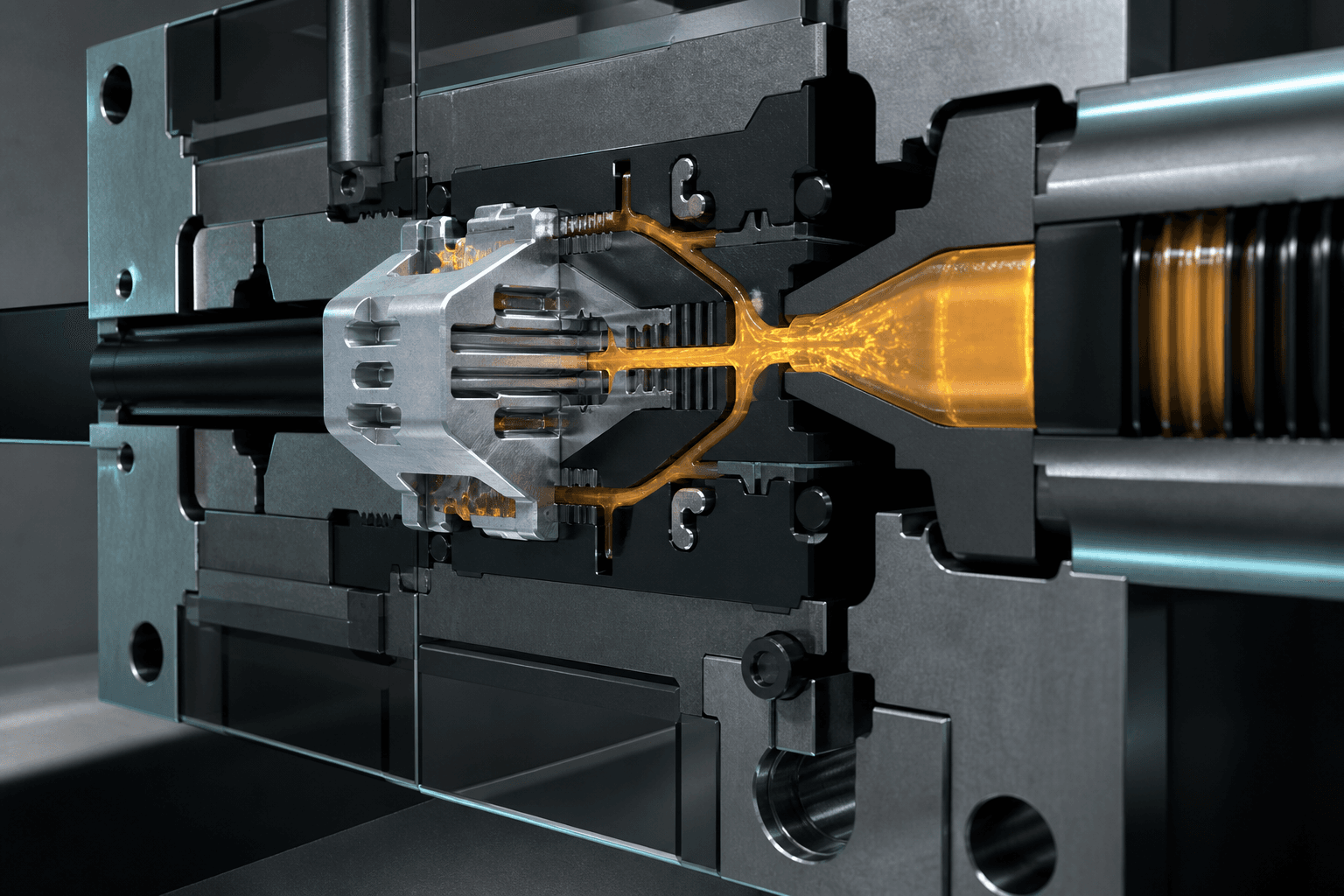
Magnesium alloys and engineering plastics can be integrated into lightweight, highly functional components via insert molding or overmolding—yet plastics do not inherently bond strongly to magnesium. Reliable adhesion typically relies on mechanical interlocking, controlled surface topography, adhesive primers, or a combination of mechanisms—while simultaneously addressing thermal expansion mismatch, injection pressure effects, and long-term humid-thermal exposure.
Four Common Bonding Strategies
| Method | Principle | Key Design Considerations |
|---|---|---|
| Holes, grooves, undercuts | Plastic flows through or encapsulates metal to create mechanical interlock | Flow behavior, structural strength, demolding, and stress concentration |
| Laser/chemical microstructuring | Molten plastic fills fine surface recesses for mechanical anchoring | Surface cleanliness, microstructure uniformity, and corrosion protection |
| Primer or adhesive promotion | Enhances chemical bonding at the interface | Process durability, humid-thermal resistance, and material compatibility |
| Hybrid structure | Macro-scale interlocking plus interfacial adhesion | Failure redundancy vs. manufacturing complexity trade-off |
What Challenges Does a Magnesium Insert Face In-Mold?
Injection pressure may deform or displace thin-walled magnesium parts; high melt temperature and repeated mold cycling induce thermal stress; and polymer shrinkage upon cooling can generate sustained clamping or peeling loads. Locating pins, support surfaces, and gate orientation must avoid subjecting the magnesium insert to unnecessary impact or distortion.
Moisture Management at the Interface Cannot Be Overlooked
Plastic hygroscopicity, capillary pathways at the interface, and thermal cycling may transport moisture to the magnesium surface. If steel or copper inserts are nearby, electrolytes can accelerate galvanic corrosion. Continuous sealing, compatible coatings, drainage paths, and controlled dissimilar-metal contact must prevent moisture entrapment within the interface.
Validation Roadmap
Begin with baseline interfacial shear, pull-out, or peel strength testing—then conduct thermal cycling (low/high temp), damp heat, salt spray/cyclic corrosion, immersion in relevant media, and vibration testing, followed by post-test re-evaluation. Use CT scanning, cross-sectioning, or dye-penetrant inspection to verify complete plastic fill in undercuts, detect interfacial voids, and assess magnesium part deformation induced by molding.
Pre-Mold Checklist
- Compatibility among magnesium alloy, coating system, and plastic melt temperature;
- Interlock geometry enabling full cavity fill and adequate venting;
- Error-proof, auto-detectable magnesium insert positioning;
- Thermal expansion mismatch and polymer shrinkage incorporated into GD&T analysis;
- Completeness of interface sealing, drainage provisions, and dissimilar-metal isolation;
- Rework, disassembly, and recyclability pathways considered early in design.
Is Pull-Out Strength Testing Alone Sufficient for Release?
No. Real-world failure modes include peeling, torsion, fatigue, thermal cycling-induced debonding, or interfacial corrosion. Test protocols must replicate service loads and environmental conditions.
For review of Mg–polymer hybrid structures, submit your plastic grade, molding temperature, and interface load requirements via Contact Us. See available magnesium alloy forms in our Product Center.
Sources
https://publica.fraunhofer.de/entities/publication/dcd9486d-3218-4c09-a9e8-f0e696b99596 ISO 19095 — Plastics — Evaluation of the Adhesion Interface Performance in Plastic-Metal Assemblies