How to Achieve SF₆-Free Melting of Magnesium Alloys: Cover Gas Selection and Retrofit Validation
Explains why magnesium melts require protection, compares SF₆-free cover gas and flux-based approaches, and details retrofit validation methods—covering gas blending, distribution, temperature control, off-gas management, safety, and cast quality.
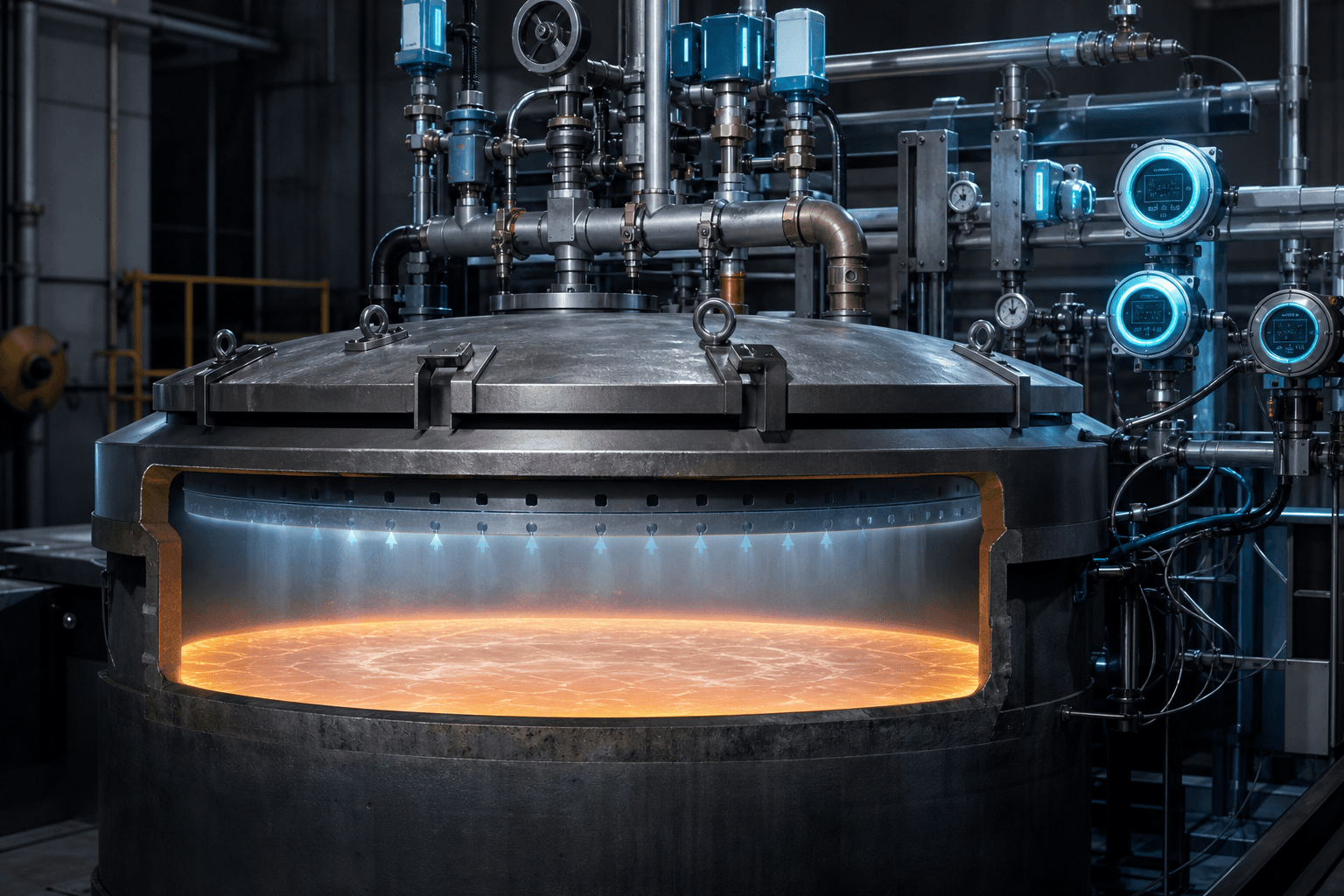
Molten magnesium rapidly oxidizes upon contact with air; therefore, reliable protection is essential during melting, holding, and transfer. SF₆ was historically favored for its stability and ease of use—but its extreme global warming potential has driven the industry to seek alternatives. SF₆-free retrofitting cannot be accomplished by simply swapping gas cylinders: active gas selection, carrier gas specification, blend concentration, cover gas distribution, furnace lid sealing, temperature window, and off-gas management must all be jointly validated.
Understanding Available Technical Routes
| Route | Characteristics | Key Risks |
|---|---|---|
| Diluted SO₂ Systems | Widely deployed industrially; forms a protective film | Corrosivity, occupational health hazards, leakage, and off-gas treatment |
| Fluorine-Containing Alternatives + Carrier Gas | Used at low concentrations to reduce SF₆ emissions | Thermal decomposition products, precise concentration/distribution control, supply variability |
| Flux-Based Covering/Refining | Simultaneously aids inclusion control | Flux inclusions, fume generation, equipment corrosion, and waste disposal |
| Hybrid Process | Segment-specific optimization for melting, holding, and transfer | System complexity; switching logic and emergency protocols must be unambiguous |
Specific medium selection must be grounded in local regulatory requirements, up-to-date supplier Safety Data Sheets (SDS), and site-specific risk assessments. Products listed in historical literature may no longer be commercially available—or suitable—for all regions today.
Where Retrofit Projects Most Commonly Fail
Alternative media are typically more sensitive than SF₆ to concentration, carrier gas dew point, and distribution uniformity. Supplying gas from only one side of the furnace lid can create localized oxidation or even combustion points on the opposite side; excessive lid leakage may render increased flow rates ineffective. Changes in melt temperature, bath level, and lid-opening operations all dynamically alter required protection conditions.
A Verifiable, Audit-Ready Validation Protocol
First calibrate gas blending and flow rates under both cold and hot (no-load) conditions. Then validate across varying bath levels, alloy grades (e.g., AZ31B, ZK61), and worst-case lid-opening scenarios. Record gas concentration, flow rate, pressure, dew point, melt temperature, oxide dross yield, and fume characteristics. Concurrently compare casting quality metrics—including inclusion content, porosity, surface finish, compositional loss, and mechanical properties. Alarm response, backup gas supply, ventilation, leak detection, and power-failure protocols must also be fully exercised.
Procurement & EHS Checklist
- Approved active media, carrier gases, and permissible concentration windows;
- Gas blending equipment accuracy, calibration, and anti-misconnection safeguards;
- Distribution and flow verification per furnace station and transfer point;
- Safety Data Sheets, thermal decomposition products, and occupational exposure controls;
- Baseline oxide dross rate, metal loss, and casting quality KPIs;
- Gas inventory management, alarm systems, emergency response, and change control.
Is SF₆-Free Always Safer and More Sustainable?
Not necessarily—focus on GWP alone is insufficient. Alternative systems may introduce toxicity, corrosivity, or hazardous decomposition byproducts; full-cycle EHS and life-cycle assessments are mandatory.
To develop a customized SF₆-free melting validation checklist, submit your furnace type, alloy grades, and current gas supply configuration via Contact Us. Product specifications are available in the Product Center.
Sources
https://www.epa.gov/sites/default/files/2016-02/documents/magbrochure_english.pdf https://nepis.epa.gov/Exe/ZyPURL.cgi?Dockey=P1008OEL.TXT