How to Choose Between Magnesium Alloy Squeeze Casting, Gravity Casting, and High-Pressure Die Casting?
A comparative analysis of squeeze casting, gravity casting, and high-pressure die casting for magnesium alloys—covering porosity, wall thickness, heat treatment compatibility, mechanical properties, dimensional accuracy, tooling, cycle time, and production volume.
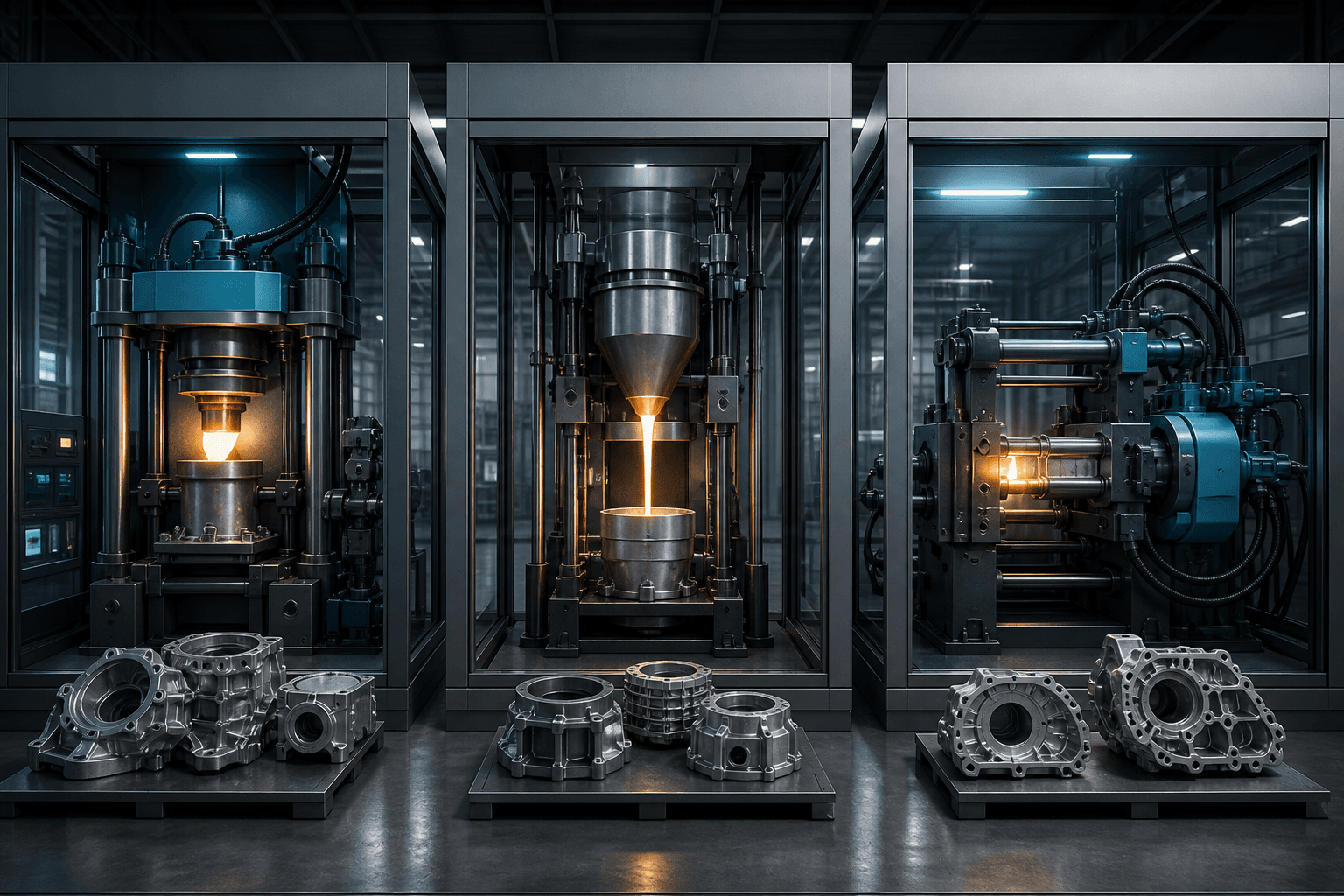
Squeeze casting, gravity casting, and high-pressure die casting (HPDC) can all produce magnesium alloy components—but they differ fundamentally in mold filling and solidification mechanisms. Process selection must be driven by internal quality, geometry, production volume, and downstream heat treatment requirements—not merely unit cost or surface finish.
Core Differences Among the Three Processes
| Process | Key Advantages | Key Limitations | Typical Application Areas |
|---|---|---|---|
| Gravity Casting | Relatively simple equipment and tooling; suitable for complex internal structures and low-to-medium volumes | Slow cycle time; dimensions and surfaces typically require more secondary machining | Aerospace, prototyping, thick-walled or geometrically complex castings |
| Squeeze Casting | Applied pressure during solidification reduces porosity and improves density and heat-treatability | High demands on tooling design and process window control; limited geometric freedom | High-integrity load-bearing components |
| High-Pressure Die Casting | Excellent for thin walls, dimensional precision, surface quality, and high-volume efficiency | High risk of gas entrapment; conventional parts face limitations in heat treatment and welding | Housings, brackets, and high-volume thin-walled components |
Eliminate Unsuitable Routes Using Functional Requirements First
If the part requires high-temperature solution heat treatment, welding, or high ductility, prioritize high-integrity, low-porosity processes. If annual volume is high, wall thickness is thin, part integration is extensive, and dimensional accuracy and cycle time are primary concerns, HPDC offers stronger competitiveness. If production volume is low, geometry is complex, or flexible gating/risering is needed, gravity casting may be more appropriate.
“Density” Must Be Verified with Data
Squeeze casting does not guarantee pore-free microstructure; gravity casting does not inherently yield inferior performance. Melt cleanliness, temperature control, mold thermal balance, pressure timing, feeding path design, and sampling location all significantly influence outcomes. Compare CT/radiography, density, metallography, tensile strength, fatigue life, and post-heat-treatment dimensional stability in critical regions—rather than relying solely on process names.
Building a Valid Cost Model
Account for tooling, equipment cycle time, material yield, trimming and machining, heat treatment, inspection, scrap, and rework. High-integrity processes incur higher per-tool costs but may reduce downstream impregnation, machining-induced porosity exposure, and performance screening. HPDC tooling investment is substantial—but amortized effectively over high volumes.
Request-for-Quotation Checklist
- Target alloy grade (e.g., AZ31B, ZK61), temper condition, critical regions, and loading requirements;
- Annual volume, total lifetime quantity, and acceptable tooling investment;
- Minimum wall thickness, overall dimensions, dimensional tolerances, and surface finish requirements;
- Heat treatment, welding, leak-tightness, and machining depth specifications;
- Internal quality acceptance level, sampling orientation, and minimum mechanical property thresholds;
- Differences between prototype and production processes—and revalidation plan.
Can Gravity-Cast Prototypes Validate HPDC Production?
Only partial validation of geometry and assembly fit is possible. Microstructure, porosity distribution, surface layer characteristics, dimensional behavior, and mechanical property profiles differ significantly. Critical conclusions must be verified using near-production processes.
For a comprehensive technical and cost comparison across these three casting routes, submit your drawings and volume requirements via Contact Us; candidate alloys are listed in our Product Center.
Sources
https://doi.org/10.1016/j.jma.2013.02.002 https://saemobilus.sae.org/papers/2005-01-0330