How to Evaluate Magnesium Alloy Vacuum Die Casting: Vacuum Curves, Porosity, and Heat Treatment Validation
Defines the operational boundaries of magnesium alloy vacuum die casting and outlines verification protocols for vacuum initiation, valve response, leakage, porosity, heat treatment blistering, and structural component release.
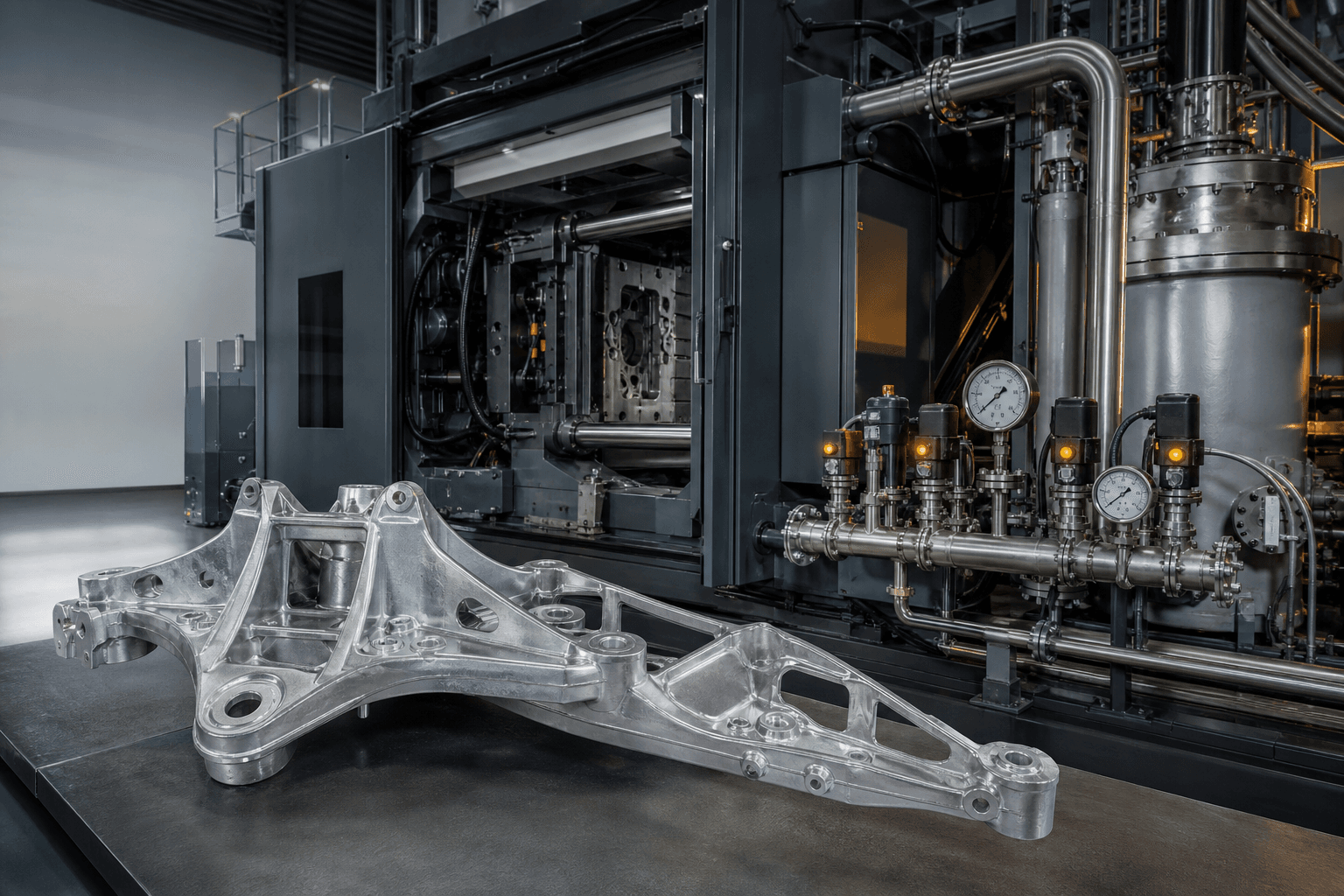
The objective of vacuum die casting is not to achieve the lowest possible cavity pressure reading, but rather to stably evacuate cavity gases before the molten metal front reaches the venting zone—while preventing vacuum channels from being blocked by metal, die lubricant, or leaks. Evaluating a vacuum system requires concurrent analysis of pressure curves, internal casting quality, and final part performance.
Addressing the Core Question First
Vacuum die casting typically reduces entrapped gas, improves hermeticity, and creates better conditions for welding or heat treatment; however, it does not automatically eliminate shrinkage porosity, cold shuts, inclusions, or thermal hot spots caused by non-optimal wall thicknesses. The vacuum system must be co-designed with gating, overflow design, shot profile, and mold thermal balance.
Five Categories of Evidence to Record
- System Status: Vacuum pump capacity, air receiver volume, filter condition, piping volume, and maintenance logs;
- Mold Status: Parting line seal integrity, leakage at ejector pins and slides, vacuum valve functionality, and exhaust channel cleanliness;
- Timing Signals: Vacuum initiation point, valve closure timing, slow-shot and high-speed transition points;
- Pressure Curves: Actual per-shot cavity pressure curves—not just machine-set parameters;
- Result Data: X-ray or CT scans, density measurements, sectioned porosity analysis, leak rate, tensile properties, and blistering after heat treatment.
Why Relying Solely on “Vacuum Level” Leads to Misjudgment
Sensor location, piping volume, and measurement timing all influence readings. A low pressure reading near the pump does not guarantee equivalent conditions at complex cavity extremities prior to metal fill. Correlations must be established between in-mold pressure curves, process repeatability, and casting outcomes—and a statistically validated, monitorable process window must be defined.
Release Criteria for Structural and Sealing Components
Structural components require internal quality grading focused on critical load-bearing zones, verified using test specimens matching actual wall thickness and sampling orientation. Sealing components further demand explicit specification of test medium, pressure, hold time, allowable leak rate, fixture sealing method, and temperature. If subsequent T5, T6, welding, or baking is required, blistering, dimensional change, and joint performance must be integrated into the same validation plan.
Common Failure Modes
- Vacuum valves progressively slowed by splashed metal or die lubricant contamination;
- Leakage at parting lines or slides—yielding seemingly normal curves but poor repeatability;
- Excessive spray application introducing moisture or organics that generate gas during filling;
- Premature high-speed transition causing turbulent metal flow to block exhaust paths;
- Improved gas entrapment mitigation while neglecting shrinkage porosity from thick-section thermal hot spots.
Supplier Documentation Requirements for Procurement
Vacuum system schematic, cavity venting layout, process capability data (Cpk/Ppk), X-ray or CT inspection protocol, leak test MSA, heat treatment validation report, first-article inspection report, and nonconformance response plan. For safety-critical components, isolation and requalification rules must be contractually defined for parameter excursions.
If your project involves evaluating high-hermeticity or heat-treatable magnesium alloy structural components, explore material options in our Product Center and submit target leak rates, loading requirements, and post-processing conditions via Contact Us.
Sources
NADCA Product Specification Standards for Die Castings ASM Handbook, Volume 15 — Casting