How to Select Magnesium Alloy Welding Wire: A Matching Guide for AZ61A, AZ92A, and Rare-Earth Alloys
Compare magnesium alloy welding wires across six dimensions—base material composition, welding process, strength, ductility, corrosion resistance, and service temperature—to clarify why AZ61A, AZ92A, and rare-earth systems (e.g., WE43) are not interchangeable based on strength alone.
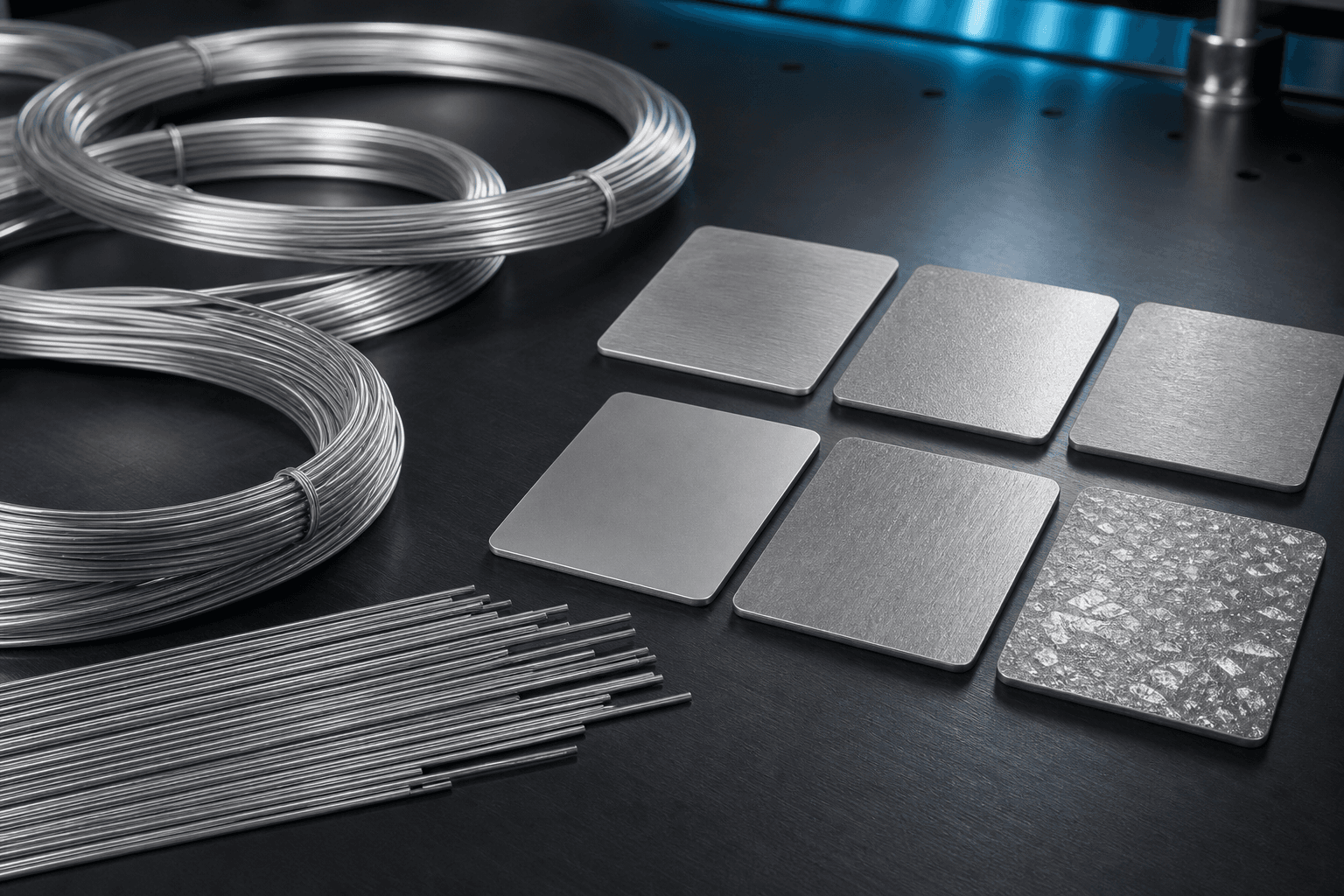
The first principle in selecting magnesium alloy welding wire is compatibility with the confirmed base material system and service requirements—not simply “higher strength is better.” Aluminum–zinc series wires such as AZ61A and AZ92A are commonly used for joining and repairing compatible magnesium alloys; rare-earth magnesium alloys like WE43 typically require dedicated or qualified matching filler metals.
Six Key Selection Dimensions
| Dimension | What to Confirm |
|---|---|
| Base Material Chemical System | Compatibility among Al–Zn, Zn–Zr, RE–Zr, etc. |
| Welding Method | Wire feedability and heat input for GTAW, laser, or other processes |
| Joint Performance | Whether strength, elongation, fatigue life, and hardness meet specifications |
| Cracking Susceptibility | Solidification temperature range, dilution level, and restraint conditions |
| Corrosion Resistance | Electrochemical potential difference between weld and base metal, plus coating system compatibility |
| Temperature & Heat Treatment | Stability of the joint under aging, solution treatment, or service temperatures |
Understanding AZ61A vs. AZ92A
Both are widely used magnesium welding filler materials—but differ in aluminum and zinc content, resulting in distinct behaviors in fluidity, strength, hot cracking susceptibility, and corrosion resistance. Specific matching must be verified against base material specifications, wire standards, and established filler metal selection charts—and validated through procedure qualification. Success with one casting does not justify direct use on forgings or different alloy grades.
Why Rare-Earth Magnesium Alloys Require Special Handling
Alloys such as WE43 rely on specific compositions for their strengthening phases, heat treatment response, and high-temperature performance. Using standard Al–Zn series filler wires may result in mismatched mechanical properties and corrosion behavior; conversely, dedicated rare-earth filler wires demand strict control over supply chain, batch consistency, and post-weld heat treatment. For aerospace or safety-critical joints, approved specifications—not general recommendations—must govern qualification.
Procedure Qualification Must Include
- Batch chemistry and condition of both base material and filler wire;
- Joint preparation, cleaning, shielding gas, preheat, and interpass temperature;
- Current, travel speed, wire feed rate, and heat input range;
- Macro examination, PT/RT, tensile, bend, or fatigue testing;
- Post-weld heat treatment, dimensional checks, and corrosion/environmental validation;
- Dilution rate, plus hardness and microstructure of weld metal and HAZ.
Storage and Handling Also Impact Results
Filler wire must remain clean, dry, and free from contamination by steel, copper, or oils; opening, issuance, and return of unused material must be fully traceable. Cleaning tools must be dedicated; surface oxides and coatings on base material must be removed using approved methods.
Can AZ61A Be Used for Trial Welding When Base Material Is Unknown?
No. An unknown alloy grade introduces unpredictable risks—including cracking, inconsistent performance, corrosion mismatch, and incompatible heat treatment response. Composition identification and risk assessment must precede any trial welding.
For magnesium alloy welding wire selection and joint qualification support, submit your base material certification, structural design, and loading requirements via Contact Us. View available materials in our Product Center.
Sources
https://media.defense.gov/2014/Jun/20/2002655936/-1/-1/1/140620-N-ZZ182-6576.pdf AWS A5.19 — Magnesium-Alloy Welding Electrodes and Rods