Biodegradable Magnesium Orthopedic Implants: Clinical Evidence, Degradation Risks and Regulatory Boundaries
Biodegradable magnesium bone screws have clinical and regulatory evidence for specific devices and indications, but industrial magnesium is not implant-ready. This guide covers degradation, gas evolution, retained strength, biocompatibility and approval boundaries.
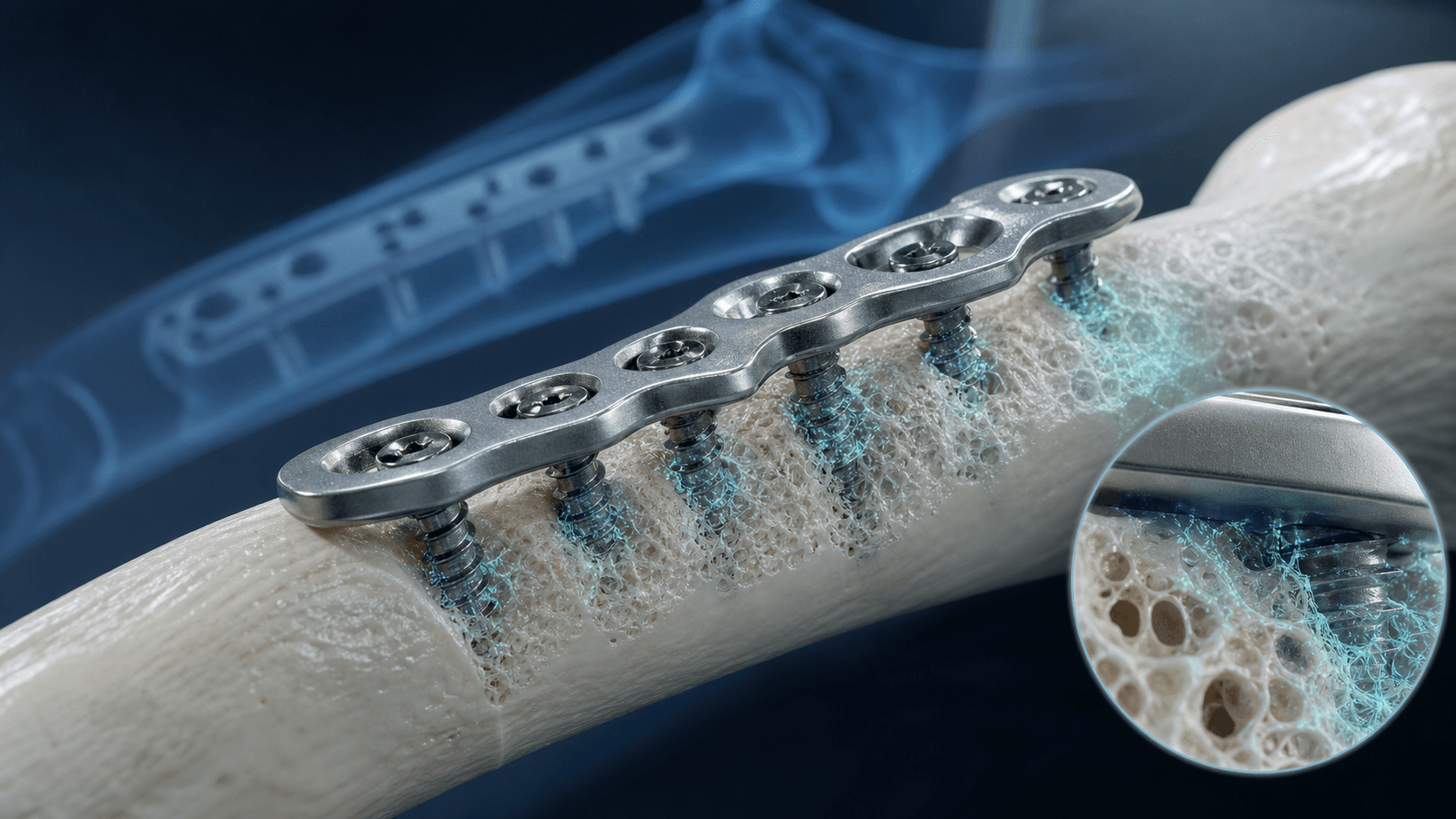
Executive answer
Biodegradable magnesium alloys have moved beyond laboratory-only research: clinical studies and regulator-reviewed bone-fixation devices now exist. However, approval is device-, alloy-, design- and indication-specific. It does not make ordinary industrial magnesium suitable for implantation, and it does not mean all orthopedic implants can safely “disappear.”
This article is an engineering and regulatory overview, not medical advice. Patients and clinicians should rely on the approved labeling and qualified healthcare professionals.
Why use a degradable metal implant?
A temporary fixation device should retain enough mechanical support during healing and then gradually lose mass. Magnesium is attractive because it is metallic during the load-bearing phase and corrodes in physiological conditions.
Potential benefits can include avoiding a removal operation in selected cases and reducing long-term retained hardware. The trade-off is difficult: degradation must not outpace bone healing, create unacceptable gas accumulation, release unsafe constituents or lose fixation prematurely.
Evidence: promising, but indication-specific
A 2013 prospective randomized pilot study enrolled 26 patients undergoing hallux valgus surgery and compared MgYREZr screws with titanium screws over six months. It reported no significant group differences in the measured clinical and radiographic outcomes. This is meaningful early evidence, but the small pilot and specific procedure cannot be generalized to all fractures or load-bearing sites.
A 2016 clinical and multiscale study reported longer-term observations in 53 cases using a Mg–Ca–Zn alloy. Again, the result supports feasibility for a defined system; it is not a universal material approval.
In the United States, FDA's De Novo review for the RemeOs Screw LAG Solid describes an absorbable Mg–Zn–Ca bone-fixation screw for a specified medial-malleolus indication. Its authorization, warnings and prescription-use restrictions apply to that device. They do not authorize generic magnesium stock for medical use.
The central engineering problem: match degradation to healing
Magnesium corrosion can produce magnesium-containing corrosion products and hydrogen gas. A successful implant balances:
- initial strength and fixation stability;
- corrosion rate and spatial uniformity;
- local gas evolution and clearance;
- bone-healing timeline;
- fatigue under physiological loading;
- surface condition and sterilization;
- patient, anatomy and indication-specific risks.
Mass loss, hydrogen evolution and mechanical retention should be measured together. A slow average mass loss can still hide dangerous localized pitting.
Material and surface controls
Medical-grade development requires exact composition and impurity limits, not a commercial alloy name. Alloying additions must be assessed for toxicological exposure as the device degrades. Manufacturing residue, machining fluids, cleaning, passivation or coating, packaging and sterilization all influence the final device.
Coatings may slow early corrosion, but cracking, delamination and changing degradation products must be evaluated over the complete exposure period.
Preclinical and clinical evidence package
A risk-based program can include:
- chemical characterization of the final sterilized device;
- toxicological assessment of alloying elements, impurities and degradation products;
- biological evaluation under ISO 10993-1 within ISO 14971 risk management;
- corrosion, ion release and hydrogen-evolution testing in justified models;
- initial and retained mechanical performance;
- fatigue, insertion torque and pull-out or fixation testing;
- imaging compatibility and artifact characterization where relevant;
- appropriate animal studies;
- clinical evidence for the exact intended use;
- post-market surveillance and follow-up.
The FDA emphasizes evaluating the final finished device, not only the raw material.
Regulatory boundaries
In the EU, an absorbable implant remains an implantable medical device under Regulation (EU) 2017/745 and requires conformity assessment, clinical evaluation and ongoing post-market obligations. In the US, the route depends on device classification and intended use.
A supplier of industrial magnesium cannot claim implant suitability without a controlled medical-device quality system, biocompatibility and toxicology evidence, device-specific performance data, sterilization validation and regulatory authorization.
Buyer and developer checklist
Before sourcing material or a finished component, confirm:
- exact alloy composition and medical-device material specification;
- raw-material and manufacturing-lot traceability;
- impurity, inclusion and microstructure controls;
- validated machining, cleaning and surface processes;
- corrosion uniformity and retained-strength profile;
- degradation-product and gas-management evidence;
- sterilization compatibility and shelf life;
- final-device biological evaluation;
- clinical and regulatory strategy;
- supplier change control and record retention.
Frequently asked questions
Does magnesium simply dissolve harmlessly in the body?
No. Degradation is a controlled corrosion process. Rate, localization, products, gas evolution and tissue response must all be evaluated.
Is every magnesium alloy biocompatible?
No. Composition, impurities, manufacturing residues, surface state, dose and exposure duration matter.
Do magnesium implants eliminate every removal surgery?
No. Whether removal is avoided depends on indication, healing, complications and clinician judgment.
Can Matrix Mg industrial products be implanted?
No such conclusion should be inferred. Implantable-device use requires a separate medical-grade specification, qualified manufacturing system, final-device testing and regulatory authorization.
Takeaway
Biodegradable magnesium is a real medical-device platform, not a generic material promise. Progress is strongest where a specific alloy, device geometry, degradation profile and clinical indication are developed and regulated as one system.
Sources
https://www.accessdata.fda.gov/cdrh_docs/reviews/DEN220030.pdf https://www.fda.gov/medical-devices/products-and-medical-procedures/safety-metals-and-other-materials-used-medical-devices https://www.iso.org/standard/10993-1 https://eur-lex.europa.eu/legal-content/EN/ALL/?uri=CELEX:32017R0745 https://pubmed.ncbi.nlm.nih.gov/23819489/ https://pubmed.ncbi.nlm.nih.gov/26729859/