Magnesium Manufacturing Processes: Die Casting, Extrusion, Rolling, Forging and Machining Guide
Select magnesium manufacturing by geometry, volume, properties and service environment. This buyer guide compares die casting, mold casting, extrusion, rolling, forging, machining, joining and surface treatment.
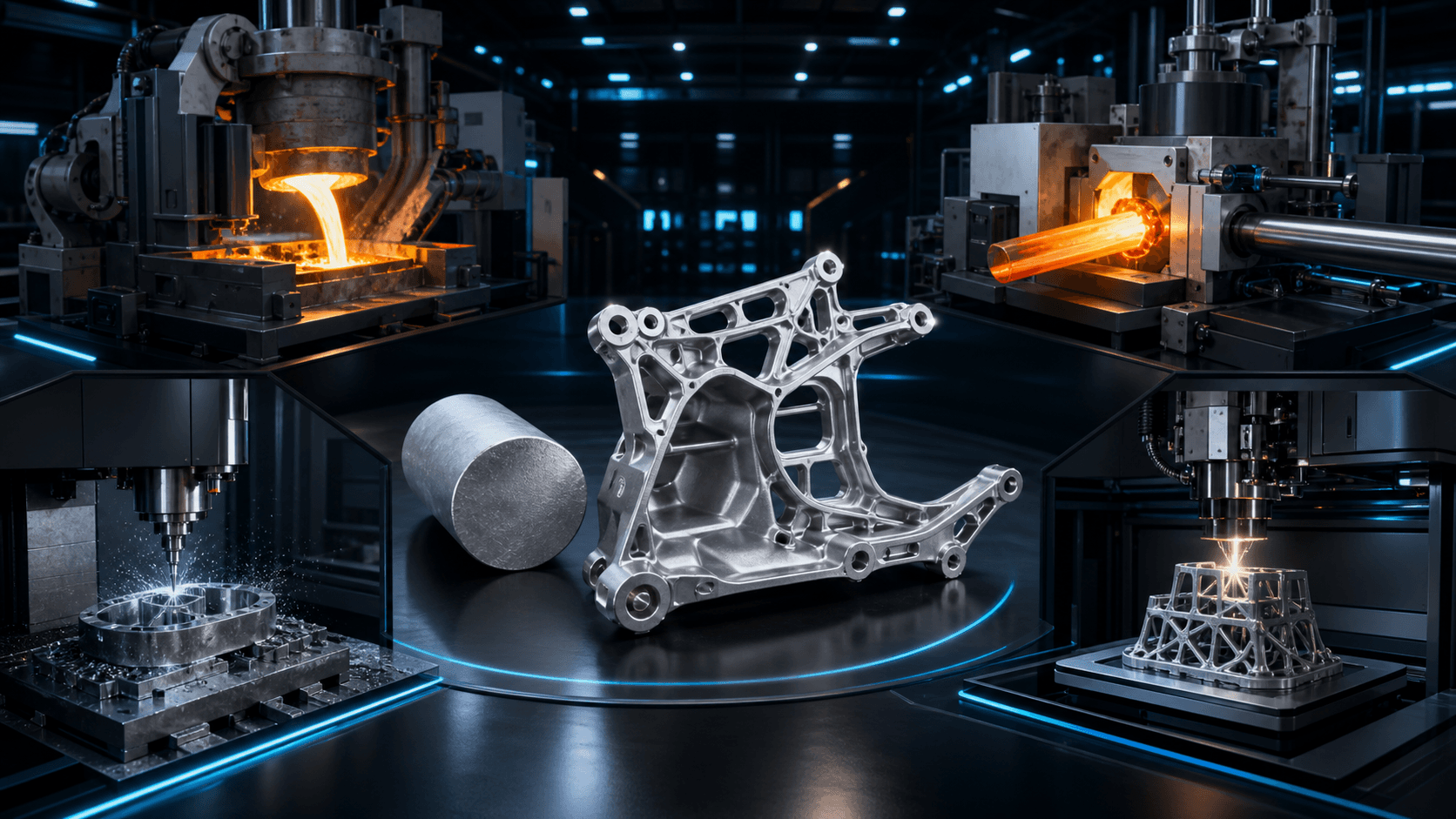
Executive answer
There is no single “best” magnesium manufacturing process. The correct route follows geometry, volume, mechanical-property direction, temperature, surface requirement, inspection level and total cost.
Choose the product form and process together. A casting alloy is not automatically suitable for sheet forming; a wrought alloy qualified for extrusion cannot be assumed to perform identically after welding or die casting.
Process selection table
| Process | Best suited to | Main strengths | Main controls |
|---|---|---|---|
| High-pressure die casting | high-volume thin-wall housings and integrated structures | fast cycle, complex shape, part consolidation | melt protection, vacuum, die heat balance, porosity |
| Sand/permanent-mold casting | larger, lower-volume or thicker components | tooling flexibility, broad geometry | feeding, shrinkage, inclusions, heat treatment, NDT |
| Extrusion | profiles, rails, tubes and frame members | efficient constant cross-section, directional properties | billet quality, temperature, speed, texture, straightness |
| Rolling | sheet and plate | thin products, panels and machined plate | texture, temperature, thickness, flatness, anisotropy |
| Forging | highly loaded compact parts | refined flow and high integrity | forging temperature, die fill, laps, heat treatment |
| Machining | precision features and low-volume billets/castings | close tolerance, good machinability | chips/dust, heat, tool condition, distortion |
| Joining | assemblies and hybrid structures | enables system integration | alloy/process match, heat effects, galvanic design |
| Surface treatment | all corrosion/cosmetic applications | protection and appearance | cleaning, pretreatment, coverage, adhesion, repair |
High-pressure die casting
HPDC is widely used for electronics, power tools and automotive parts. Its value comes from thin walls and integrated ribs or bosses. Critical variables include metal cleanliness, protective atmosphere, transfer, die temperature, vacuum, venting, shot profile and local solidification.
Specify critical-zone properties and inspection rather than relying only on separately cast test bars.
Sand and permanent-mold casting
These routes suit larger or lower-volume shapes and alloys requiring different thermal histories. Design feeding and risers around shrinkage; control inclusions, oxide films and heat treatment. Radiography, CT, penetrant inspection or destructive sectioning may be appropriate depending on structural significance.
Extrusion
Extrusion creates profiles and tubes for frames, rails and heat-management structures. Properties depend on alloy, billet homogenization, extrusion ratio, temperature, speed, cooling, aging and orientation.
Buyers should define cross-section tolerance, twist, straightness, surface quality and mechanical-property direction. Validate joining and coating on the delivered temper.
Sheet and plate rolling
Rolling produces thin sheet for formed panels and plate for machined structures. Magnesium texture causes directional behavior and can limit room-temperature forming. Warm forming, suitable alloys and grain/texture control can expand the window.
Specify thickness tolerance, flatness, surface, ultrasonic requirements if applicable, tensile direction and forming condition.
Forging
Forging can produce high-integrity wheels, brackets or aerospace-type components when the business case supports tooling. Process design must control temperature, strain path, die fill, laps, grain flow and heat treatment. Qualification should include representative sections, not only billet certificates.
Machining and chip safety
Magnesium machines efficiently, but fine chips and dust are combustible-metal hazards. Use a documented process for extraction, housekeeping, segregation, coolant or dry-machining strategy, storage and approved extinguishing media. Do not mix magnesium fines with incompatible scrap streams.
Dimensional plans should account for casting residual stress and distortion after material removal.
Joining
Options can include mechanical fastening, inserts, adhesives, friction-stir or fusion processes where qualified. Welding response depends on alloy and product form. Validate heat-affected properties, porosity, distortion, fatigue and coating restoration.
Map galvanic contacts and isolate dissimilar materials where needed.
Surface treatment
Corrosion protection is a system: alloy purity, cleaning, conversion or anodic layer, primer, topcoat, sealant, edge coverage and repair. Validate the actual production sequence after forming, machining and joining.
Salt spray is a consistency tool, not a complete service-life prediction.
Supplier evidence checklist
Request:
- exact alloy and governing material standard;
- raw-material and lot traceability;
- process route, temper and heat treatment;
- chemistry and impurity limits;
- mechanical properties by direction and location;
- dimensional capability and measurement method;
- NDT and acceptance criteria;
- surface-treatment control plan;
- chip, dust and melt-safety controls;
- change notification and requalification rules.
Frequently asked questions
Which process is cheapest?
It depends on annual volume, geometry, tooling, yield, machining and finishing. Compare total landed component cost.
Is die casting always weaker than wrought magnesium?
No universal ranking is valid. Compare exact alloys, defects, direction, temperature and design allowables.
Can magnesium be welded?
Some alloy/process combinations can be welded successfully. Qualification must cover joint properties, distortion and corrosion restoration.
What should be frozen first?
Freeze functional requirements and service environment first; then select alloy, product form and process as one system.
Buyer takeaway
A reliable magnesium component starts with process-aware design and ends with controlled evidence. Select the manufacturing route by the required function, then qualify the complete process chain from metal to coating.
Sources
ASTM B94 Magnesium-Alloy Die Castings ASTM B80 Magnesium-Alloy Sand Castings ASTM B107/B107M Magnesium-Alloy Extruded Bars, Rods, Profiles, Tubes, and Wire ASTM B90/B90M Magnesium-Alloy Sheet and Plate ASTM B91/B91M Magnesium-Alloy Forgings ISO 16220 Magnesium and magnesium alloys — Magnesium alloy ingots and castings NFPA 484 Standard for Combustible Metals