Magnesium for eVTOL and Humanoid Robots: Validation Guide
eVTOL aircraft and humanoid robots are both mass-sensitive, but public evidence does not support claiming broad magnesium adoption. This guide explains where magnesium may be screened and how to validate airworthiness, fatigue, corrosion, fire, impact, thermal and service requirements.
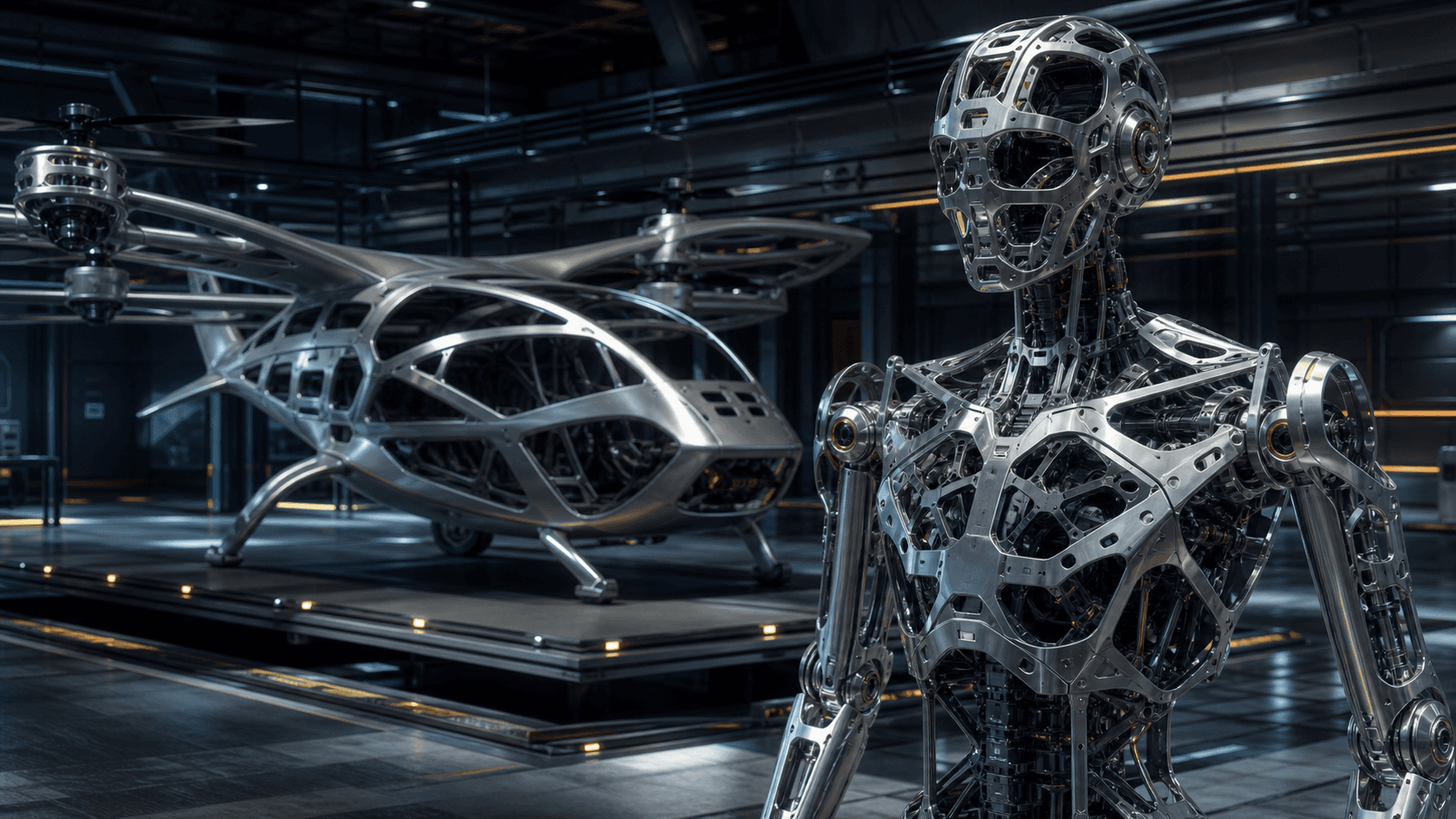
Why do eVTOL aircraft and humanoid robots care about mass?
Both platforms are mass-sensitive, but for different reasons. In eVTOL aircraft, mass affects hover power, mission energy, payload and reserve. In a humanoid robot, mass far from a joint increases rotational inertia and actuator demand.
Magnesium may be screened for housings, brackets, seats, joint or gearbox housings and secondary frames. However, current public primary evidence does not justify saying that mainstream eVTOL aircraft or production humanoids widely use magnesium. The correct framing is “candidate material plus validation route,” not a guaranteed market boom.
eVTOL: reduce installed mass, not just material density
Aircraft trade studies must use installed system mass. A lighter component may require:
- protective coatings;
- inserts and fasteners;
- galvanic isolation;
- local reinforcement;
- inspection access;
- fire barriers;
- repair provisions.
There is no universal answer to “how much range does one kilogram save?” Configuration, rotor disk loading, mission, reserve, pack specific energy and control strategy determine the result. Use an aircraft-level sensitivity model.
Where magnesium may be screened in eVTOL
| Candidate area | Potential value | Main qualification |
|---|---|---|
| Seat structures and cabin brackets | Payload and empty-mass reduction | Occupant loads, fatigue, flammability and crash |
| Avionics or electronics housings | Integrated geometry, EMI shielding and heat paths | Thermal, sealing, corrosion, grounding and fire zone |
| Gearbox, motor or actuator housings | Complex interfaces and mass reduction | Bearing alignment, fatigue, creep, lubrication and fire exposure |
| Secondary frames and access panels | Part consolidation | Damage tolerance, corrosion, lightning/grounding as applicable |
| Primary flight structure | Potential high value | Highest airworthiness, fatigue, damage-tolerance and inspection burden |
FAA research on specific magnesium aircraft-seat alloys and configurations shows that defined materials can be tested successfully. It does not certify every alloy, wall thickness, component or aircraft fire zone.
Powered-lift certification must follow the applicable FAA or EASA basis and approved means of compliance. A material supplier cannot replace the aircraft applicant’s substantiation.
Humanoid robots: mass location matters
Reducing distal limb mass can reduce joint inertia, but the benefit depends on motion speed, payload, gearing, control and duty cycle. Candidate parts include:
- arm and leg housings;
- joint brackets;
- motor and gearbox housings;
- pelvis or torso frames;
- battery and controller enclosures.
Bearing seats, wear surfaces, repeatedly serviced threads and high-temperature interfaces may require inserts or another material. A metal housing can provide integrated ribs, bearing interfaces, threads, EMI shielding and thermal paths that are difficult to combine in a pure CFRP design.
What must a humanoid part survive?
Robots can experience repeated acceleration, torsional reversals, vibration, falls and collisions. Validation should include:
- representative joint load spectrum;
- fatigue and backlash growth;
- fall and impact directions;
- fastener and insert pull-out;
- bearing-seat stability;
- motor and gearbox temperature;
- coating wear and sweat/cleaning-fluid exposure;
- cable and grounding interfaces;
- repair and repeated disassembly;
- human-contact and pinch-risk controls.
Lower mass can reduce impact energy at a given velocity, but it does not automatically make a robot safer or more drop-resistant.
Magnesium vs CFRP for moving structures
CFRP may provide superior directional stiffness-to-weight when the load path is clear. Magnesium may be more attractive when the part needs complex integrated geometry, metal threads, bearing seats, EMI shielding, thermal conduction and high-volume casting.
The best architecture may be hybrid. Carbon-fiber members can carry directional loads while magnesium provides joints or housings. Such interfaces require galvanic isolation, sealing and thermal-expansion analysis.
Corrosion and fire are system requirements
For eVTOL, consider humidity, salt, fluids, dissimilar metals, electrical grounding, battery zones and post-crash fire. For robots, consider indoor cleaning agents, outdoor moisture, hand contact, scratches and mixed-metal joints.
Fire performance depends on the exact alloy, geometry, surface condition, location and test. Do not transfer a successful aircraft-seat test to a propulsion or battery fire zone.
Qualification matrix
eVTOL
- limit and ultimate loads;
- fatigue and damage tolerance;
- crash and occupant protection where applicable;
- corrosion and coating damage;
- flammability/fire-zone compliance;
- vibration, thermal and electrical grounding;
- manufacturing defects and NDT;
- approved repairs and continued airworthiness.
Humanoid robot
- torque, bending and combined joint loads;
- repeated duty-cycle fatigue;
- fall, collision and abuse testing;
- thermal paths and surface temperature;
- insert, thread and bearing durability;
- corrosion and coating wear;
- acoustic/NVH and dimensional stability;
- service-cycle and replacement procedures.
Matrix Mg’s magnesium die-casting parts page can support an early design-for-manufacture discussion. It does not prove airworthiness or robot durability.
Frequently asked questions
How much eVTOL range does saving one kilogram add?
There is no universal number. Use the specific aircraft configuration, mission, reserve, rotor and battery-pack model.
Can magnesium meet aviation fire requirements?
Specific alloys and seat configurations have passed FAA-developed tests. Compliance is alloy-, geometry-, location- and test-specific.
Why not make a humanoid robot entirely from CFRP?
CFRP is valuable for directional structures, but metals can integrate ribs, bearing seats, threads, EMI/thermal paths and cast geometry. Selection is part-specific.
Does magnesium make a robot safer when it falls?
Lower mass may reduce kinetic energy at the same speed, but injury and part durability depend on velocity, geometry, contact surface, joints, control response and failure mode.
Procurement checklist
- exact alloy, process and coating;
- load spectrum and thermal map;
- mass saved at component—not material—level;
- joints, inserts and galvanic isolation;
- casting defect and NDT criteria;
- fatigue, impact and corrosion tests;
- fire or airworthiness compliance basis where applicable;
- repair, inspection and replacement plan;
- supplier process control and change notification.
Conclusion
eVTOL and humanoid robots create credible lightweighting opportunities, but not automatic magnesium demand. The strongest engineering case starts with system mass sensitivity, selects a suitable candidate part and validates the complete alloy/process/geometry/joint/coating system. Avoid market-size forecasts and adoption claims that lack primary evidence.
This article is a material-screening guide, not an airworthiness approval, robot safety assessment or substitute for component qualification.
Sources
NASA, eVTOL Public Services White Paper — https://ntrs.nasa.gov/api/citations/20205000636/downloads/2021-08-20-eVTOL-White-Paper-Final_V48.pdf Sripad and Viswanathan, Performance Metrics Required of Next-Generation Batteries to Make a Practical Electric Semi Truck — https://doi.org/10.1073/pnas.2111164118 FAA, AC 21.17-4 Type Certification—Powered-lift — https://www.faa.gov/regulations_policies/advisory_circulars/index.cfm/go/document.information/documentID/1044836 FAA, Evaluating the Flammability of Various Magnesium Alloys During Laboratory- and Full-Scale Aircraft Fire Tests — https://downloads.regulations.gov/FAA-2019-0491-0014/attachment_1.pdf ISO, Robotics standards overview — https://www.iso.org/cms/live/live/en/sites/isoorg/home/sectors/engineering/robotics.html