Magnesium for Drones and eVTOL: Component Selection and Flight Qualification Guide
Magnesium can reduce payload and moving mass in drones and eVTOL systems, but mission value depends on component location, vibration, fire, corrosion, carbon-fiber isolation and flight qualification.
Executive answer
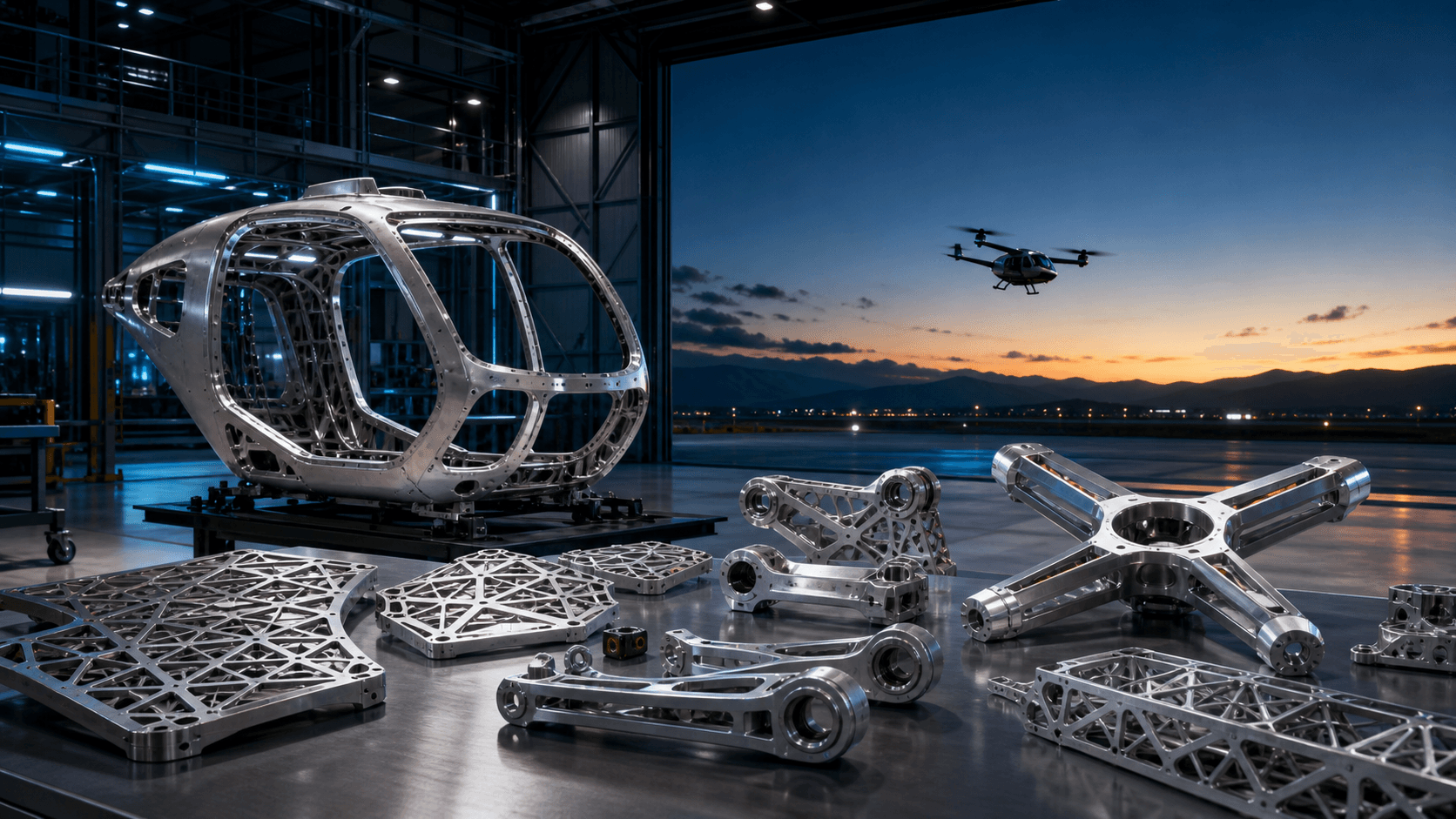
Magnesium alloys can support low-altitude aircraft, drones and eVTOL systems where payload, moving mass and structural integration have measurable value. Their best near-term roles are usually housings, brackets, gimbal structures, covers, frames and other components whose stiffness, fire, corrosion and fatigue risks can be qualified.
Magnesium is not an automatic range multiplier. The vehicle benefit depends on where mass is removed, mission profile, propulsion, battery, aerodynamics, certification basis and redesign.
Convert mass saving into mission value
A kilogram removed from a gimbal or rotor-adjacent assembly can affect dynamics differently from a kilogram removed from a stationary cabin panel. For every candidate, quantify:
- payload or energy reserve created;
- center-of-gravity change;
- rotor/actuator inertia;
- vibration modes;
- battery and thermal-system response;
- mission duration and operating environment;
- maintenance and replacement consequences.
Use a complete vehicle model; do not apply one generic flight-time coefficient.
Candidate components
UAV and drone hardware
Camera housings, gimbal arms, motor/electronics covers, central frames, brackets and payload enclosures can benefit from low mass and die-cast integration. Validate propeller/rotor vibration, fatigue, drop or crash, moisture, salt, dust ingress and carbon-fiber galvanic contact.
eVTOL and powered-lift subsystems
Potential candidates include avionics housings, seat or cabin hardware, brackets, access covers and non-primary structures. Flight-critical adoption needs a higher evidence threshold: material allowables, fatigue and damage tolerance, fire behavior, environmental qualification and authority approval.
Ground infrastructure and portable support equipment
Charging, battery-handling, sensor and service equipment may also benefit from portable lightweight housings. Requirements differ from airborne hardware and should not be marketed as flight qualification.
Material and process selection
Die casting suits complex housings and integrated ribs. Extrusions can suit rails and frame members. Sheet or plate can serve panels, covers and machined structures. Rare-earth-containing alloys may expand temperature or ignition performance, but exact data and supply-chain control are required.
Select alloy, product form, joining and coating as one qualified system.
Fire and production safety
Separate the fire behavior of an intact component from chips, dust and molten metal. Airborne applications need tests appropriate to the certification basis and installation; foundries and machine shops need combustible-metal controls.
Terms such as “flame resistant” must include alloy, specimen form, test method and acceptance criterion.
Corrosion and carbon-fiber interfaces
Low-altitude vehicles may operate in rain, condensation, coastal salt, agricultural chemicals or urban pollution. Magnesium in direct electrical contact with carbon fiber or dissimilar fasteners can face galvanic corrosion.
Define isolation, sealant, drainage, coating, conductive/grounding zones and field repair. Test complete assemblies under cyclic conditions, not only flat salt-spray coupons.
Structural and environmental qualification
A staged plan can include:
- chemistry, microstructure and product-form traceability;
- local static properties and elastic modulus;
- fatigue and vibration under the mission spectrum;
- insert, fastener, adhesive and joint tests;
- corrosion and fluid susceptibility;
- thermal cycling and dimensional stability;
- fire/ignition evidence for the installed form;
- ingress, rain, dust or salt tests as applicable;
- production-intent component and subsystem tests;
- process freeze, change control and continued airworthiness data.
Supplier evidence
Request exact material specification, lot pedigree, melt and heat-treatment history, mechanical-property locations, NDT plan, dimensional capability, coating system, joint data, environmental tests, EHS controls, capacity and change notification.
Frequently asked questions
Does magnesium always increase drone flight time?
No. The result depends on total mass, aerodynamics, battery, propulsion efficiency, mission and redesign.
Can magnesium touch carbon-fiber structures?
Direct contact can create galvanic risk. Use qualified isolation and sealing and test the real assembly.
Is a magnesium housing automatically flight approved?
No. Approval applies to the complete part, process, installation and certification program.
What is the best first project?
A mass-sensitive, non-primary housing or bracket with manageable environment and clear component-level tests.
Buyer takeaway
Low-altitude magnesium projects should start from mission value and end with flight-relevant evidence. Use magnesium where integrated geometry and reduced moving mass justify disciplined structural, fire, corrosion and traceability controls.
Sources
RTCA DO-160G Environmental Conditions and Test Procedures for Airborne Equipment FAA Report DOT/FAA/AR-11/31, Flammability of Magnesium Alloys https://www.fire.tc.faa.gov/pdf/11-31.pdf ASTM B94 Magnesium-Alloy Die Castings ASTM B107/B107M Magnesium-Alloy Extruded Bars, Rods, Profiles, Tubes, and Wire ISO 16220 Magnesium and magnesium alloys — Magnesium alloy ingots and castings