Aluminum vs Magnesium for Gigacasting: A System-Level Selection Guide
Aluminum has the mature gigacasting ecosystem; magnesium offers a lower-density route with different stiffness, corrosion and process controls. Compare redesigned assemblies—not equal-thickness coupons—with this qualification workflow.
Executive answer
There is no universal winner between aluminum and magnesium for gigacasting. Aluminum currently offers the broader industrial ecosystem, mature joining routes and extensive structural databases. Magnesium offers a density near 1.8 g/cm³ versus roughly 2.7 g/cm³ for aluminum, potentially reducing component and handling mass. The winning material is the one that meets the same stiffness, crash, fatigue, corrosion, dimensional and total-cost requirements after the geometry and process are redesigned.
Why density alone gives the wrong answer
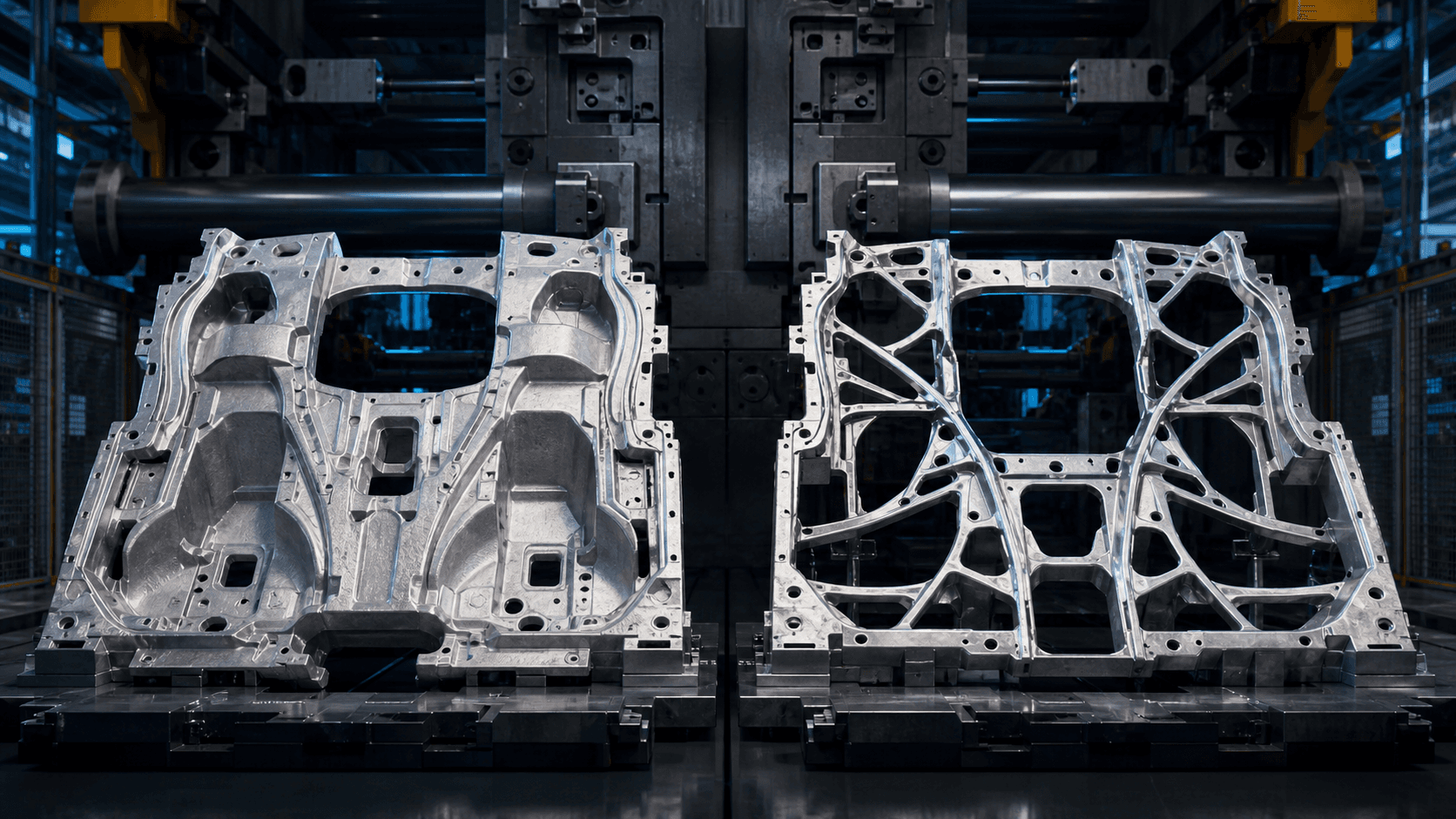
A magnesium casting cannot be compared with an aluminum casting at identical wall thickness and called a valid lightweight result. Magnesium has a lower elastic modulus, so stiffness-controlled regions may need ribs, curvature or local thickness. Conversely, magnesium's castability can permit thin walls and part consolidation in suitable geometries. Compare complete assemblies at equal performance, including fasteners, coatings, inserts and scrap.
System-level comparison
| Decision factor | Aluminum gigacasting | Magnesium large casting |
|---|---|---|
| Supply base | Broad and mature | More specialized |
| Density | About 2.7 g/cm³ | About 1.74–1.84 g/cm³ |
| Stiffness | Higher modulus | Geometry must compensate |
| Casting behavior | Mature large-machine practice | Strong thin-wall potential; melt control is critical |
| Corrosion | Established automotive systems | Galvanic isolation and coating discipline are essential |
| Joining and repair | Broad field experience | Requires alloy- and coating-specific validation |
| Recycling | Mature closed-loop routes | Segregated clean scrap greatly improves recovery |
These are screening tendencies, not guaranteed part results.
Qualification workflow
- Freeze the load cases, crash targets, stiffness modes, fatigue life and environmental profile.
- Create separate aluminum and magnesium concepts instead of changing only material properties in one geometry.
- Simulate filling, solidification, distortion and local mechanical performance.
- Cast representative subcomponents using production-intent alloy, vacuum, die temperature and cycle time.
- Validate porosity, oxide films, heat-affected joining zones, dimensional capability and coating coverage.
- Test complete assemblies for crash, vibration, fatigue, salt exposure, thermal cycling and repair.
- Compare total landed cost: metal input, shot mass, cycle time, tool life, scrap recovery, coating, joining, logistics and warranty risk.
Key magnesium controls
Large magnesium castings require disciplined melt protection, transfer, vacuum, venting and ignition-risk management. Buyers should specify alloy chemistry, impurity limits, recycled-content rules, mechanical-property sampling locations, CT or sectioning plans and traceability. Galvanic interfaces with steel, aluminum, copper-rich alloys and carbon fiber need isolation and drainage design.
Frequently asked questions
Is magnesium automatically 33% lighter than aluminum in a vehicle part?
No. The density difference is about one-third, but component saving depends on redesigned geometry, stiffness, joining and safety requirements.
Can magnesium be used for crash structures?
Potentially, but only with alloy-, geometry- and process-specific crash validation. Coupon tensile data cannot substitute for component tests.
Which is cheaper?
There is no universal answer. Magnesium may reduce shot mass and logistics load, while aluminum may benefit from a larger supplier base and mature recycling. The correct comparison is total assembly cost at equal performance.
Buyer takeaway
Run aluminum and magnesium as competing system concepts with identical pass/fail criteria. A material decision made before casting trials, corrosion-system validation and assembly testing is a hypothesis—not a production-ready conclusion.
Sources
https://doi.org/10.1016/j.jma.2023.11.003 https://www.energy.gov/eere/vehicles/lightweight-materials-cars-and-trucks https://doi.org/10.4271/2012-01-2325 https://doi.org/10.4271/1999-01-0016 https://www.iso.org/standard/60537.html