Magnesium Integrated Die Casting for EVs: From Part Selection to Production Launch
Magnesium integrated die casting can reduce EV assembly mass and part count, but launch requires a repeatable casting window, zone-specific quality, joints, corrosion, crash, repair and stable-yield economics.
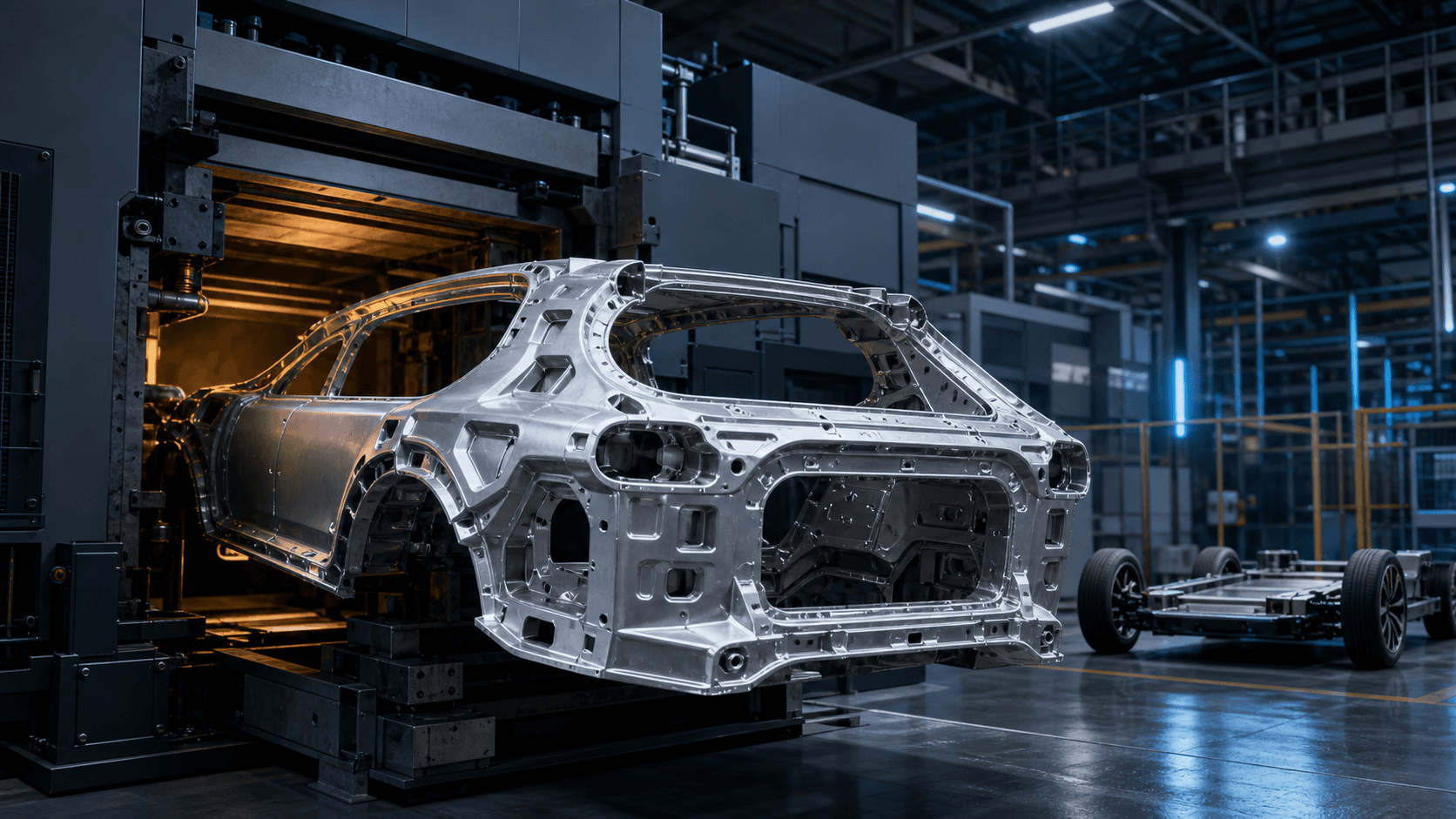
Executive answer
Magnesium integrated die casting can reduce part count and assembly mass in electric vehicles, but the business case depends on more than a large casting machine. A production program must prove fill and solidification control, local mechanical properties, dimensional stability, joining, corrosion, crash behavior, repair and stable yield.
The best first application is usually not the largest possible body casting. It is the component whose mass saving and consolidation value justify the qualification risk.
Step 1: choose the right component
Screen candidate parts by:
- mass and number of parts eliminated;
- stiffness and fatigue requirements;
- crash-energy or load-path criticality;
- corrosion and galvanic exposure;
- joining and service access;
- dimensional tolerance and sealing;
- repair strategy and replacement cost;
- annual volume and tool utilization.
Seat structures, cross-car members, front-end carriers, instrument-panel beams, housings or battery-related covers may have different risk profiles. Do not infer suitability from geometry alone.
Step 2: redesign for magnesium
A magnesium concept should not copy an aluminum or stamped-steel assembly. Lower modulus may require ribs, curvature and local thickness. Die casting can consolidate brackets, bosses and interfaces, but transitions must avoid hot spots, shrinkage concentration and fatigue notches.
Use topology and casting simulation together. Freeze functional load cases before optimizing mass.
Step 3: establish the casting window
Production-intent trials should control:
- alloy chemistry, impurity limits and metal temperature;
- melt protection, transfer and dwell time;
- die temperature and thermal balance;
- vacuum, venting and overflow design;
- shot profile, intensification and gate velocity;
- local solidification, porosity and oxide films;
- trimming, straightening and residual stress;
- lubrication and coating contamination.
A machine-tonnage number is not proof of capability. The evidence is a repeatable process window and component-quality distribution.
Step 4: build a quality map
Large castings are not uniform coupons. Define critical zones and link each to an inspection and property requirement:
- CT or radiography for internal discontinuities;
- destructive sectioning during validation;
- local tensile, bearing or fatigue specimens where justified;
- leak testing for sealed regions;
- flatness and datum capability;
- surface and coating inspection;
- traceability from metal batch to finished casting.
Acceptance criteria must be tied to structural significance, not arbitrary pore-size limits alone.
Step 5: qualify joints and corrosion
Validate production fasteners, inserts, adhesives and weld alternatives. Test bearing, pull-out, torque retention, fatigue and crash after environmental conditioning.
Map every steel, aluminum, copper-rich or carbon-fiber contact. Specify isolation, sealant, coating, drainage and repair. Salt spray alone is insufficient; use realistic cyclic conditions and complete assemblies.
Step 6: crash, durability and repair
Component and vehicle-level tests must address stiffness modes, fatigue spectra, curb and road loads, impact, thermal cycles and crash load paths. If the casting is damaged, define inspection, repairability and replacement procedures. A consolidated part can save assembly operations but increase service replacement scope.
Step 7: prove economics at stable yield
Model metal input, shot mass, cycle time, tool life, energy, trimming, machining, straightening, scrap remelt, coating, joining, logistics, inspection, warranty and downtime. Run sensitivity to yield and tool maintenance. A low piece price at pilot volume is not a bankable series-production cost.
Launch-gate checklist
Release to production only when:
- design loads and corrosion environment are frozen;
- alloy and supplier specifications are approved;
- process window and control plan are demonstrated;
- critical-zone quality map is validated;
- dimensional capability meets assembly needs;
- joints and coatings pass conditioned durability;
- crash and fatigue evidence covers production variation;
- repair and recycling routes are defined;
- traceability and change control are active;
- economics remain viable at conservative yield.
Frequently asked questions
Does integrated casting automatically reduce cost?
No. It may remove tools and assembly steps, but large-tool investment, yield, inspection, coating and repair can offset savings.
Can coupon properties approve a large casting?
No. Local microstructure and defects vary with flow and solidification. Use zone-specific evidence and complete-component tests.
Is magnesium suitable for a battery enclosure?
Potentially, but sealing, fire exposure, galvanic contact, crash intrusion, thermal management and service requirements must be qualified for the exact design.
What is the lowest-risk entry strategy?
Start with a high-value, non-primary or moderately loaded consolidated component, establish supplier/process maturity, then expand on measured evidence.
Buyer takeaway
Treat magnesium integrated die casting as a vehicle-system and manufacturing program, not a material substitution. Repeatable quality, conditioned assembly tests and stable-yield economics are the real launch criteria.
Sources
https://doi.org/10.1016/j.jma.2023.11.003 https://www.energy.gov/eere/vehicles/lightweight-materials-cars-and-trucks https://doi.org/10.4271/2012-01-2325 ASTM B94 Magnesium-Alloy Die Castings ASTM E155 Reference Radiographs for Inspection of Aluminum and Magnesium Castings ISO 16220 Magnesium and magnesium alloys — Magnesium alloy ingots and castings