Thixomolding vs. Magnesium Alloy Die Casting: How to Choose for Thin-Wall Components
A comparative analysis of Thixomolding and conventional high-pressure magnesium alloy die casting—covering raw material form, filling behavior, porosity, minimum wall thickness, equipment, tooling, surface quality, and production volume.
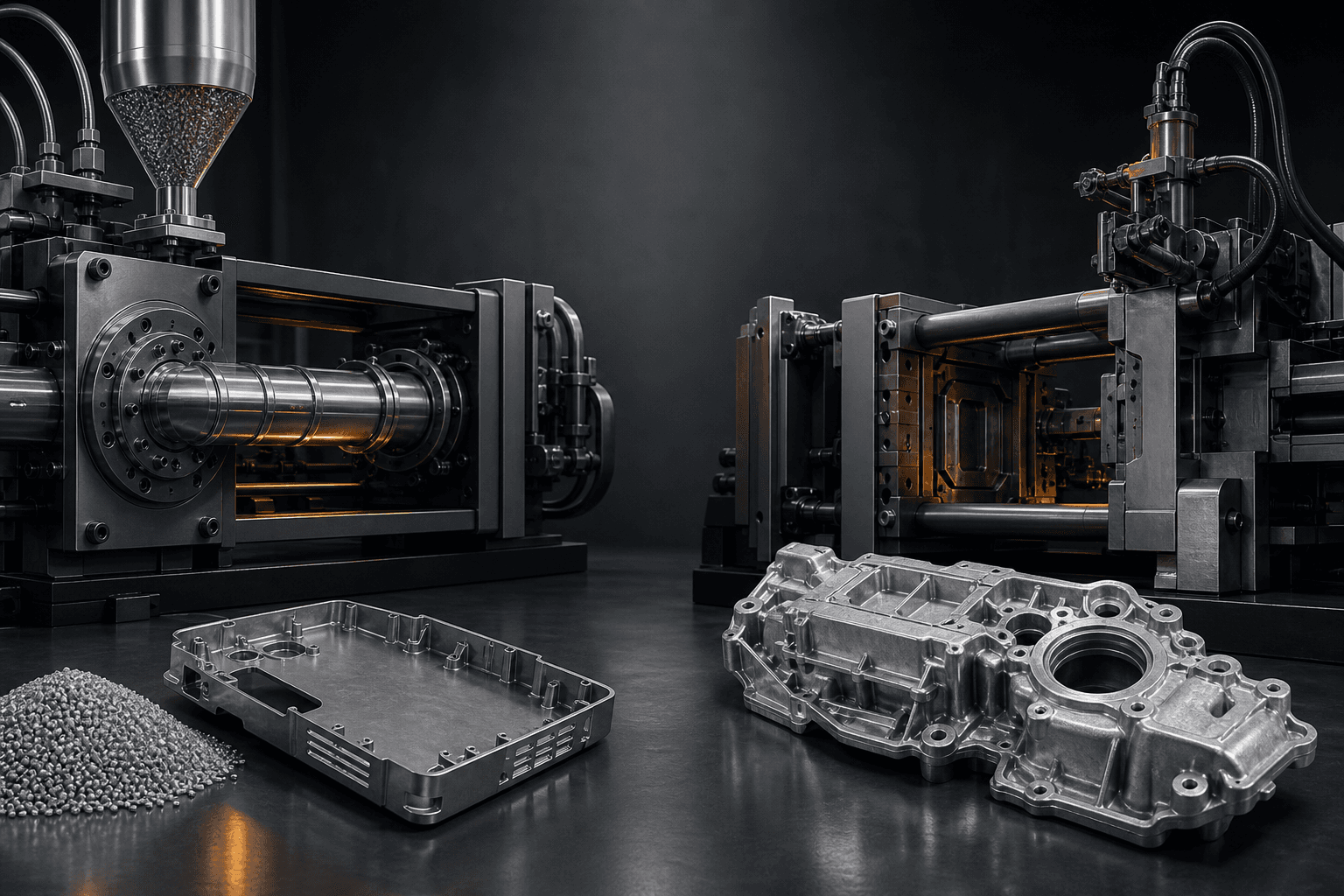
Thixomolding is often termed “magnesium alloy injection molding,” yet it differs significantly from both plastic injection molding and conventional high-pressure die casting. Process selection should not hinge solely on which yields lower porosity; rather, it must consider part dimensions, minimum wall thickness, mechanical performance, cycle time, tooling maturity, and supply chain readiness.
Core Differences Between the Two Processes
| Dimension | Thixomolding | High-Pressure Die Casting |
|---|---|---|
| Raw Material | Magnesium alloy granules or chips | Molten magnesium alloy liquid |
| Filling State | Semi-solid slurry formed in barrel, then injected | High-velocity liquid metal filling |
| Process Characteristics | Closed system, lower processing temperature, relatively stable flow | Fast cycle time, mature supply chain, broad dimensional capability |
| Common Advantages | Thin walls, fine features, reduced gas entrapment risk | High-volume output, complex geometries, strong cost amortization |
| Key Limitations | Dedicated equipment & feedstock, limited supplier base, part size constraints | Gas porosity, spray/vacuum control complexity, internal porosity |
When to Consider Thixomolding Evaluation
For enclosures in consumer electronics, optics, or precision instrumentation—where thin walls, aesthetics, localized fine features, and low porosity are simultaneously critical—Thixomolding merits evaluation. Design teams must still verify feasibility of bosses, ribs, inserts, secondary machining, and coating within the supplier’s proven process window.
When High-Pressure Die Casting Is Preferable
Medium-to-large structural components, mature automotive parts, or high-volume programs typically benefit more from high-pressure die casting’s equipment scale, extensive tooling experience, and multi-supplier capability. With optimized gating/venting, vacuum assistance, and thermal balance, stable thin-wall and leak-tight performance can be achieved.
Often Overlooked Cost Factors
Don’t compare only per-part molding costs. Include dedicated equipment availability, mold life, feedstock preparation, trial runs, yield rate, CNC machining, impregnation, coating, inspection, and capacity backup. At low annual volumes, mold and validation costs dominate; at high volumes, cycle time and yield become decisive.
DFM Review Must Address These Questions
- Can minimum wall thickness and wall-thickness transitions be stably formed?
- Do flow convergence, venting, or semi-solid flow create weak zones?
- Are internal quality requirements functionally justified?
- Do critical dimensions require secondary machining?
- Is surface condition compatible with pre-treatment and coating?
- Does prototype process reliably represent mass-production conditions?
- Is a second source or equipment-failure contingency plan in place?
Frequently Asked Questions
Does Thixomolding guarantee “zero porosity”?
No such claim should be made. While it reduces certain gas entrapment risks, CT scanning, sectioning, leak testing, and mechanical performance data remain essential to validate target parts.
Can the same tooling be used for both processes?
Generally not. Gating systems, thermal management, venting design, and machine interfaces differ significantly—separate DFM reviews are required at the concept stage.
Submit part dimensions, annual volume, minimum wall thickness, and performance targets via Contact Us; we’ll assess suitable processes against alloy capabilities in our Product Center, including AZ31B, ZK61, and other Mg alloys.
Sources
NADCA Product Design for Die Casting ASM Handbook, Volume 15 — Casting