Magnesium for EV Megacasting and Solid-State-Battery Vehicles
Magnesium is a candidate for large integrated EV structures, not a drop-in replacement for aluminum. Lower density can create mass-saving potential, but stiffness, crash ductility, casting defects, joining, galvanic corrosion, coatings, thermal safety and repairability must be redesigned and validated.
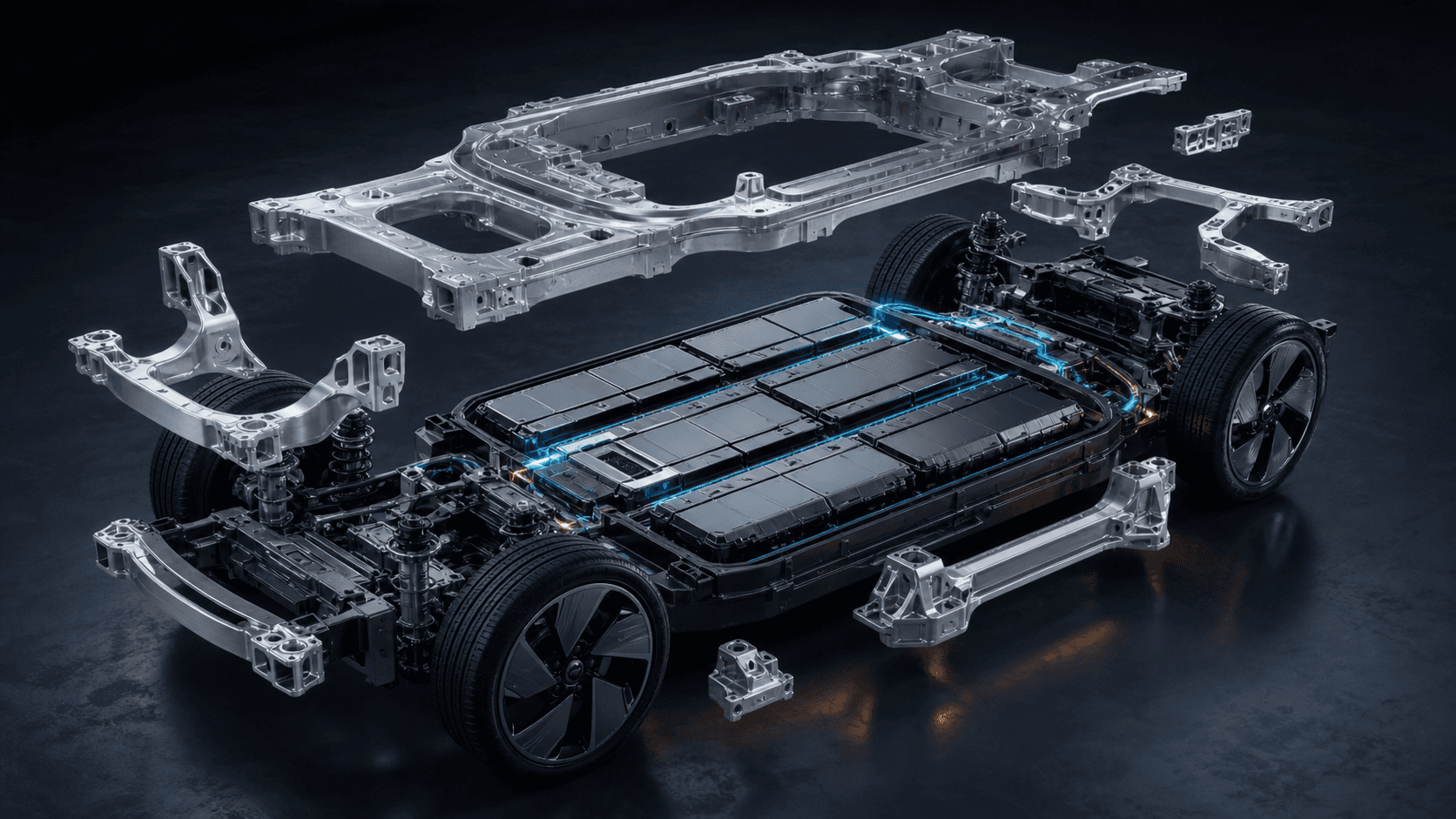
Can magnesium carry high structural loads in next-generation EVs?
Potentially, but only through component-level redesign and validation. Magnesium’s density is roughly two-thirds that of aluminum, yet an equivalent component will not automatically be one-third lighter. Magnesium has a lower elastic modulus, so wall thickness, ribs, joints and local reinforcement may change to meet stiffness, buckling and crash targets.
Public research has reported an 8,800-ton super-sized high-pressure die-casting trial for a magnesium component. That is meaningful process evidence, but it should not be described as proof of blanket high-volume adoption.
Megacasting is an architecture—not a material
“Megacasting” or “integrated die casting” means consolidating many stamped, cast and welded parts into a larger casting. The business case may include:
- fewer parts and joining stations;
- reduced dimensional stack-up;
- simplified logistics and tooling sets;
- potential mass and assembly savings;
- different crash-repair and manufacturing risks.
Aluminum is the more mature baseline for current large structural castings. Magnesium may offer additional mass reduction, but the full material/process/geometry system must compete—not density alone.
Where magnesium may be screened first
A practical program can rank candidate parts by structural criticality:
| Candidate | Why magnesium may help | Main validation |
|---|---|---|
| Instrument-panel beam or cockpit cross-car structure | Part consolidation, bracket integration, mass reduction | Stiffness, NVH, joints, corrosion |
| Seat frame or interior structural carrier | High value of mass reduction | Occupant loads, fatigue, crash and fire requirements |
| Front-end carrier, housings and brackets | Complex geometry and integrated features | Fatigue, local impact, fasteners, environment |
| Battery electronics or powertrain housing | EMI shielding, heat paths and integrated bosses | Sealing, thermal, corrosion, fire exposure |
| Large non-primary crash-path casting | Fewer parts and lower mass | Defect tolerance, fatigue, repair and full-vehicle crash |
| Primary sill, suspension node or critical crash joint | Potential mass saving but severe consequences | Highest validation threshold; no shortcut from coupon data |
This is a screening framework, not a claim that every listed part should use magnesium.
What changes when solid-state batteries arrive?
A solid-state cell may improve specific energy or alter thermal behavior, but it does not eliminate:
- side-impact and underbody-impact protection;
- electrical isolation;
- thermal management;
- propagation and failure containment;
- sealing against water and contaminants;
- pack-level structural loads;
- repair and post-crash handling.
Cell-level energy density is not installed pack-level energy density. Structure, cooling, busbars, controls, enclosure and crash protection remain. Higher cell energy can also concentrate more energy within a smaller volume, so emerging failure modes require testing.
Solid-state batteries change the vehicle mass and packaging trade space; they do not independently prove that magnesium is required.
Why density does not equal finished-part mass saving
The final mass depends on:
- stiffness and buckling requirements;
- crash-energy absorption and failure mode;
- local bearing and fastener loads;
- casting minimum wall and filling behavior;
- ribs and reinforcement;
- corrosion isolation and coatings;
- machining allowance and dimensional control;
- repair strategy and replaceable zones.
Always compare functionally equivalent designs under the same load cases.
Large-casting process risks
Super-sized magnesium castings must manage:
- melt cleanliness and oxide control;
- die filling, cold shuts and air entrapment;
- vacuum performance and porosity;
- thermal balance across a large die;
- shrinkage and distortion;
- local section transitions;
- trimming, machining and heat exposure;
- nondestructive inspection and defect acceptance;
- die life, cycle stability and scrap recovery.
A small coupon cast under ideal conditions does not represent the defect population of a production-scale part.
Joining and corrosion need early design
Magnesium in a multi-material body may contact aluminum, steel, carbon-fiber composite, fasteners and conductive adhesives. Moisture and salts can drive galvanic corrosion if interfaces are not isolated.
The joint design should define:
- fastener and insert materials;
- barrier coatings and insulating washers;
- adhesive compatibility;
- drainage and edge sealing;
- coating repair after assembly or collision;
- thermal expansion and clamp-load retention;
- disassembly and recycling.
DOE lightweight-material research has repeatedly treated joining and corrosion as system-level barriers, not secondary finishing details.
Required structural verification
A high-load application should validate:
- static stiffness and strength;
- local buckling;
- front, side, pole and underbody crash load cases as applicable;
- fatigue and vibration;
- fastener bearing and joint durability;
- cast-defect tolerance;
- temperature and creep at hot spots;
- corrosion with damaged coatings;
- NVH and dimensional stability;
- post-impact inspection and repair.
Prototype testing should use production-intent alloy, thickness, joining, coating and casting process.
RFQ and DFMEA checklist
- Specific alloy, temper and approved production route
- Complete vehicle or component load spectrum
- Temperature and corrosion environments
- Mixed-material joint and isolation details
- Allowable porosity, cold shuts and oxide inclusions
- NDT method and sampling plan
- Prototype, pre-series and rate-production capability
- Coating damage and repair validation
- Recycled-content and scrap-segregation requirements
- Crash-repair and end-of-life strategy
- Process-change notification and traceability
Matrix Mg’s magnesium die-casting parts page can support an initial manufacturability review. A production award still requires vehicle-specific PPAP, crash validation and supplier process qualification.
Frequently asked questions
Is magnesium megacasting already in mass production?
Public evidence supports an 8,800-ton trial-manufactured magnesium casting. Do not generalize that evidence into industry-wide high-volume adoption without a current OEM or supplier production statement.
Does one-third lower density mean one-third lower component mass?
No. Stiffness, walls, ribs, joints, crash performance and local reinforcement determine finished-part mass.
Can a solid-state battery pack remove crash protection?
No. Emerging solid-state systems still require side-impact, underbody-impact, thermal, electrical and failure-containment validation.
Can magnesium be used for a battery enclosure?
Potentially, after impact, sealing, corrosion, thermal, electrical-isolation, fire-exposure and repair requirements are demonstrated for the complete enclosure.
Conclusion
Magnesium can enter the EV megacasting trade space, especially where part integration and mass reduction justify a new design. The defensible path is not replacing an aluminum geometry one-for-one; it is optimizing a magnesium component and validating casting quality, crash behavior, joints, corrosion, thermal safety and repair at vehicle level.
This is a material-screening framework, not a substitute for vehicle crash validation, battery safety testing, component PPAP or supplier process qualification.
Sources
Li et al., Super-sized high-pressure die casting of magnesium alloy — https://doi.org/10.1016/j.jma.2023.11.003 U.S. Department of Energy, Long-Term Lightweight Materials Research — https://www.energy.gov/cmei/vehicles/long-term-lightweight-materials-research-magnesium-and-carbon-fiber U.S. Department of Energy, Lightweight Materials R&D 2013 Annual Progress Report — https://www.energy.gov/eere/vehicles/articles/lightweight-materials-rd-2013-annual-progress-report U.S. Department of Energy, Energy Storage Safety Strategic Plan — https://www.energy.gov/sites/default/files/2024-05/EED_2827_FIG_SafetyStrategy%20240505v2.pdf Optimization of magnesium body crashworthiness and vibration performance — https://doi.org/10.1016/j.jma.2014.05.005