Where Magnesium Alloys Create the Most Value: Five Application Clusters and a Screening Matrix
Screen magnesium opportunities in electric mobility, electronics, aerospace/UAV, robotics and portable equipment by mass value, part integration, corrosion, process maturity and qualification risk.
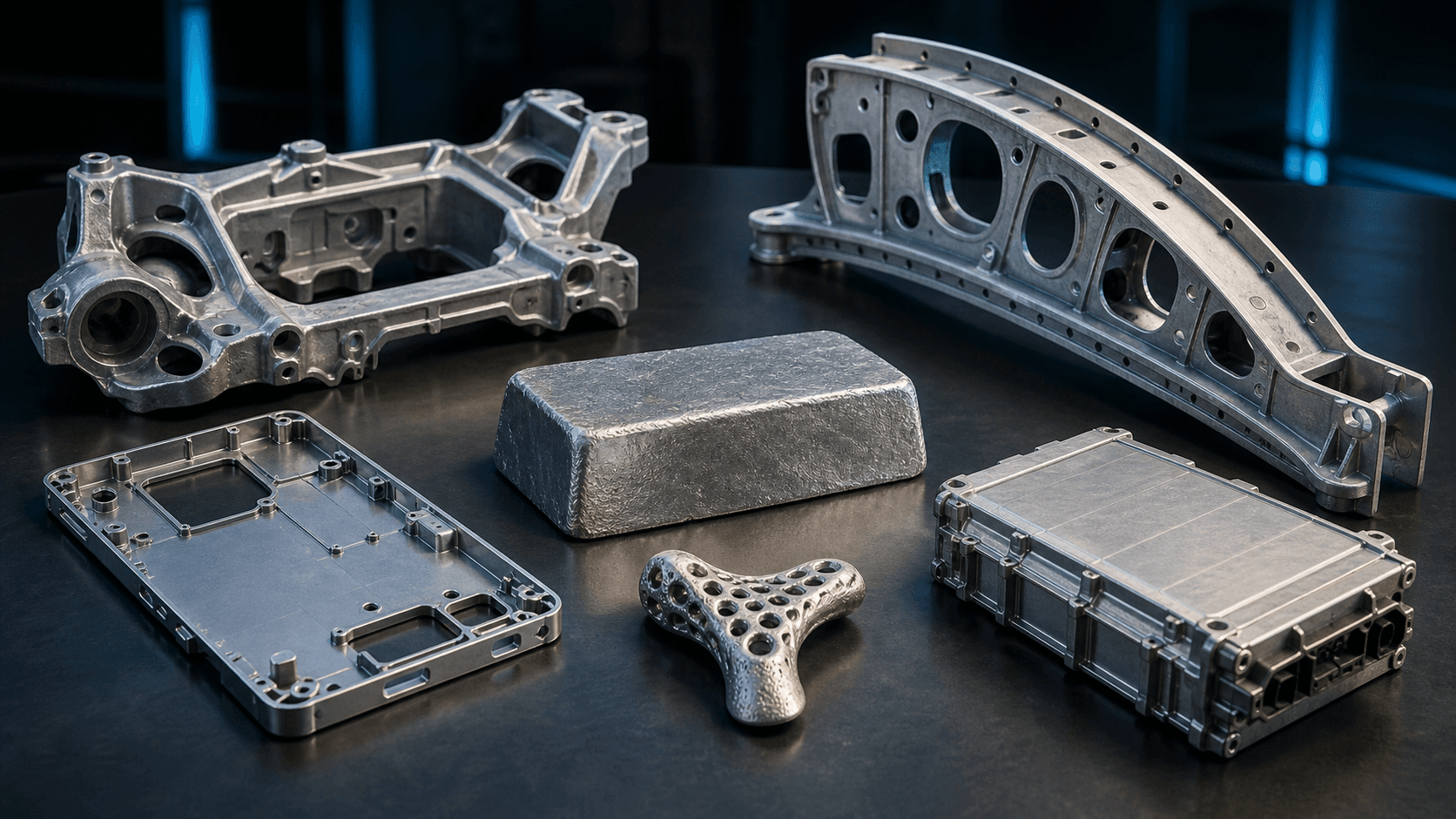
Executive answer
Magnesium alloys are most compelling in applications where every kilogram affects energy, portability, dynamic response or payload—and where geometry, corrosion protection and manufacturing volume support the business case. Five high-opportunity clusters are mobility, electronics, aerospace/UAV, robotics/automation and portable medical or sports equipment.
“High growth” is not a guaranteed market forecast. Buyers should evaluate a concrete part with measurable requirements and supplier evidence.
Application-screening matrix
| Cluster | Typical candidates | Primary value | Critical qualification |
|---|---|---|---|
| Electric mobility | housings, seat frames, brackets, carriers, integrated castings | mass and part-count reduction | crash, fatigue, galvanic corrosion, stable yield |
| 3C and electronics | laptop decks, camera bodies, support plates, tool housings | portability, shielding, part integration | drop, RF, thermal path, coating and cosmetics |
| Aerospace and UAV | instrument housings, brackets, covers, non-primary structures | payload and moving-mass reduction | fire, corrosion, fatigue, traceability, approval |
| Robotics and automation | arm housings, mobile chassis, end-effectors | lower inertia and faster dynamics | stiffness, vibration, joint loads, durability |
| Medical, rehabilitation and sports | equipment housings, wheelchair members, portable frames | handling and user effort | product standards, fatigue, sweat corrosion, cleanability |
1. Electric mobility
Vehicle value comes from system design, not density alone. Magnesium can consolidate die-cast structures or reduce mass in seats, cross-car components and housings. Programs must validate local casting quality, joints, corrosion, crash, repair and recycling.
Battery-electric vehicles do not guarantee a fixed range improvement per kilogram; benefits depend on vehicle mass, duty cycle and redesign.
2. Consumer electronics and power tools
Magnesium can combine low density, electrical conductivity and die-cast integration. It may serve laptop, camera, display-support and tool enclosures. Antenna windows, thermal interfaces, drop durability, threaded inserts and coating yield are often decisive.
Do not infer a specific brand's material from an unverified supplier claim.
3. Aerospace, UAV and low-altitude systems
Lower structural or gimbal mass can improve payload allocation and dynamic performance. Suitable first targets are often housings, brackets, panels and non-primary structures.
Qualification must address fire scenario, carbon-fiber isolation, salt/humidity, fatigue, NDT and material pedigree. Historical aerospace use does not approve a new part automatically.
4. Robotics and automation
Reducing arm or end-effector inertia can lower actuator demand or improve acceleration. Magnesium castings and extrusions can integrate cable routes, bearings and covers, but stiffness and joint-interface loads must be modeled.
Compare a complete robot duty cycle. A lighter link may offer little benefit if gearbox, motor or payload dominates.
5. Portable medical, rehabilitation and sports equipment
Portable diagnostic housings, mobility products, camera supports and sports components can benefit from lower handling mass. These are industrial product applications, not implantable-medical claims.
Validate applicable safety standards, repeated loads, cleaning agents, sweat, moisture, coating wear and repair. For any patient-contacting product, evaluate the final device and intended exposure.
How to rank opportunities
Score each candidate from 1 to 5 on:
- economic value of each kilogram saved;
- potential for part consolidation;
- geometry fit with casting, extrusion, sheet or plate;
- stiffness compensation through design;
- corrosion and galvanic severity;
- supplier/process maturity;
- inspection and regulatory burden;
- stable-yield total cost;
- recycling and service route;
- evidence available for launch.
A high mass-saving score cannot compensate for an unmanageable corrosion or certification risk.
Buyer evidence pack
Request exact alloy and product form, chemistry/impurity limits, local mechanical properties, fatigue and environmental data, process capability, coating stack, joint tests, dimensional reports, production-intent prototypes, traceability and change control.
Frequently asked questions
Which industry uses the most magnesium?
The answer depends on geography, year, product definition and whether primary metal or finished parts are counted. Use current, sourced market data for any volume claim.
Is magnesium best only for premium products?
No. High-volume die casting can be economical, while premium low-volume products may justify higher material or finishing cost. Evaluate total cost.
What is the fastest way to identify a good part?
Find a component where mass affects system performance, geometry supports part integration and environmental risks can be qualified.
Can one alloy serve all five clusters?
No. Casting, wrought, heat-resistant, corrosion-controlled and medical-device programs have different requirements.
Buyer takeaway
Start with the function, not the industry label. The strongest magnesium opportunities combine high mass value, process-compatible geometry and a clear qualification path.
Sources
https://www.energy.gov/eere/vehicles/lightweight-materials-cars-and-trucks https://pubs.usgs.gov/periodicals/mcs2026/mcs2026-magnesium-metal.pdf ISO 16220 Magnesium and magnesium alloys — Magnesium alloy ingots and castings ASTM B94 Magnesium-Alloy Die Castings ASTM B107/B107M Magnesium-Alloy Extruded Bars, Rods, Profiles, Tubes, and Wire ASTM B90/B90M Magnesium-Alloy Sheet and Plate