Magnesium Surface Treatment Guide: Conversion, Anodizing, PEO, E-Coat and Paint
Choose magnesium surface treatment as a complete system—from substrate and pretreatment to conversion, anodizing/PEO, primer, topcoat, galvanic isolation, testing and repair.
Executive answer
No single coating makes every magnesium component corrosion-proof. Durable protection comes from a complete system: alloy purity, casting or wrought surface quality, cleaning, pretreatment, conversion or anodic layer, primer, topcoat, sealing, edge coverage, galvanic isolation and repair.
Select the system by environment, geometry, conductivity, wear, cosmetics, temperature, joining and regulatory requirements—not by salt-spray hours alone.
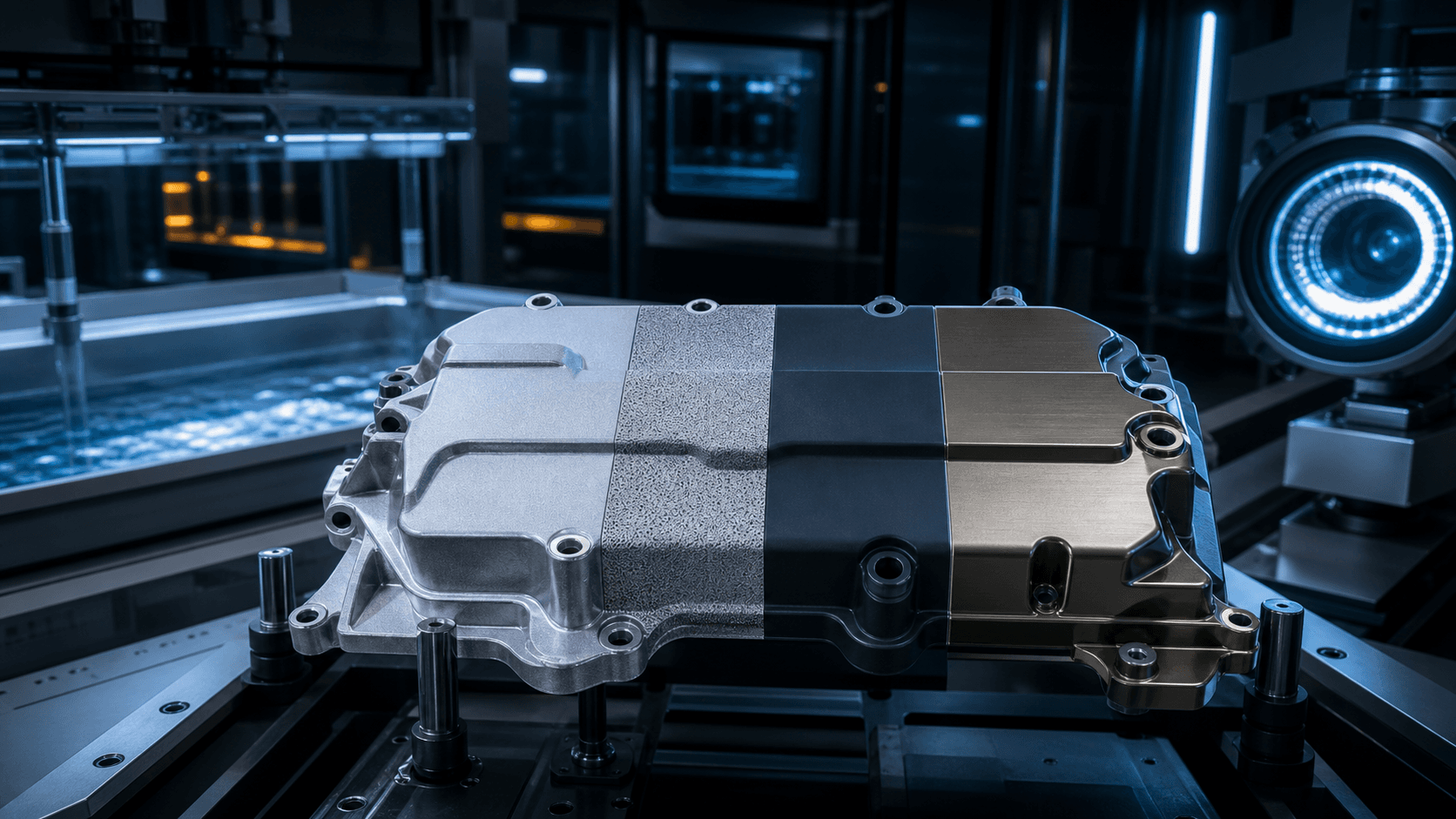
Treatment-selection matrix
| Route | Typical role | Strengths | Main limits |
|---|---|---|---|
| Conversion coating | pretreatment under paint, temporary protection | thin, paint-compatible, can retain conductivity | limited standalone barrier; chemistry/process control critical |
| Anodizing | barrier and paint base | harder, thicker oxide than conversion | pores, edge effects, dimensional change, sealing needs |
| Plasma electrolytic oxidation (PEO/MAO) | wear-resistant ceramic-like layer and functional base | hardness, thermal/wear functions, good adhesion to substrate | porous outer layer, energy/cost, often needs sealing/topcoat |
| E-coat / electrophoretic primer | uniform primer on complex parts | good coverage and scalable automation | rack/contact design, bath control, pretreatment dependence |
| Liquid or powder paint | color, UV and environmental barrier | broad appearance and repair options | edge damage, masking, adhesion, heat-cure limits |
| Electro/electroless plating | conductivity, wear or decorative function | metallic surface functions | difficult activation, porosity, galvanic risk, wastewater control |
| Hybrid stack | demanding automotive/electronics/aerospace systems | combines pretreatment, barrier and finish | more process steps, compatibility and rework complexity |
Start with the substrate
Coatings cannot hide uncontrolled porosity, mold release, oxide films, machining contamination or high Fe/Ni/Cu impurity. Define the alloy, casting surface, machining state and acceptable defects before selecting chemistry.
Different areas of one part—cast skin, machined face, thread, sharp edge and insert interface—can respond differently.
Cleaning and pretreatment
The most common coating failures begin before coating. Control degreasing, rinsing, pickling/etching, desmutting, water quality, bath age, temperature and transfer time. Measure bath chemistry and surface condition, not only final film thickness.
Validate production contaminants such as die lubricant, cutting fluid, adhesive and handling residue.
Conversion, anodizing and PEO
Conversion layers are generally thin and useful as paint bases or for controlled electrical contact. Anodic routes create thicker oxides. PEO uses high-voltage discharges to build a ceramic-like layer, but the outer region is often porous; sealing or an organic topcoat may be needed for corrosion.
Terms such as “nano-coating” or “ceramic coating” are not sufficient specifications. State chemistry, thickness, sealing, electrical resistance, adhesion and acceptance tests.
Paint, e-coat and powder
Primer and topcoat provide the main environmental barrier in many systems. E-coat can improve coverage on complex geometry, while powder or liquid coatings offer appearance and chemical resistance.
Validate cure temperature against alloy temper, adhesives and inserts. Check edge coverage, recesses, drainage, threaded holes, masking boundaries and repair.
Plating and functional integration
Metallic plating may add conductivity, solderability, wear resistance or appearance, but magnesium requires careful activation and compatible intermediate layers. Any pore or damaged area can create a strong galvanic couple.
Functional surfaces may need low contact resistance for EMI grounding, thermal interface control or local wear. Define protected and conductive zones separately rather than compromising the whole coating.
Test plan: salt spray is not enough
ISO 9227 or ASTM B117 salt spray can monitor consistency and compare systems, but it is not a direct service-life conversion. A useful validation program can include:
- adhesion before and after conditioning;
- cyclic corrosion with wet/dry and temperature changes;
- scribed creepage and edge corrosion;
- humidity and condensation;
- immersion or splash fluids;
- thermal cycling and UV for exposed finishes;
- abrasion, stone chip, sweat or cleaning agents as applicable;
- galvanic assembly tests with production fasteners/inserts;
- cosmetic color, gloss and texture;
- electrical contact resistance where required.
Test complete, production-intent parts and damaged/repaired areas.
Supplier control plan
Request:
- substrate alloy and surface-state specification;
- cleaning and pretreatment sequence;
- bath chemistry, limits and analysis frequency;
- film thickness and coverage map;
- adhesion and cure verification;
- rack/contact and masking plan;
- corrosion and functional acceptance criteria;
- rework and repair limits;
- lot traceability and retained records;
- change notification for chemicals, suppliers or equipment.
Frequently asked questions
Which coating is best for magnesium?
There is no universal best. Choose a stack for the specific environment, geometry and functions.
How many salt-spray hours equal years of service?
There is no reliable universal conversion. Use salt spray as one controlled test within a broader validation plan.
Does PEO alone stop corrosion?
Not always. Porosity, sealing, edges and service environment determine whether a topcoat is needed.
Can a coating preserve EMI grounding?
Yes, if conductive contact zones, masking, fasteners and contact resistance are engineered and maintained.
Buyer takeaway
Specify a coating system, not a coating name. The most reliable magnesium protection links substrate control, pretreatment, multilayer coverage, galvanic design, realistic testing and repair.
Sources
ISO 9227 Corrosion tests in artificial atmospheres — Salt spray tests ASTM B117 Standard Practice for Operating Salt Spray Apparatus ASTM D3359 Standard Test Methods for Rating Adhesion by Tape Test ISO 2409 Paints and varnishes — Cross-cut test ASTM D1654 Evaluation of Painted or Coated Specimens Subjected to Corrosive Environments SAE AMS-M-3171 Magnesium Alloy, Processes for Pretreatment and Prevention of Corrosion