Why Magnesium Alloys Are Popular: Six Engineering Advantages and a Selection Decision Tree
Magnesium combines low density, casting integration, damping, conductivity and useful specific properties. This decision tree explains where those advantages create value—and where modulus, corrosion, heat or cost favor another material.
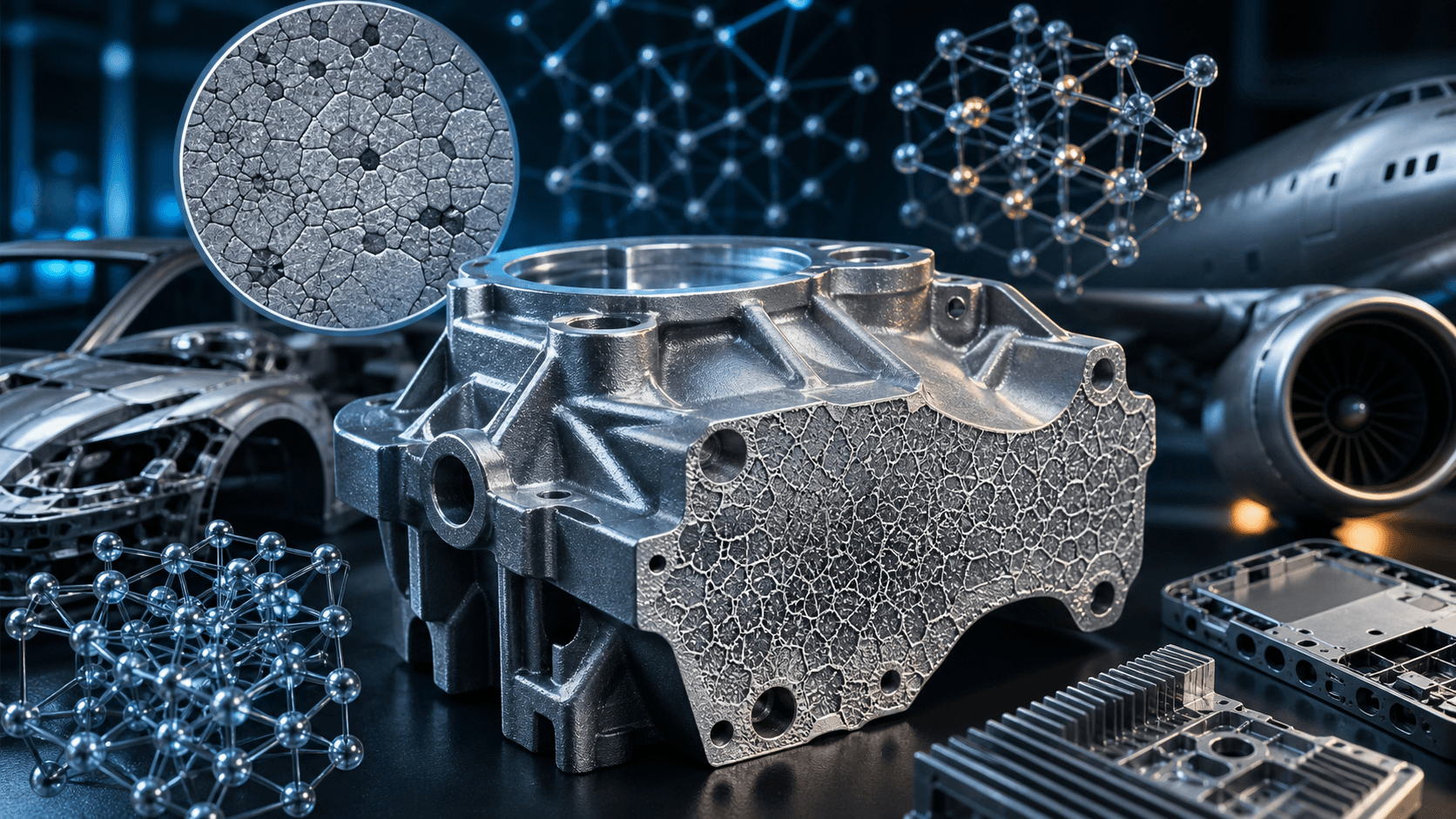
Executive answer
Magnesium alloys attract engineers because they combine low density, castability, damping, electrical conductivity and useful specific properties. They are popular where a redesigned component can turn those traits into lower system mass, integrated geometry or better dynamics.
They are not universally superior. Lower elastic modulus, galvanic corrosion, temperature limits for some alloys, surface-treatment needs and supplier maturity define the boundary.
The six reasons engineers consider magnesium
1. Low density
Most engineering magnesium alloys are around 1.74–1.84 g/cm³, compared with aluminum near 2.7 g/cm³ and steel near 7.8 g/cm³. Component savings are smaller or larger depending on stiffness-driven geometry and consolidation.
2. Part integration by casting
High-pressure die casting can combine ribs, bosses, shielding walls and attachment features. Removing fasteners, welds and brackets may create more value than density alone.
3. Specific structural performance
Strength-to-weight can be attractive for selected alloys and product forms. Stiffness-to-weight must be evaluated carefully because magnesium's elastic modulus is lower than aluminum's.
4. Damping and dynamic response
Magnesium can provide useful vibration damping. In robot links, power tools, camera systems and mobile equipment, lower mass and damping may improve feel or dynamics, but complete-system tests are required.
5. Electrical and shielding functions
A conductive enclosure can contribute to EMI shielding and grounding. Seams, apertures, coatings, contacts and antennas determine actual performance.
6. Machinability and manufacturing options
Magnesium can be die cast, mold cast, extruded, rolled, forged and machined. Each alloy-product-form combination has its own properties, safety controls and economics.
Decision tree
Ask these questions in order:
- Does lower mass have measurable value?
- Can geometry compensate for modulus?
- Does the shape benefit from casting or another magnesium process?
- What temperature and sustained load apply?
- What humidity, salt, fluids and galvanic contacts exist?
- Can the supplier qualify coating, joining and inspection?
- Does total cost work at conservative yield?
- Is recycling and service defined?
If several answers are weak, another material may be better.
Application fit
Magnesium is often evaluated for automotive castings, electronics and tool housings, aerospace/UAV brackets and covers, robot structures, portable medical/rehabilitation equipment and sports hardware.
A list of industries is not a qualification. Each part needs exact alloy, process, environment, loads, tests and traceability.
Common misunderstandings
- “33% lower density means 33% lighter part.” Not necessarily; redesign and stiffness matter.
- “Magnesium always corrodes.” Purity, isolation, coating and environment control performance.
- “Solid magnesium burns like powder.” Material form and ignition scenario are fundamentally different.
- “Magnesium is always expensive.” Compare complete part and system cost, not raw metal price.
- “One alloy fits every process.” Casting and wrought products require different selections.
Buyer evidence checklist
Request alloy designation, chemistry and impurity limits, product form and temper, mechanical properties by direction/location, fatigue and temperature data, dimensional capability, NDT, coating system, joint tests, production-intent prototypes, traceability and change control.
Frequently asked questions
What is magnesium's biggest advantage?
Its strongest advantage is often the combination of low density and process-enabled integration, not one isolated property.
What is its biggest limitation?
The limiting factor varies by application; modulus, corrosion interfaces, elevated temperature, coating or supply maturity may dominate.
Is magnesium better than carbon fiber?
They solve different problems. Compare stiffness, impact, joining, repair, volume, shielding and total cost for the same function.
How should a first project start?
Choose a mass-sensitive, process-compatible component with manageable corrosion and a clear test plan.
Buyer takeaway
Magnesium is popular because it gives designers a distinctive package of properties and manufacturing options. It succeeds when the complete qualified component—not the material brochure—wins the system comparison.
Sources
https://www.energy.gov/eere/vehicles/lightweight-materials-cars-and-trucks https://pubs.usgs.gov/periodicals/mcs2026/mcs2026-magnesium-metal.pdf ASTM B94 Magnesium-Alloy Die Castings ASTM B107/B107M Magnesium-Alloy Extruded Bars, Rods, Profiles, Tubes, and Wire ASTM B90/B90M Magnesium-Alloy Sheet and Plate ISO 16220 Magnesium and magnesium alloys — Magnesium alloy ingots and castings